
American Crow
Corvus brachyrhynchos
American Crows are ubiquitous in Oregon, inhabiting a wide range of environments from rural farmlands to bustling urban centers like Portland. They are highly intelligent, social birds, and a familiar sight and sound.
However, when it comes to differentiating between male and female American Crows, it's a significant challenge. American Crows are considered sexually monomorphic, meaning there are no distinct visual differences in their plumage or coloration between the sexes. Both males and females are entirely iridescent black, from their feathers to their legs and bills.
Therefore, for the casual observer in Oregon, visually telling a male from a female American Crow is practically impossible.
While visual distinctions are lacking, there are a few subtle cues and behavioral differences that might offer hints, especially if you have the opportunity for prolonged observation:
General Characteristics (Both Sexes):
Plumage: Glossy, all-black feathers with a slight iridescent sheen, especially in sunlight.
Size and Shape: Large, stout-bodied birds with strong legs, a thick neck, and a heavy, straight black bill. Their tails are typically squared off or slightly rounded.
Vocalizations: Known for their diverse vocalizations, most famously the loud "caw-caw-caw." They also have a wide range of other calls, alarm calls, and even mimicry.
Social Behavior: Highly social, often forming large communal roosts in fall and winter. During the breeding season, they break into smaller family groups.
Subtle Differences and Behavioral Cues (where distinctions might be observed):
Size (Slight Average Difference): On average, males tend to be slightly larger and bulkier than females, with a thicker neck and bill. However, this difference is often too subtle to discern in the field without direct comparison or precise measurements. There's also significant overlap in size, so a smaller male might be the same size as a larger female.
Bill Structure (Anecdotal): Some observers suggest that male crows might have slightly larger or more robust bills, sometimes appearing to have a more pronounced "overhang" on the upper part. This is an anecdotal observation and not a universally reliable identification feature.
Vocalizations (Subtle Pitch Differences): While both sexes "caw," some experienced observers report that **male crows may have a deeper-toned, more boisterous call**, often delivering three distinct "caws" in a sequence. Females might have a slightly higher-pitched or "shriekier" single "caw." This is very subtle and can be complicated by the presence of juvenile crows, whose voices also differ.
Behavior during Breeding Season (Most Reliable): This is where differences become most apparent:
Courtship Feeding: During courtship and especially while the female is incubating eggs, the male will frequently bring food to the female. Observing one crow consistently feeding another is a strong indicator of a male-female pair.
Incubation: The female does most, if not all, of the egg incubation (typically 4-6 eggs, dull blue-green with brown blotches, incubated for about 18 days). The male will often provide food to the incubating female.
Territorial Defense: Both sexes are highly protective of their nest and young, but males can sometimes appear more overtly aggressive or display more prominently during territorial disputes. Some anecdotal accounts suggest males might fluff up their feathers more during displays.
Nest Building: Both parents participate in building the large, bulky stick nests in trees (often 15-60 feet high).
However, when it comes to differentiating between male and female American Crows, it's a significant challenge. American Crows are considered sexually monomorphic, meaning there are no distinct visual differences in their plumage or coloration between the sexes. Both males and females are entirely iridescent black, from their feathers to their legs and bills.
Therefore, for the casual observer in Oregon, visually telling a male from a female American Crow is practically impossible.
While visual distinctions are lacking, there are a few subtle cues and behavioral differences that might offer hints, especially if you have the opportunity for prolonged observation:
General Characteristics (Both Sexes):
Plumage: Glossy, all-black feathers with a slight iridescent sheen, especially in sunlight.
Size and Shape: Large, stout-bodied birds with strong legs, a thick neck, and a heavy, straight black bill. Their tails are typically squared off or slightly rounded.
Vocalizations: Known for their diverse vocalizations, most famously the loud "caw-caw-caw." They also have a wide range of other calls, alarm calls, and even mimicry.
Social Behavior: Highly social, often forming large communal roosts in fall and winter. During the breeding season, they break into smaller family groups.
Subtle Differences and Behavioral Cues (where distinctions might be observed):
Size (Slight Average Difference): On average, males tend to be slightly larger and bulkier than females, with a thicker neck and bill. However, this difference is often too subtle to discern in the field without direct comparison or precise measurements. There's also significant overlap in size, so a smaller male might be the same size as a larger female.
Bill Structure (Anecdotal): Some observers suggest that male crows might have slightly larger or more robust bills, sometimes appearing to have a more pronounced "overhang" on the upper part. This is an anecdotal observation and not a universally reliable identification feature.
Vocalizations (Subtle Pitch Differences): While both sexes "caw," some experienced observers report that **male crows may have a deeper-toned, more boisterous call**, often delivering three distinct "caws" in a sequence. Females might have a slightly higher-pitched or "shriekier" single "caw." This is very subtle and can be complicated by the presence of juvenile crows, whose voices also differ.
Behavior during Breeding Season (Most Reliable): This is where differences become most apparent:
Courtship Feeding: During courtship and especially while the female is incubating eggs, the male will frequently bring food to the female. Observing one crow consistently feeding another is a strong indicator of a male-female pair.
Incubation: The female does most, if not all, of the egg incubation (typically 4-6 eggs, dull blue-green with brown blotches, incubated for about 18 days). The male will often provide food to the incubating female.
Territorial Defense: Both sexes are highly protective of their nest and young, but males can sometimes appear more overtly aggressive or display more prominently during territorial disputes. Some anecdotal accounts suggest males might fluff up their feathers more during displays.
Nest Building: Both parents participate in building the large, bulky stick nests in trees (often 15-60 feet high).
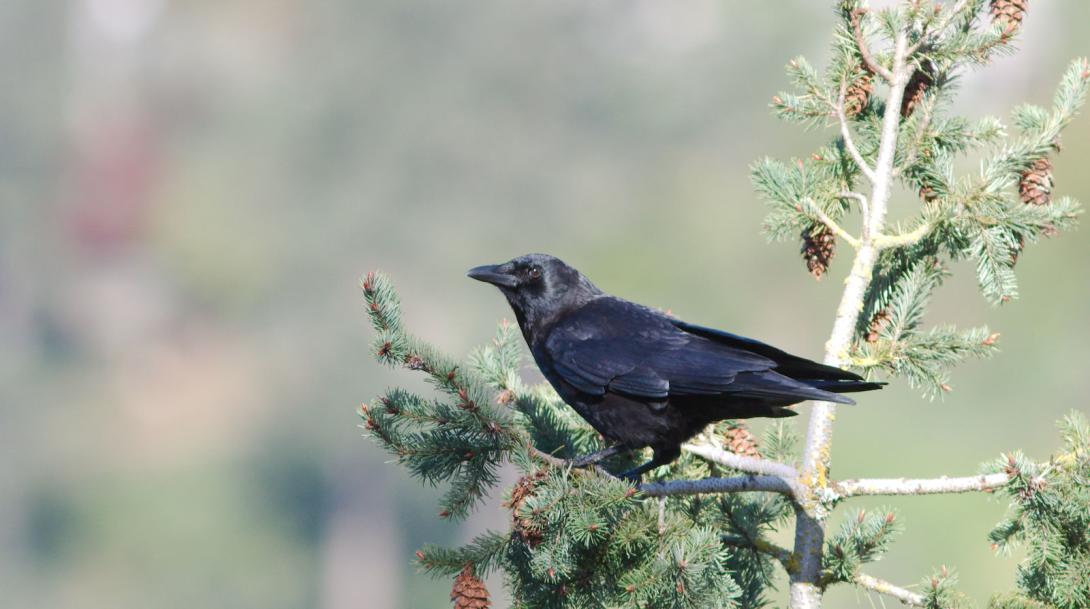
Taken by Steve Bennett at Willamette View on
.
American Crow