
American White Pelican
Pelecanus erythrorhynchos
American White Pelicans are magnificent and easily recognizable birds in Oregon, known for their immense size and striking white plumage. However, distinguishing between males and females in the field can be challenging as they exhibit limited sexual dimorphism in their appearance.
General Appearance (Both Sexes):
Size: They are one of North America's largest birds, with an impressive wingspan that can range from 8 to 9.5 feet (96 to 114 inches). Their body length is typically 50-70 inches (1.3-1.8 meters).
Plumage: Adults are almost entirely snowy white. The only significant exception is their black primary and secondary flight feathers, which are prominently visible when the bird is in flight, creating a striking contrast against the white body and underwings. When on the water or land with wings folded, they appear almost entirely white.
Bill and Pouch: They possess an enormous, flat bill with a large, expandable gular pouch underneath. Outside of the breeding season, the bill, pouch, legs, and feet are typically a pale yellow to dull pink-orange.
Legs and Feet: Short, webbed feet, usually pale yellow to orange.
Flight: American White Pelicans are powerful and graceful fliers. They often soar at high altitudes on thermals, sometimes in large, synchronized flocks. They fly with their necks withdrawn, creating a distinctive profile. Unlike Brown Pelicans, they do not plunge-dive for fish; instead, they forage by dipping their bills into the water while swimming, often cooperatively.
Sexual Dimorphism (Subtle Differences):
Size: The most consistent difference is that males are generally slightly larger and heavier than females. While this might not be immediately apparent without direct comparison or measuring, studies have shown average weight differences (e.g., males averaging around 14.3 pounds, females around 11.2 pounds). Males also tend to have slightly longer bills.
Breeding Season Features (Both Sexes develop these, but can be slightly more pronounced in males):
Nuptial Tubercle (Horn): During the breeding season (roughly March through August in Oregon), both male and female American White Pelicans develop a unique, laterally flattened, fibrous "horn" or plate on the upper part of their bill. This "horn" is made of keratin, is shed after breeding (typically after eggs are laid), and regrows each year. While both sexes grow it, it might be slightly larger or more prominent in males, though this is not a reliable field mark for sexing. It's thought to play a role in courtship or aggressive interactions within the colony.
Bill, Pouch, and Facial Skin Coloration: During the breeding season, the bill, gular pouch, and the bare skin around the eye become a vivid orange or red-orange, much brighter than in the non-breeding season. This coloration is present in both sexes.
Breast Feather Tint: The breast feathers can develop a yellowish tinge during early spring and the breeding season.
Head Feathering: The top of the head may appear "dusted" with black feathers during the breeding season.
Juvenile American White Pelicans:
Young pelicans have dusky or brownish-gray plumage on their head, neck, and back, which gradually whitens as they mature. Their bare parts (bill, pouch, legs, feet) are typically dull gray or pale yellow.
Habitat and Behavior in Oregon:
American White Pelicans in Oregon are primarily found in inland freshwater wetlands, large lakes, and rivers, particularly in eastern Oregon (e.g., Malheur Lake, Klamath Basin, Columbia River). They are colonial breeders, nesting on isolated islands where they are less susceptible to terrestrial predators and human disturbance. They are highly social and often forage cooperatively, forming lines or circles to herd fish into shallower water before scooping them up.
General Appearance (Both Sexes):
Size: They are one of North America's largest birds, with an impressive wingspan that can range from 8 to 9.5 feet (96 to 114 inches). Their body length is typically 50-70 inches (1.3-1.8 meters).
Plumage: Adults are almost entirely snowy white. The only significant exception is their black primary and secondary flight feathers, which are prominently visible when the bird is in flight, creating a striking contrast against the white body and underwings. When on the water or land with wings folded, they appear almost entirely white.
Bill and Pouch: They possess an enormous, flat bill with a large, expandable gular pouch underneath. Outside of the breeding season, the bill, pouch, legs, and feet are typically a pale yellow to dull pink-orange.
Legs and Feet: Short, webbed feet, usually pale yellow to orange.
Flight: American White Pelicans are powerful and graceful fliers. They often soar at high altitudes on thermals, sometimes in large, synchronized flocks. They fly with their necks withdrawn, creating a distinctive profile. Unlike Brown Pelicans, they do not plunge-dive for fish; instead, they forage by dipping their bills into the water while swimming, often cooperatively.
Sexual Dimorphism (Subtle Differences):
Size: The most consistent difference is that males are generally slightly larger and heavier than females. While this might not be immediately apparent without direct comparison or measuring, studies have shown average weight differences (e.g., males averaging around 14.3 pounds, females around 11.2 pounds). Males also tend to have slightly longer bills.
Breeding Season Features (Both Sexes develop these, but can be slightly more pronounced in males):
Nuptial Tubercle (Horn): During the breeding season (roughly March through August in Oregon), both male and female American White Pelicans develop a unique, laterally flattened, fibrous "horn" or plate on the upper part of their bill. This "horn" is made of keratin, is shed after breeding (typically after eggs are laid), and regrows each year. While both sexes grow it, it might be slightly larger or more prominent in males, though this is not a reliable field mark for sexing. It's thought to play a role in courtship or aggressive interactions within the colony.
Bill, Pouch, and Facial Skin Coloration: During the breeding season, the bill, gular pouch, and the bare skin around the eye become a vivid orange or red-orange, much brighter than in the non-breeding season. This coloration is present in both sexes.
Breast Feather Tint: The breast feathers can develop a yellowish tinge during early spring and the breeding season.
Head Feathering: The top of the head may appear "dusted" with black feathers during the breeding season.
Juvenile American White Pelicans:
Young pelicans have dusky or brownish-gray plumage on their head, neck, and back, which gradually whitens as they mature. Their bare parts (bill, pouch, legs, feet) are typically dull gray or pale yellow.
Habitat and Behavior in Oregon:
American White Pelicans in Oregon are primarily found in inland freshwater wetlands, large lakes, and rivers, particularly in eastern Oregon (e.g., Malheur Lake, Klamath Basin, Columbia River). They are colonial breeders, nesting on isolated islands where they are less susceptible to terrestrial predators and human disturbance. They are highly social and often forage cooperatively, forming lines or circles to herd fish into shallower water before scooping them up.
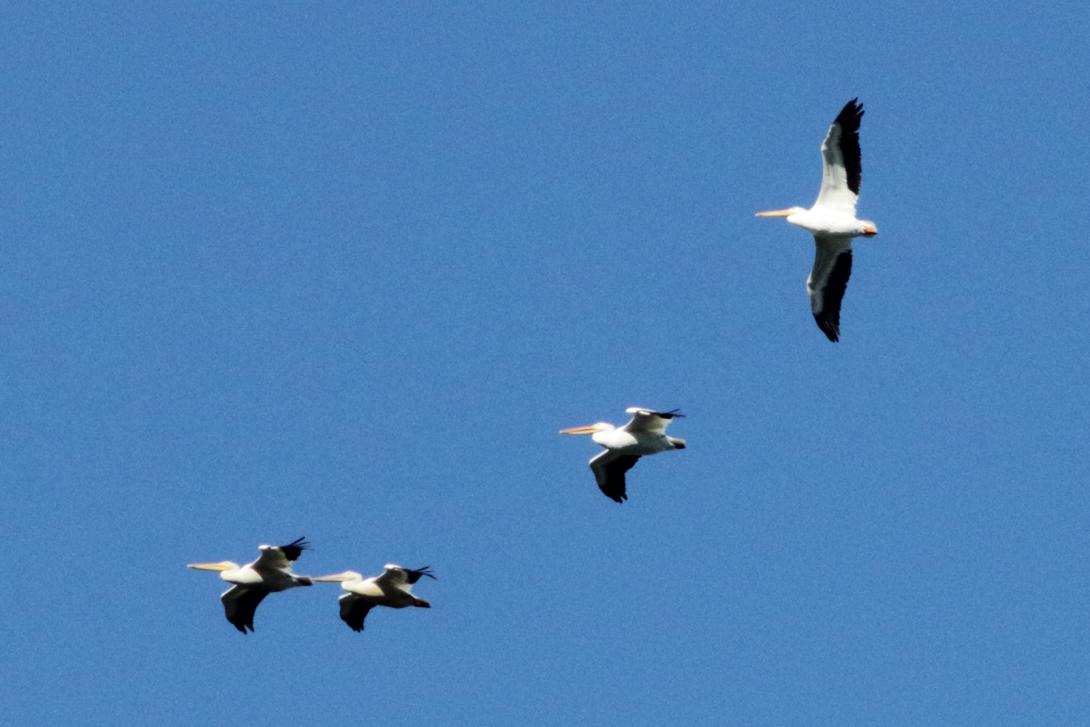
Taken by Steve Bennett at Willamette View on
.
Part of a group of 150 American White Pelicans flying over Willamette View.