
Black-capped Chickadee
Poecile atricapillus
Black-capped Chickadees are one of Oregon's most beloved and recognizable backyard birds, known for their cheerful "chick-a-dee-dee-dee" call and their acrobatic antics at feeders. They are small, energetic, and seemingly overflowing with good spirits, even in the depths of winter.
However, like many songbirds, male and female Black-capped Chickadees are remarkably similar in appearance, making them visually indistinguishable to the casual observer. They are considered monomorphic.
General Appearance (Both Sexes):
Size and Shape: Small, plump birds with a relatively large head (giving them a "cute" appearance), short neck, and small, pointed bill.
Coloration: Distinctive and easily recognized:
Head: A prominent black "cap" covering the top of the head.
Throat/Bib: A contrasting black "bib" below the bill.
Cheeks: Bright white cheeks, sharply defined against the black cap and bib.
Back and Wings: Grayish on the back, wings, and tail. The wing feathers often have white edging.
Underparts: Whitish belly, often with a subtle buffy or rusty wash on the flanks (sides).
Bill, Legs, and Feet: All are black.
Vocalizations: Their most famous call is the "chick-a-dee-dee-dee," which can vary in the number of "dee" notes to communicate alarm levels. They also have a clear, whistled "fee-bee" or "fee-bee-ee" song.
Subtle Differences and Behavioral Cues (where distinctions might be observed):
Since direct visual identification is nearly impossible, behavioral observations, particularly during the breeding season, are the most reliable way to infer sex.
Size (Minimal Average Difference): Males tend to be very slightly larger and heavier than females on average. This difference is so marginal that it's not a reliable field mark for identification. You'd need precise measurements to confirm it.
Dominance Hierarchies: In winter flocks, males generally rank higher in dominance than females. You might observe dominant birds (often males) asserting themselves over subordinates (often females or younger birds) at a feeder by fluffing feathers or making specific "gargle" calls.
Behavior during Breeding Season (Most Reliable):
Pair Bonds: Black-capped Chickadees form monogamous pair bonds, often as early as autumn, and remain together as part of winter flocks.
Nest Site Selection and Excavation: They are cavity nesters. The female often selects the nest site, usually an excavated hole in a rotten tree or an old woodpecker hole, or they will use nest boxes. Both sexes may help enlarge the cavity, but the female generally takes the lead in hollowing it out.
Nest Construction: The female exclusively builds the actual nest within the cavity, using a foundation of moss and lining it with soft materials like animal hair, feathers, and plant down.
Incubation: The female is the sole incubator of the eggs (typically 6-8, white with fine reddish-brown dots). The incubation period lasts about 12-13 days.
Courtship Feeding/Feeding the Incubating Female: During incubation, the male diligently brings food to the female at the nest. You might see the male perched near the nest, singing a soft song, and the female will then fly out to him, give a tiny begging call, and quiver her wings to receive food. This is one of the strongest indicators of sex.
Parental Care: Once the eggs hatch, the female remains with the young for the initial period, and the male continues to bring food for both the female and the nestlings. As the nestlings grow (they fledge in about 16 days), both parents actively participate in feeding them.
However, like many songbirds, male and female Black-capped Chickadees are remarkably similar in appearance, making them visually indistinguishable to the casual observer. They are considered monomorphic.
General Appearance (Both Sexes):
Size and Shape: Small, plump birds with a relatively large head (giving them a "cute" appearance), short neck, and small, pointed bill.
Coloration: Distinctive and easily recognized:
Head: A prominent black "cap" covering the top of the head.
Throat/Bib: A contrasting black "bib" below the bill.
Cheeks: Bright white cheeks, sharply defined against the black cap and bib.
Back and Wings: Grayish on the back, wings, and tail. The wing feathers often have white edging.
Underparts: Whitish belly, often with a subtle buffy or rusty wash on the flanks (sides).
Bill, Legs, and Feet: All are black.
Vocalizations: Their most famous call is the "chick-a-dee-dee-dee," which can vary in the number of "dee" notes to communicate alarm levels. They also have a clear, whistled "fee-bee" or "fee-bee-ee" song.
Subtle Differences and Behavioral Cues (where distinctions might be observed):
Since direct visual identification is nearly impossible, behavioral observations, particularly during the breeding season, are the most reliable way to infer sex.
Size (Minimal Average Difference): Males tend to be very slightly larger and heavier than females on average. This difference is so marginal that it's not a reliable field mark for identification. You'd need precise measurements to confirm it.
Dominance Hierarchies: In winter flocks, males generally rank higher in dominance than females. You might observe dominant birds (often males) asserting themselves over subordinates (often females or younger birds) at a feeder by fluffing feathers or making specific "gargle" calls.
Behavior during Breeding Season (Most Reliable):
Pair Bonds: Black-capped Chickadees form monogamous pair bonds, often as early as autumn, and remain together as part of winter flocks.
Nest Site Selection and Excavation: They are cavity nesters. The female often selects the nest site, usually an excavated hole in a rotten tree or an old woodpecker hole, or they will use nest boxes. Both sexes may help enlarge the cavity, but the female generally takes the lead in hollowing it out.
Nest Construction: The female exclusively builds the actual nest within the cavity, using a foundation of moss and lining it with soft materials like animal hair, feathers, and plant down.
Incubation: The female is the sole incubator of the eggs (typically 6-8, white with fine reddish-brown dots). The incubation period lasts about 12-13 days.
Courtship Feeding/Feeding the Incubating Female: During incubation, the male diligently brings food to the female at the nest. You might see the male perched near the nest, singing a soft song, and the female will then fly out to him, give a tiny begging call, and quiver her wings to receive food. This is one of the strongest indicators of sex.
Parental Care: Once the eggs hatch, the female remains with the young for the initial period, and the male continues to bring food for both the female and the nestlings. As the nestlings grow (they fledge in about 16 days), both parents actively participate in feeding them.
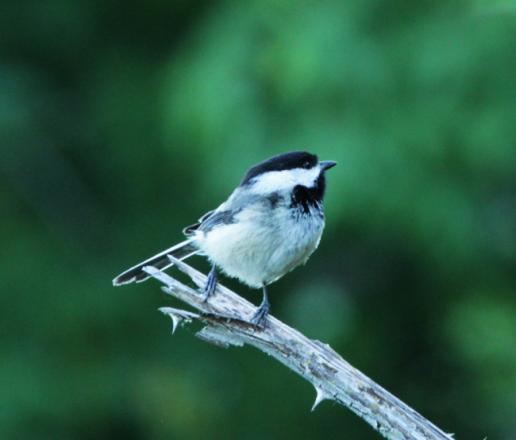
Taken by Steve Bennett at Willamette View on
.
Black-capped Chickadee