
Black-crowned Night-Heron
Nycticorax nycticorax
Black-crowned Night-Herons are distinctive and widespread wading birds found in various wetland habitats across Oregon. True to their name, they are primarily active from dusk through dawn. While their overall appearance is quite striking, distinguishing between males and females in the field can be subtle as they exhibit limited sexual dimorphism in plumage.
General Appearance (Adults, Both Sexes):
Size and Shape: They are stocky, medium-sized herons, somewhat compact in appearance with a relatively short neck and legs. They often have a hunched posture when at rest, with their neck pulled into their body. Their size is roughly between a crow and a goose.
Plumage:
Crown and Back: A key identifying feature is their glossy black cap (crown) and black back. This black often has a greenish or bluish sheen in good light.
Underparts: The face, throat, neck, and underparts are white to pale gray.
Wings: The wings are a uniform pale gray.
Eyes: Adults have striking bright red eyes.
Bill: Their bill is stout, thick, and entirely black.
Legs and Feet: In the non-breeding season, their legs and feet are typically yellow-green. However, during the breeding season (roughly April to August in Oregon), their legs and feet turn a vibrant pink or red-orange. This color change is present in both sexes.
Head Plumes: During the breeding season, adults develop two or more long, thin, white ornamental plumes that extend from the back of their head. These are used in courtship displays.
Sexual Dimorphism (Subtle Differences):
Size: Males are generally slightly larger and heavier than females. This is often the most consistent difference, though it can be hard to judge on an individual bird without direct comparison. Males may also have slightly longer head plumes during the breeding season.
Plumage Coloration (Minor): Some sources suggest that the black on the crown, back, and tail of males might have a more pronounced greenish-black sheen, while females might show more purple-chestnut tones. However, this distinction is often very subtle and can be highly dependent on lighting conditions, making it unreliable for field identification.
Behavior (Breeding Displays): During the breeding season, males engage in elaborate courtship displays to attract females, involving bowing, ruffing feathers, and vocalizations. Both sexes participate in nest building and incubation.
Juvenile Black-crowned Night-Herons:
Juveniles look distinctly different from adults. They are primarily brown with heavy white and buff streaking on their underparts and large white spots on their wings. Their eyes are yellowish or amber, and their bill is yellow and black. They gradually acquire adult plumage over a year or two.
Habitat and Behavior in Oregon:
Black-crowned Night-Herons are found in a variety of wetland habitats across Oregon, including:
Freshwater marshes, Lakes, Rivers, Estuaries and tidal mudflats, Swamps and flooded agricultural fields
They are most active at dusk and through the night, though they may forage during the day, especially during the demanding breeding season. They are highly social birds, often roosting communally in trees or dense marsh vegetation during the day. They typically feed by standing still at the water's edge or walking slowly, waiting to ambush fish, crustaceans (like crayfish), amphibians, and insects.
In Oregon, they are a fairly common summer resident east of the Cascades, where they breed locally at large wetlands like Malheur Lake. They are also found along the coast and in western Oregon's wetlands, though breeding in western Oregon can be more elusive to confirm due to their secretive nature. Their characteristic "quok" or "quark" call is often heard as they fly overhead at twilight.
General Appearance (Adults, Both Sexes):
Size and Shape: They are stocky, medium-sized herons, somewhat compact in appearance with a relatively short neck and legs. They often have a hunched posture when at rest, with their neck pulled into their body. Their size is roughly between a crow and a goose.
Plumage:
Crown and Back: A key identifying feature is their glossy black cap (crown) and black back. This black often has a greenish or bluish sheen in good light.
Underparts: The face, throat, neck, and underparts are white to pale gray.
Wings: The wings are a uniform pale gray.
Eyes: Adults have striking bright red eyes.
Bill: Their bill is stout, thick, and entirely black.
Legs and Feet: In the non-breeding season, their legs and feet are typically yellow-green. However, during the breeding season (roughly April to August in Oregon), their legs and feet turn a vibrant pink or red-orange. This color change is present in both sexes.
Head Plumes: During the breeding season, adults develop two or more long, thin, white ornamental plumes that extend from the back of their head. These are used in courtship displays.
Sexual Dimorphism (Subtle Differences):
Size: Males are generally slightly larger and heavier than females. This is often the most consistent difference, though it can be hard to judge on an individual bird without direct comparison. Males may also have slightly longer head plumes during the breeding season.
Plumage Coloration (Minor): Some sources suggest that the black on the crown, back, and tail of males might have a more pronounced greenish-black sheen, while females might show more purple-chestnut tones. However, this distinction is often very subtle and can be highly dependent on lighting conditions, making it unreliable for field identification.
Behavior (Breeding Displays): During the breeding season, males engage in elaborate courtship displays to attract females, involving bowing, ruffing feathers, and vocalizations. Both sexes participate in nest building and incubation.
Juvenile Black-crowned Night-Herons:
Juveniles look distinctly different from adults. They are primarily brown with heavy white and buff streaking on their underparts and large white spots on their wings. Their eyes are yellowish or amber, and their bill is yellow and black. They gradually acquire adult plumage over a year or two.
Habitat and Behavior in Oregon:
Black-crowned Night-Herons are found in a variety of wetland habitats across Oregon, including:
Freshwater marshes, Lakes, Rivers, Estuaries and tidal mudflats, Swamps and flooded agricultural fields
They are most active at dusk and through the night, though they may forage during the day, especially during the demanding breeding season. They are highly social birds, often roosting communally in trees or dense marsh vegetation during the day. They typically feed by standing still at the water's edge or walking slowly, waiting to ambush fish, crustaceans (like crayfish), amphibians, and insects.
In Oregon, they are a fairly common summer resident east of the Cascades, where they breed locally at large wetlands like Malheur Lake. They are also found along the coast and in western Oregon's wetlands, though breeding in western Oregon can be more elusive to confirm due to their secretive nature. Their characteristic "quok" or "quark" call is often heard as they fly overhead at twilight.
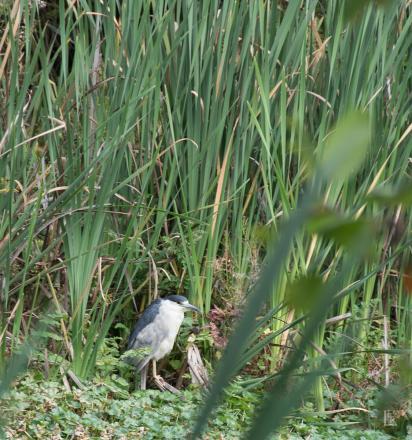
Taken by Eva K. Laevastu at Arcata Marsh on
.
Black-crowned Night Herons are abundant in the Arcata Marsh in the fall and winter, as well as breeding there.