
Bonaparte’s Gull
Chroicocephalus philadelphia
The Bonaparte's Gull is a small, graceful gull often described as "tern-like" in its flight and movements. In Oregon, they are common migrants and winter visitors, especially along the coast in estuaries, bays, and open waters, but also on larger inland lakes and rivers.
Overall Characteristics of Bonaparte's Gulls:
Size: They are the smallest gull commonly seen in North America, roughly the size of a pigeon, about 11-15 inches long.
Bill: Small, slender, and entirely black, often described as "pin-like."
Legs: Vary with season: pinkish in non-breeding plumage, becoming reddish in breeding plumage.
Flight: Very agile and buoyant, with quick wingbeats. A key identification feature in flight is the **prominent white wedge (or "slash")** along the leading edge of the outer wing (primaries) on the upper surface, which contrasts with the black tips of the outer primaries. The trailing edge of the outer wing also has a thin black line.
Voice: A high, nasal "chew-wit" or "cherr."
Plumage - Very Similar for Male and Female, but varies significantly by age and season:
1. Breeding Plumage (Adult, seen in Oregon during spring migration, April-May, and sometimes very early fall):
Head: A striking, solid **slaty-black hood** covers the entire head down to the nape, with a distinct white eye-crescent (incomplete white eye-ring) around the eye.
Body: White underparts, pale gray back and upperwings.
Wings: Distinct white wedge on the outer primaries and black tips.
Legs: Reddish.
2. Non-breeding (Winter) Plumage (Adult, most common in Oregon from late summer through winter):
Head: The black hood is lost. The head is entirely white, except for a distinct **dark, smudgy spot behind the eye** (ear spot).
Body: White underparts, pale gray back and upperwings.
Wings: Still show the diagnostic white wedge on the outer primaries and black tips.
Legs: Pinkish.
3. First-Winter Plumage (Immature, very common in Oregon during fall and winter):
Resembles the non-breeding adult but with some key differences that indicate immaturity.
Head: White with a dark ear spot, similar to non-breeding adults.
Upperparts: The back and wings are generally a darker, mottled gray-brown, and often show a distinct **dark bar across the "shoulder" (carpal bar)** on the upperwing, which is visible both at rest and in flight.
Tail: Has a noticeable **black band** at the tip of the white tail.
Wings: The outer primaries have more black than adults, and the white wedge may be less prominent.
Distinguishing Male from Female:
Like most gull species, **male and female Bonaparte's Gulls are virtually identical in plumage**. There are no reliable field marks in their coloration or feather patterns that allow for confident sex determination in the field.
Size: Males tend to be *slightly* larger and heavier than females, but this difference is subtle and within the range of individual variation, making it almost impossible to discern unless you have a known pair side-by-side or are observing behavior where size differences become apparent (e.g., during courtship, which largely occurs on their northern breeding grounds).
Therefore, when observing Bonaparte's Gulls in Oregon, you will focus on their size, bill shape, leg color, flight patterns, and most importantly, their age (adult vs. immature) and seasonal plumage (breeding vs. non-breeding).
Overall Characteristics of Bonaparte's Gulls:
Size: They are the smallest gull commonly seen in North America, roughly the size of a pigeon, about 11-15 inches long.
Bill: Small, slender, and entirely black, often described as "pin-like."
Legs: Vary with season: pinkish in non-breeding plumage, becoming reddish in breeding plumage.
Flight: Very agile and buoyant, with quick wingbeats. A key identification feature in flight is the **prominent white wedge (or "slash")** along the leading edge of the outer wing (primaries) on the upper surface, which contrasts with the black tips of the outer primaries. The trailing edge of the outer wing also has a thin black line.
Voice: A high, nasal "chew-wit" or "cherr."
Plumage - Very Similar for Male and Female, but varies significantly by age and season:
1. Breeding Plumage (Adult, seen in Oregon during spring migration, April-May, and sometimes very early fall):
Head: A striking, solid **slaty-black hood** covers the entire head down to the nape, with a distinct white eye-crescent (incomplete white eye-ring) around the eye.
Body: White underparts, pale gray back and upperwings.
Wings: Distinct white wedge on the outer primaries and black tips.
Legs: Reddish.
2. Non-breeding (Winter) Plumage (Adult, most common in Oregon from late summer through winter):
Head: The black hood is lost. The head is entirely white, except for a distinct **dark, smudgy spot behind the eye** (ear spot).
Body: White underparts, pale gray back and upperwings.
Wings: Still show the diagnostic white wedge on the outer primaries and black tips.
Legs: Pinkish.
3. First-Winter Plumage (Immature, very common in Oregon during fall and winter):
Resembles the non-breeding adult but with some key differences that indicate immaturity.
Head: White with a dark ear spot, similar to non-breeding adults.
Upperparts: The back and wings are generally a darker, mottled gray-brown, and often show a distinct **dark bar across the "shoulder" (carpal bar)** on the upperwing, which is visible both at rest and in flight.
Tail: Has a noticeable **black band** at the tip of the white tail.
Wings: The outer primaries have more black than adults, and the white wedge may be less prominent.
Distinguishing Male from Female:
Like most gull species, **male and female Bonaparte's Gulls are virtually identical in plumage**. There are no reliable field marks in their coloration or feather patterns that allow for confident sex determination in the field.
Size: Males tend to be *slightly* larger and heavier than females, but this difference is subtle and within the range of individual variation, making it almost impossible to discern unless you have a known pair side-by-side or are observing behavior where size differences become apparent (e.g., during courtship, which largely occurs on their northern breeding grounds).
Therefore, when observing Bonaparte's Gulls in Oregon, you will focus on their size, bill shape, leg color, flight patterns, and most importantly, their age (adult vs. immature) and seasonal plumage (breeding vs. non-breeding).
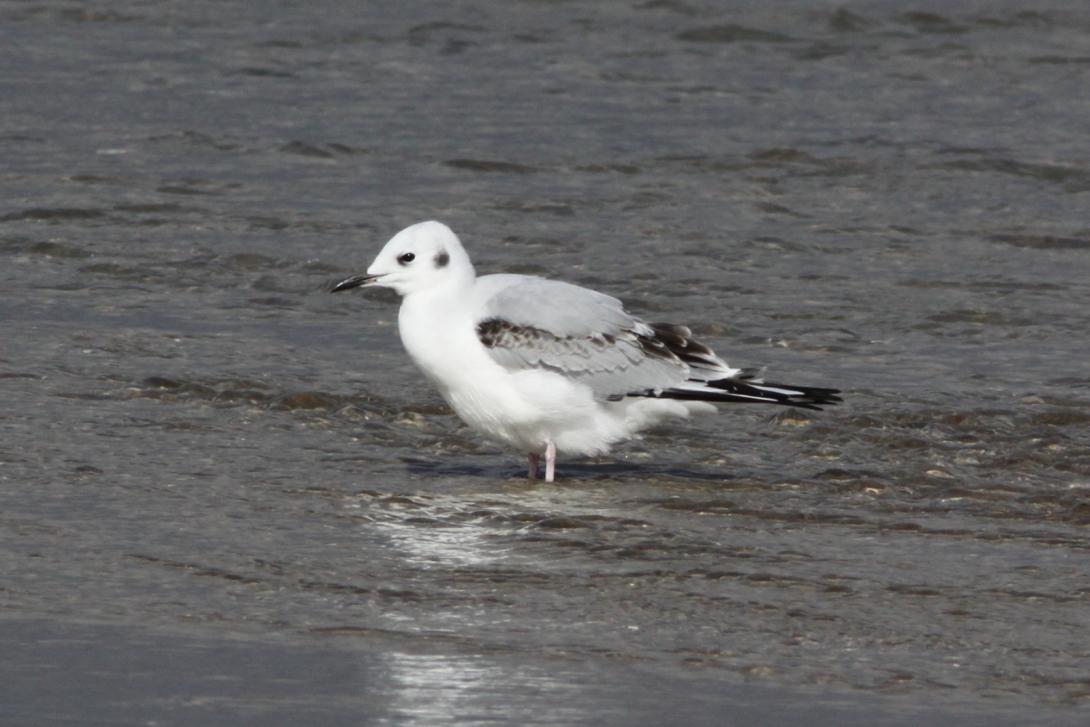
Taken by Steve Bennett at Pawley's Island, South Carolina on
.
Winter plumage Bonaparte's Gull.