
Cackling Goose
Branta hutchinsii
Male and female Cackling Geese look very similar, with the main difference being size; males are typically larger than females. Both sexes share the same overall plumage, featuring a black head and neck, white cheek patches, a white chin strap, and a mottled brown body. They also have black legs and feet, and a black tail with a white band on the rump. The bill is short and stubby, meeting the forehead at a steep angle.
Detailed Description:
• Size and Shape: Cackling Geese are small and compact, with a short neck and a rounded head. They are smaller than Canada Geese, with a wingspan of about 42.5 to 43.7 inches.
• Plumage: Both males and females have a dark brown to pale brown mottled body, a black neck and head, and white cheek patches divided by a black chin stripe. They also have a white band on the rump and a white chin strap extending from ear to ear.
• Bill and Legs: The bill is short and black, and the legs and feet are also black.
• Sexual Dimorphism: The primary difference between males and females is size, with males being larger. However, this difference can be subtle, especially among some subspecies.
• Vocalizations: Both sexes make a variety of calls, but females tend to have a softer, less incisive flight call according to All About Birds.
• Subspecies Variation: There are several subspecies of Cackling Goose, with varying sizes. The smallest subspecies is only about one-quarter the size of the largest Canada Goose subspecies.
Detailed Description:
• Size and Shape: Cackling Geese are small and compact, with a short neck and a rounded head. They are smaller than Canada Geese, with a wingspan of about 42.5 to 43.7 inches.
• Plumage: Both males and females have a dark brown to pale brown mottled body, a black neck and head, and white cheek patches divided by a black chin stripe. They also have a white band on the rump and a white chin strap extending from ear to ear.
• Bill and Legs: The bill is short and black, and the legs and feet are also black.
• Sexual Dimorphism: The primary difference between males and females is size, with males being larger. However, this difference can be subtle, especially among some subspecies.
• Vocalizations: Both sexes make a variety of calls, but females tend to have a softer, less incisive flight call according to All About Birds.
• Subspecies Variation: There are several subspecies of Cackling Goose, with varying sizes. The smallest subspecies is only about one-quarter the size of the largest Canada Goose subspecies.
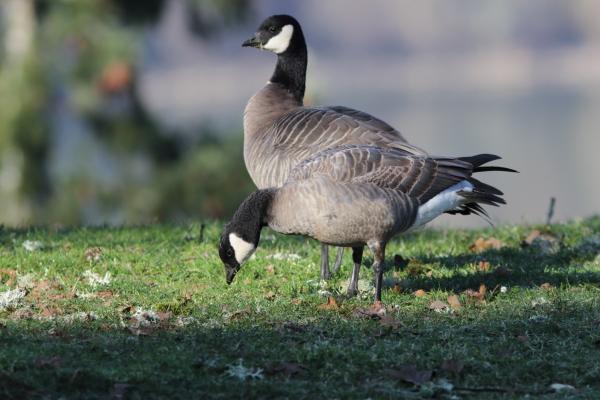
Taken by Steve Bennett at Willamette View on
.
A pair of Cackling Geese. Note the small heads, short bills, short necks, and overall brownish breasts.
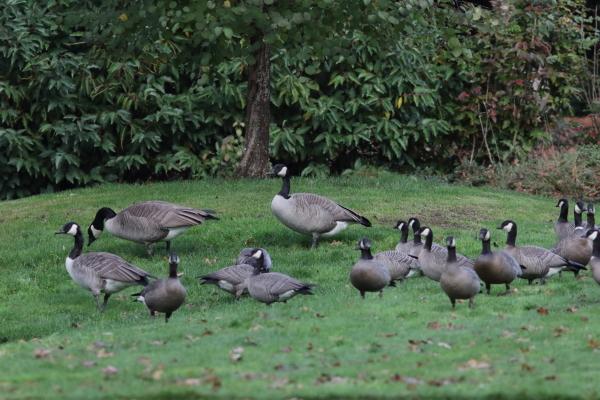
Taken by Steve Bennett at Willamette View on
.
Compare the size of the three Canada on the left to the smaller Cackling Geese to the right. In addition to the overall size difference (Canada are much larger that Cackling), note also the length of the necks and the color of the breasts of the birds.