
Cooper’s Hawk
Astur cooperii
Cooper's Hawks are common raptors found throughout Oregon, inhabiting a variety of wooded areas from deep forests to suburban backyards. They are renowned for their agility in weaving through trees in pursuit of prey, primarily birds. A key characteristic of Cooper's Hawks, like other accipiters, is reversed sexual dimorphism, where the female is significantly larger than the male. While their adult plumages are similar, their size difference is a primary way to tell them apart.
Male Cooper's Hawk
Size: Males are medium-sized hawks, roughly the size of an American Crow. They are noticeably larger than Sharp-shinned Hawks, but smaller than female Cooper's Hawks.
Length: 14.6 - 15.3 inches (37-39 cm)
Wingspan: 24.4 - 35.4 inches (62-90 cm)
Weight: 7.8 - 14.5 ounces (220-410 g) - Males are typically around 60% the weight of females.
Plumage (Adult):
Upperparts: Steely bluish-gray to slate-gray on the back, wings, and head. They often have a distinct darker cap on the head, which contrasts with a slightly paler nape (back of the neck).
Underparts: White to creamy white with fine, horizontal reddish-brown or rufous barring on the breast and belly. The barring tends to be dense and uniform.
Tail: Long and **rounded at the tip** (a key difference from the squared-off tail of a Sharp-shinned Hawk). It has distinct dark bands and a relatively wide white terminal band at the very end.
Eyes: Bright **red** or reddish-orange eyes (juveniles have yellow eyes that gradually turn red with age).
Legs: Yellowish, relatively thick legs and strong feet.
Behavior: Males are agile hunters, specializing in catching medium-sized birds like robins, jays, and flickers. Their smaller size allows for quicker maneuvers through dense cover.
Female Cooper's Hawk
Size: Females are substantially larger and heavier than males, often reaching the size of a small Red-tailed Hawk. This size difference is the most reliable way to sex Cooper's Hawks in the field, especially if seen next to a male.
Length: 16.5 - 17.7 inches (42-45 cm)
Wingspan: 29.5 - 35.4 inches (75-90 cm)
Weight: 11.6 - 24.0 ounces (330-680 g) - Females can be nearly twice as heavy as males.
Plumage (Adult):
Upperparts: Similar to males, but often a duller or more brownish-gray on the back and wings. The darker cap may be less pronounced or contrasting compared to the male's.
Underparts:** White to creamy white with **broader and often more extensive reddish-brown or rufous streaking/barring** than males. The barring can sometimes appear less uniform.
Tail: Long and rounded at the tip, with distinct dark bands and a relatively **wide white terminal band**.
Eyes: Bright red or reddish-orange eyes (juveniles have yellow eyes).
Legs: Yellowish, relatively thick legs and strong feet.
Behavior: Due to their larger size, females can successfully prey on a wider range of birds, including larger species, as well as small mammals like squirrels and chipmunks. During nesting, the female does most of the incubation and brooding, with the male bringing her food.
Key Identification Points (Both Sexes & Differentiation from Sharp-shinned Hawks):
Head Shape: Cooper's Hawks typically have a relatively large, blocky head that projects noticeably beyond the "wrist" of the wing in flight, giving them a more "capped" appearance. Sharp-shinned Hawks have smaller, rounder heads.
Tail Shape: The rounded tail tip is a crucial distinguishing feature for Cooper's Hawks (compared to the squared-off tail of a Sharp-shinned Hawk). This can be subtle but is often visible, especially during turns in flight.
Plumage Detail (Adults): While both have barred underparts, Cooper's Hawks generally have bolder, often more rufous barring, especially compared to the fine barring of male Sharp-shinned Hawks.
Legs: Cooper's Hawks have noticeably thicker legs and feet than the delicate legs of Sharp-shinned Hawks.
Juvenile Plumage: Young Cooper's Hawks (both sexes) are primarily brown above with heavy brown streaking on their white underparts and yellow eyes. As they mature, their eyes turn red, and their plumage transitions to the adult gray and rufous barring.
Cooper's Hawks are adaptable and their population has rebounded in many areas, including Oregon, where they are often seen hunting in urban and suburban environments, drawn by the abundance of feeder birds.
Male Cooper's Hawk
Size: Males are medium-sized hawks, roughly the size of an American Crow. They are noticeably larger than Sharp-shinned Hawks, but smaller than female Cooper's Hawks.
Length: 14.6 - 15.3 inches (37-39 cm)
Wingspan: 24.4 - 35.4 inches (62-90 cm)
Weight: 7.8 - 14.5 ounces (220-410 g) - Males are typically around 60% the weight of females.
Plumage (Adult):
Upperparts: Steely bluish-gray to slate-gray on the back, wings, and head. They often have a distinct darker cap on the head, which contrasts with a slightly paler nape (back of the neck).
Underparts: White to creamy white with fine, horizontal reddish-brown or rufous barring on the breast and belly. The barring tends to be dense and uniform.
Tail: Long and **rounded at the tip** (a key difference from the squared-off tail of a Sharp-shinned Hawk). It has distinct dark bands and a relatively wide white terminal band at the very end.
Eyes: Bright **red** or reddish-orange eyes (juveniles have yellow eyes that gradually turn red with age).
Legs: Yellowish, relatively thick legs and strong feet.
Behavior: Males are agile hunters, specializing in catching medium-sized birds like robins, jays, and flickers. Their smaller size allows for quicker maneuvers through dense cover.
Female Cooper's Hawk
Size: Females are substantially larger and heavier than males, often reaching the size of a small Red-tailed Hawk. This size difference is the most reliable way to sex Cooper's Hawks in the field, especially if seen next to a male.
Length: 16.5 - 17.7 inches (42-45 cm)
Wingspan: 29.5 - 35.4 inches (75-90 cm)
Weight: 11.6 - 24.0 ounces (330-680 g) - Females can be nearly twice as heavy as males.
Plumage (Adult):
Upperparts: Similar to males, but often a duller or more brownish-gray on the back and wings. The darker cap may be less pronounced or contrasting compared to the male's.
Underparts:** White to creamy white with **broader and often more extensive reddish-brown or rufous streaking/barring** than males. The barring can sometimes appear less uniform.
Tail: Long and rounded at the tip, with distinct dark bands and a relatively **wide white terminal band**.
Eyes: Bright red or reddish-orange eyes (juveniles have yellow eyes).
Legs: Yellowish, relatively thick legs and strong feet.
Behavior: Due to their larger size, females can successfully prey on a wider range of birds, including larger species, as well as small mammals like squirrels and chipmunks. During nesting, the female does most of the incubation and brooding, with the male bringing her food.
Key Identification Points (Both Sexes & Differentiation from Sharp-shinned Hawks):
Head Shape: Cooper's Hawks typically have a relatively large, blocky head that projects noticeably beyond the "wrist" of the wing in flight, giving them a more "capped" appearance. Sharp-shinned Hawks have smaller, rounder heads.
Tail Shape: The rounded tail tip is a crucial distinguishing feature for Cooper's Hawks (compared to the squared-off tail of a Sharp-shinned Hawk). This can be subtle but is often visible, especially during turns in flight.
Plumage Detail (Adults): While both have barred underparts, Cooper's Hawks generally have bolder, often more rufous barring, especially compared to the fine barring of male Sharp-shinned Hawks.
Legs: Cooper's Hawks have noticeably thicker legs and feet than the delicate legs of Sharp-shinned Hawks.
Juvenile Plumage: Young Cooper's Hawks (both sexes) are primarily brown above with heavy brown streaking on their white underparts and yellow eyes. As they mature, their eyes turn red, and their plumage transitions to the adult gray and rufous barring.
Cooper's Hawks are adaptable and their population has rebounded in many areas, including Oregon, where they are often seen hunting in urban and suburban environments, drawn by the abundance of feeder birds.
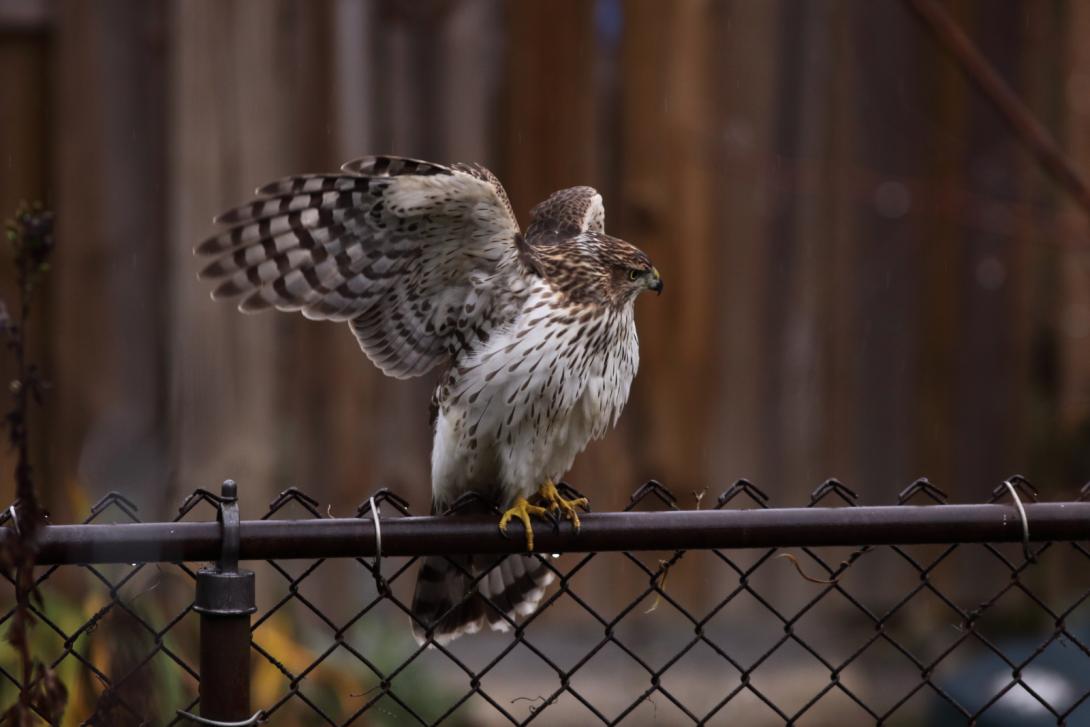
Taken by Steve Bennett at Rodgers Forge, Maryland on
.
Immature Cooper's Hawk
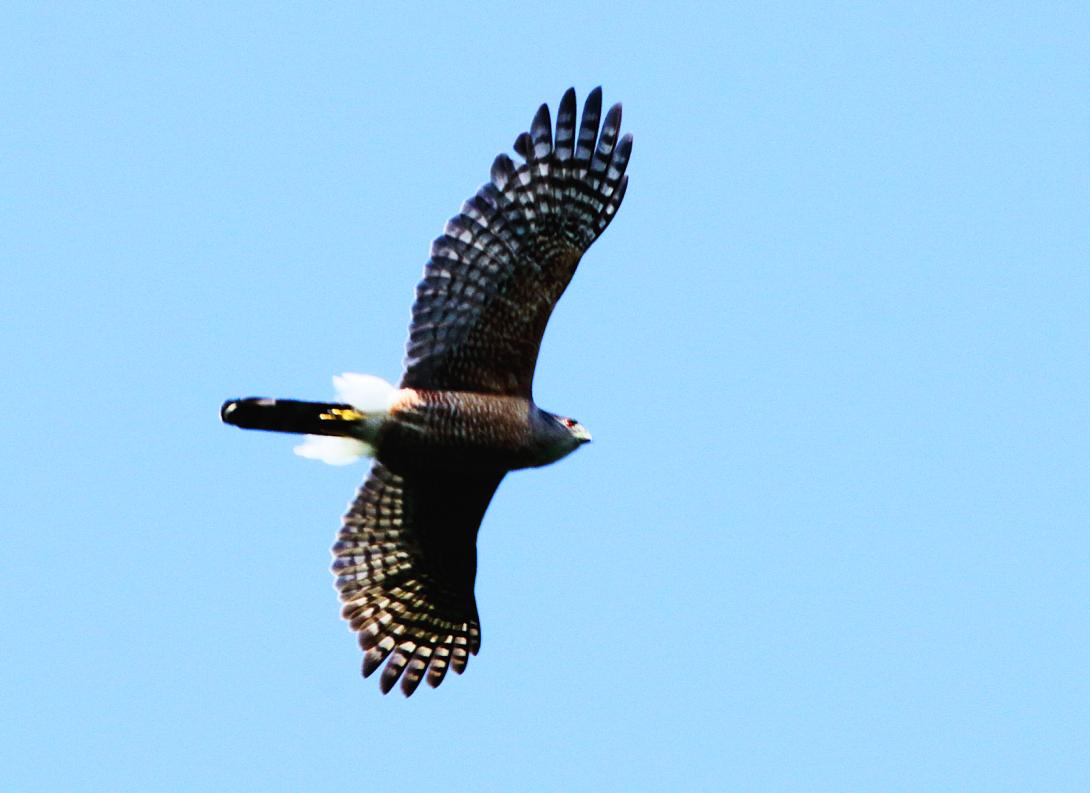
Taken by Steve Bennett at Willamette View on
.
Male Cooper's Hawk in courtship display.
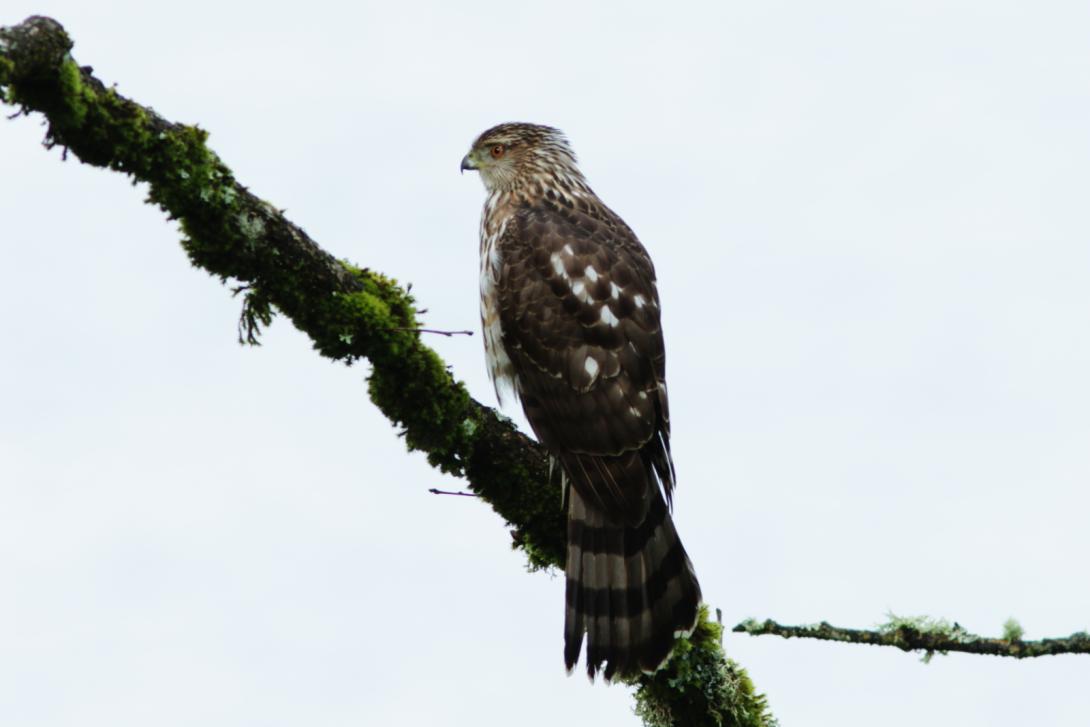
Taken by Steve Bennett at Willamette View on
.
Immature Cooper's Hawk