
Double-crested Cormorant
Nannopterum auritum
Double-crested Cormorants in Oregon, both male and female, are generally quite similar in appearance, making it difficult to distinguish between the sexes without close observation, especially outside of the breeding season.
General Appearance (Both Sexes):
Size and Shape: They are large waterbirds, roughly between the size of a crow and a goose, with a wingspan of about four feet. They have a stocky body, a long, often kinked or S-shaped neck, a medium-sized, wedge-shaped tail, and webbed feet. Their bills are slender and strongly hooked at the tip.
Plumage: Adults are primarily dark brown-black, with deep, coppery feathers that can glisten with a green iridescence in good light.
Facial Skin: They have a distinctive yellow-orange patch of bare skin on their faces and throats, extending to the area in front of their eyes (lores). The lining inside their mouths is a striking bright blue.
Eyes: Their eyes are a vibrant aquamarine color.
Sexual Dimorphism (Differences between Males and Females):
Size: The primary difference is that males are typically slightly larger and more robust than females. However, this can be hard to discern without direct comparison, as there's overlap in individual sizes. In a breeding pair at the nest, the male may appear noticeably larger.
Plumage Variations (Both Sexes):
Breeding Plumage (Spring and Summer in Oregon): This is when the "double crest" becomes visible. During the breeding season (roughly March through May), adults develop two small, stringy tufts of feathers, known as nuptial crests, located just above each eye. These crests can be either white, black, or a mixture of both colors, depending on the individual and possibly geographic variation. The orange facial skin also becomes more vibrant.
Non-breeding Plumage: Outside of the breeding season, the crests are absent. The facial skin may appear more yellowish than vibrant orange.
Juvenile Plumage: Younger Double-crested Cormorants have a more dark gray or brownish plumage, with lighter underparts, including a pale throat and breast that darkens towards the belly. Their bills are typically more orange or yellowish. As they mature, their plumage darkens.
Habitat in Oregon:
Double-crested Cormorants are adaptable and can be found throughout Oregon, both inland and along the coast. They are common breeders in spring and summer in bays, estuaries, and on islands and cliffs along the coast and the lower Columbia River.
General Appearance (Both Sexes):
Size and Shape: They are large waterbirds, roughly between the size of a crow and a goose, with a wingspan of about four feet. They have a stocky body, a long, often kinked or S-shaped neck, a medium-sized, wedge-shaped tail, and webbed feet. Their bills are slender and strongly hooked at the tip.
Plumage: Adults are primarily dark brown-black, with deep, coppery feathers that can glisten with a green iridescence in good light.
Facial Skin: They have a distinctive yellow-orange patch of bare skin on their faces and throats, extending to the area in front of their eyes (lores). The lining inside their mouths is a striking bright blue.
Eyes: Their eyes are a vibrant aquamarine color.
Sexual Dimorphism (Differences between Males and Females):
Size: The primary difference is that males are typically slightly larger and more robust than females. However, this can be hard to discern without direct comparison, as there's overlap in individual sizes. In a breeding pair at the nest, the male may appear noticeably larger.
Plumage Variations (Both Sexes):
Breeding Plumage (Spring and Summer in Oregon): This is when the "double crest" becomes visible. During the breeding season (roughly March through May), adults develop two small, stringy tufts of feathers, known as nuptial crests, located just above each eye. These crests can be either white, black, or a mixture of both colors, depending on the individual and possibly geographic variation. The orange facial skin also becomes more vibrant.
Non-breeding Plumage: Outside of the breeding season, the crests are absent. The facial skin may appear more yellowish than vibrant orange.
Juvenile Plumage: Younger Double-crested Cormorants have a more dark gray or brownish plumage, with lighter underparts, including a pale throat and breast that darkens towards the belly. Their bills are typically more orange or yellowish. As they mature, their plumage darkens.
Habitat in Oregon:
Double-crested Cormorants are adaptable and can be found throughout Oregon, both inland and along the coast. They are common breeders in spring and summer in bays, estuaries, and on islands and cliffs along the coast and the lower Columbia River.
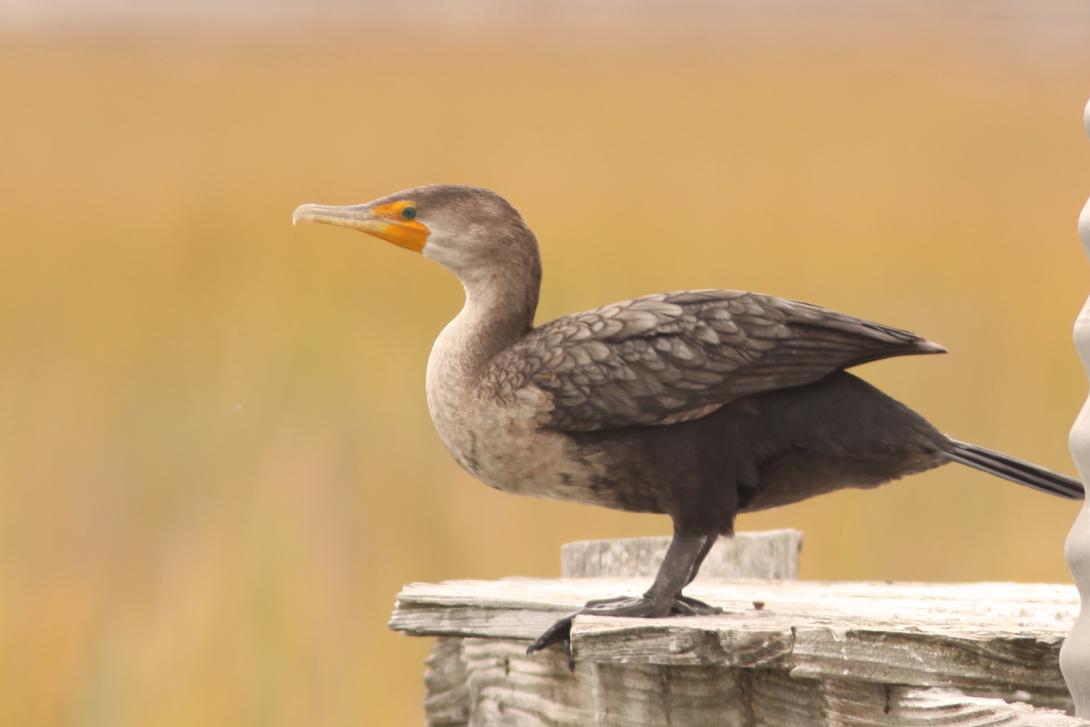
Taken by Steve Bennett at Huntington Beach, South Carolina on
.
Double-crested Cormorant