
Downy Woodpecker
Dryobates pubescens
Downy Woodpeckers are the smallest and one of the most common woodpeckers found in Oregon. They are highly adaptable, inhabiting a wide range of wooded habitats, from dense forests to suburban backyards and parks. Their small size, active foraging, and distinct calls make them a favorite sight for many.
Distinguishing between male and female Downy Woodpeckers is quite simple due to a clear and consistent plumage difference.
General Appearance (Male and Female):
Size & Shape: They are tiny woodpeckers, about the size of a sparrow, with a small, straight, chisel-tipped bill (proportionally shorter than a Hairy Woodpecker's). They have a compact body and stiff tail feathers used as a prop when clinging to trees.
Plumage: Both sexes have a classic black and white "ladder-back" pattern on their wings and a white belly. Their head is striped with black and white: a white supercilium (stripe above the eye), a black eye-line, and a white stripe below the eye that extends down the neck.
Vocalization: They have a distinctive high-pitched "pik" call and a rapid, descending whinny. Their drumming is typically a short, rapid burst.
Behavior: They are active foragers, often seen hitching up tree trunks and branches, probing for insects. Their small size allows them to forage on thinner branches and even tall weeds.
Distinguishing Male and Female Downy Woodpeckers in Oregon:
The key to telling male and female Downy Woodpeckers apart lies in a small but distinct red patch on the back of the head.
1. Red Nape Patch:
Male Downy Woodpeckers: Have a small, bright red patch (or band) on the nape (the back of their head/neck). This red patch is usually quite clear and often the easiest way to identify a male.
Female Downy Woodpeckers: Lack this red patch. The back of their head is entirely black.
2. Size (Not Reliable for Field ID):
Females are generally very slightly larger than males, but this size difference is negligible and not a practical field mark for identification. The plumage difference is much more reliable and easily observed.
Distinguishing between male and female Downy Woodpeckers is quite simple due to a clear and consistent plumage difference.
General Appearance (Male and Female):
Size & Shape: They are tiny woodpeckers, about the size of a sparrow, with a small, straight, chisel-tipped bill (proportionally shorter than a Hairy Woodpecker's). They have a compact body and stiff tail feathers used as a prop when clinging to trees.
Plumage: Both sexes have a classic black and white "ladder-back" pattern on their wings and a white belly. Their head is striped with black and white: a white supercilium (stripe above the eye), a black eye-line, and a white stripe below the eye that extends down the neck.
Vocalization: They have a distinctive high-pitched "pik" call and a rapid, descending whinny. Their drumming is typically a short, rapid burst.
Behavior: They are active foragers, often seen hitching up tree trunks and branches, probing for insects. Their small size allows them to forage on thinner branches and even tall weeds.
Distinguishing Male and Female Downy Woodpeckers in Oregon:
The key to telling male and female Downy Woodpeckers apart lies in a small but distinct red patch on the back of the head.
1. Red Nape Patch:
Male Downy Woodpeckers: Have a small, bright red patch (or band) on the nape (the back of their head/neck). This red patch is usually quite clear and often the easiest way to identify a male.
Female Downy Woodpeckers: Lack this red patch. The back of their head is entirely black.
2. Size (Not Reliable for Field ID):
Females are generally very slightly larger than males, but this size difference is negligible and not a practical field mark for identification. The plumage difference is much more reliable and easily observed.
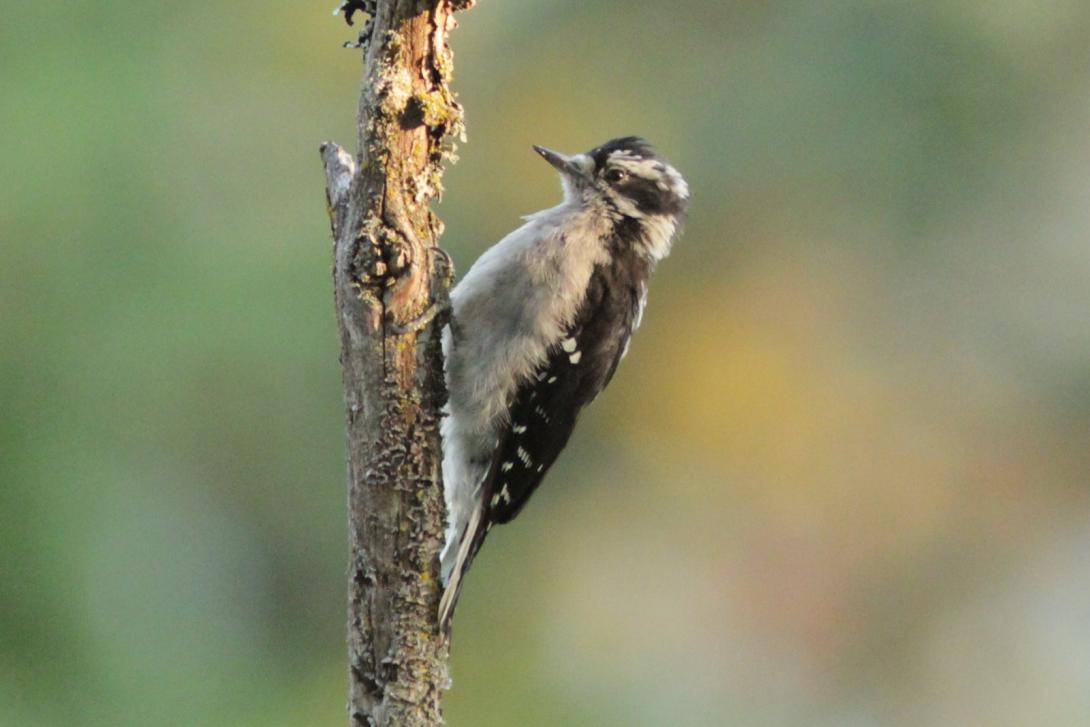
Taken by Steve Bennett at Willamette View on
.
Female Downy Woodpecker