
Great Egret
Ardea alba
The Great Egret is a stunning and iconic wading bird found across various wetland habitats in Oregon. They are highly conspicuous due to their large size and pristine white plumage. However, when it comes to distinguishing between males and females, it's generally very difficult in the field as they exhibit only minor sexual dimorphism.
General Appearance (Adults, Both Sexes):
Size and Shape: Great Egrets are large birds, standing about 37-41 inches (94-104 cm) tall with an impressive wingspan of 52-57 inches (131-145 cm). They have a long, S-curved neck, long black legs, and a long, dagger-like bill. They are somewhat smaller and more slender than a Great Blue Heron, but considerably larger than a Snowy Egret.
Plumage: They are entirely snowy white in all plumages. There are no color variations on their body feathers.
Legs and Feet: Their legs and feet are black.
Bill: Their bill is typically yellowish-orange.
Lore (Facial Skin): The patch of bare skin between the eye and the bill (the lores) is typically yellow in the non-breeding season.
Flight: In flight, they hold their long necks tucked into an S-curve and their long black legs extend far beyond their short tail, creating a very elegant silhouette.
Sexual Dimorphism (Subtle Differences):
Size: Males are generally slightly larger and heavier than females. While this is a consistent average difference (males averaging around 5.5 lbs, females around 4.7 lbs), it's rarely discernible when observing a single bird in the field due to individual variation and lack of a direct comparison.
Breeding Season Features (Both Sexes develop these, but can be slightly more pronounced in males):
Lores (Facial Skin): During the breeding season (typically beginning mid-April in Oregon), the lores undergo a dramatic color change, becoming a vibrant, brilliant lime-green. This striking green is a strong indicator of an adult in breeding condition, regardless of sex.
Breeding Plumes (Aigrettes): Both sexes grow magnificent, delicate, long, lacy plumes (known as "aigrettes") on their backs, which extend well beyond their tail. These plumes are fanned out during elaborate courtship displays. While both sexes possess these, some sources suggest males may develop slightly longer or more numerous plumes. These plumes were once highly prized for ladies' hats, leading to severe population declines in the late 19th and early 20th centuries before conservation efforts helped them recover.
Bill Color: While typically yellow, during the most intense part of courtship, the bill can sometimes show a more orange or even reddish tint, particularly in males, before fading back to yellow.
Juvenile Great Egrets:
Juvenile Great Egrets look similar to non-breeding adults, being entirely white with black legs. However, they lack the ornamental breeding plumes, and their bill is typically duller yellow, sometimes with a dark tip. Their lores will be yellow, not bright green.
Habitat and Behavior in Oregon:
Great Egrets are common throughout Oregon's wetlands, both freshwater and brackish, and are often seen in lakes, ponds, and slow-moving rivers, marshes and flooded fields, estuaries and tidal mudflats, coastal bays.
They are primarily diurnal foragers, hunting by standing motionless in shallow water or wading slowly, waiting to strike at fish, amphibians, reptiles, and large aquatic insects with their sharp bills. They often roost and nest communally in mixed-species colonies with other herons and cormorants, usually in trees or shrubs near water. While present year-round in some parts of Oregon (like the Klamath Basin), their numbers often increase during the breeding season.
General Appearance (Adults, Both Sexes):
Size and Shape: Great Egrets are large birds, standing about 37-41 inches (94-104 cm) tall with an impressive wingspan of 52-57 inches (131-145 cm). They have a long, S-curved neck, long black legs, and a long, dagger-like bill. They are somewhat smaller and more slender than a Great Blue Heron, but considerably larger than a Snowy Egret.
Plumage: They are entirely snowy white in all plumages. There are no color variations on their body feathers.
Legs and Feet: Their legs and feet are black.
Bill: Their bill is typically yellowish-orange.
Lore (Facial Skin): The patch of bare skin between the eye and the bill (the lores) is typically yellow in the non-breeding season.
Flight: In flight, they hold their long necks tucked into an S-curve and their long black legs extend far beyond their short tail, creating a very elegant silhouette.
Sexual Dimorphism (Subtle Differences):
Size: Males are generally slightly larger and heavier than females. While this is a consistent average difference (males averaging around 5.5 lbs, females around 4.7 lbs), it's rarely discernible when observing a single bird in the field due to individual variation and lack of a direct comparison.
Breeding Season Features (Both Sexes develop these, but can be slightly more pronounced in males):
Lores (Facial Skin): During the breeding season (typically beginning mid-April in Oregon), the lores undergo a dramatic color change, becoming a vibrant, brilliant lime-green. This striking green is a strong indicator of an adult in breeding condition, regardless of sex.
Breeding Plumes (Aigrettes): Both sexes grow magnificent, delicate, long, lacy plumes (known as "aigrettes") on their backs, which extend well beyond their tail. These plumes are fanned out during elaborate courtship displays. While both sexes possess these, some sources suggest males may develop slightly longer or more numerous plumes. These plumes were once highly prized for ladies' hats, leading to severe population declines in the late 19th and early 20th centuries before conservation efforts helped them recover.
Bill Color: While typically yellow, during the most intense part of courtship, the bill can sometimes show a more orange or even reddish tint, particularly in males, before fading back to yellow.
Juvenile Great Egrets:
Juvenile Great Egrets look similar to non-breeding adults, being entirely white with black legs. However, they lack the ornamental breeding plumes, and their bill is typically duller yellow, sometimes with a dark tip. Their lores will be yellow, not bright green.
Habitat and Behavior in Oregon:
Great Egrets are common throughout Oregon's wetlands, both freshwater and brackish, and are often seen in lakes, ponds, and slow-moving rivers, marshes and flooded fields, estuaries and tidal mudflats, coastal bays.
They are primarily diurnal foragers, hunting by standing motionless in shallow water or wading slowly, waiting to strike at fish, amphibians, reptiles, and large aquatic insects with their sharp bills. They often roost and nest communally in mixed-species colonies with other herons and cormorants, usually in trees or shrubs near water. While present year-round in some parts of Oregon (like the Klamath Basin), their numbers often increase during the breeding season.
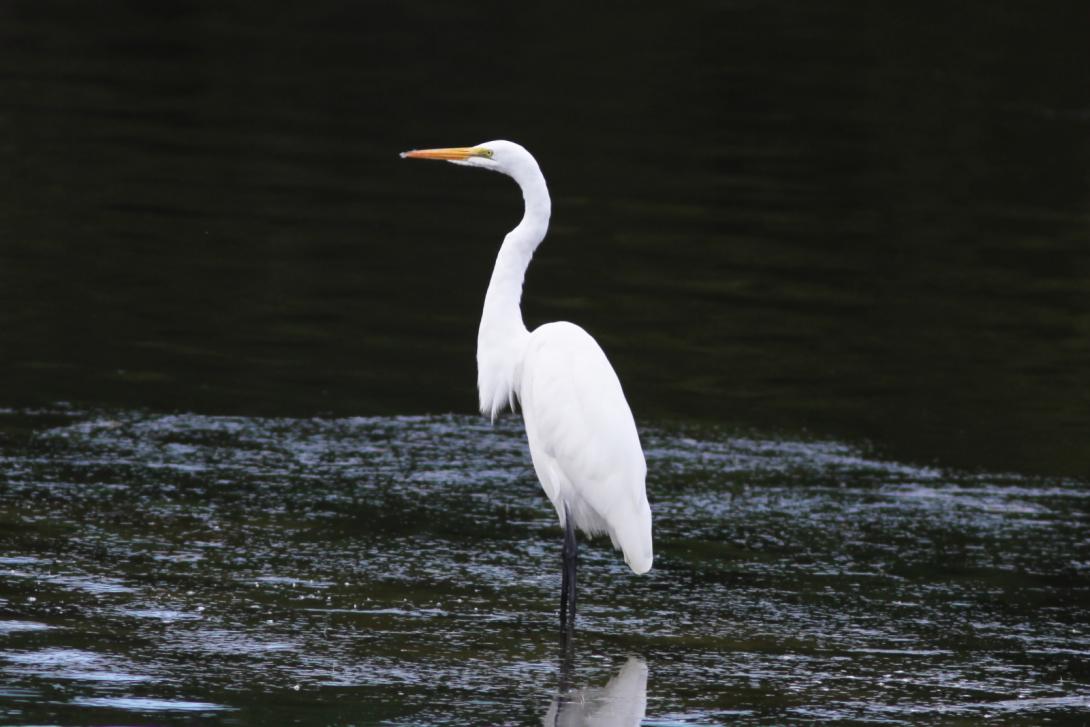
Taken by Steve Bennett at Pawley's Island, South Carolina on
.
Great Egret