
Hairy Woodpecker
Dryobates villosus
Hairy Woodpeckers are medium-sized woodpeckers commonly found throughout Oregon, particularly in mature forests, woodlands, and even larger suburban trees. They bear a strong resemblance to the smaller Downy Woodpecker, but a few key differences, especially in size and bill proportion, allow for differentiation. Like Downy Woodpeckers, the sexes are easily distinguished by a specific head marking.
General Appearance (Male and Female):
Size & Shape: Hairy Woodpeckers are significantly larger than Downy Woodpeckers, roughly the size of a robin. Their most distinguishing feature from a Downy is their proportionally long, chisel-tipped bill, which is about as long as their head. They have a stout body and stiff tail feathers that act as a prop when clinging to trees.
Plumage: Both sexes display a classic black and white "ladder-back" pattern on their wings and a clean white belly. Their head is striped with black and white: a white supercilium (stripe above the eye), a black eye-line, and a white stripe below the eye that extends down the neck.
Vocalization: They have a sharp, loud "peek!" call and a rapid, non-descending rattle or whinny. Their drumming is typically a loud, rapid roll.
Behavior: They forage by hitching up tree trunks and branches, primarily on larger trees, scaling off bark or excavating into wood to find insects. Their larger size and bill allow them to tackle bigger prey and tougher wood than Downy Woodpeckers.
Distinguishing Male and Female Hairy Woodpeckers in Oregon:
Similar to Downy Woodpeckers, the key to telling male and female Hairy Woodpeckers apart is a specific **red patch on the back of the head**.
1. Red Nape Patch:
Male Hairy Woodpeckers: Possess a small, bright red patch (or band) on the nape (the back of their head). This red patch is a clear and consistent marker for identifying the male.
Female Hairy Woodpeckers: Lack this red patch. The back of their head is entirely black, matching the black stripes on their head.
2. Size (Not a primary diagnostic for sexing):
Females are generally very slightly larger and heavier than males, but this difference is subtle and not reliably used for field identification of sex. The presence or absence of the red nape patch is the definitive visual cue.
General Appearance (Male and Female):
Size & Shape: Hairy Woodpeckers are significantly larger than Downy Woodpeckers, roughly the size of a robin. Their most distinguishing feature from a Downy is their proportionally long, chisel-tipped bill, which is about as long as their head. They have a stout body and stiff tail feathers that act as a prop when clinging to trees.
Plumage: Both sexes display a classic black and white "ladder-back" pattern on their wings and a clean white belly. Their head is striped with black and white: a white supercilium (stripe above the eye), a black eye-line, and a white stripe below the eye that extends down the neck.
Vocalization: They have a sharp, loud "peek!" call and a rapid, non-descending rattle or whinny. Their drumming is typically a loud, rapid roll.
Behavior: They forage by hitching up tree trunks and branches, primarily on larger trees, scaling off bark or excavating into wood to find insects. Their larger size and bill allow them to tackle bigger prey and tougher wood than Downy Woodpeckers.
Distinguishing Male and Female Hairy Woodpeckers in Oregon:
Similar to Downy Woodpeckers, the key to telling male and female Hairy Woodpeckers apart is a specific **red patch on the back of the head**.
1. Red Nape Patch:
Male Hairy Woodpeckers: Possess a small, bright red patch (or band) on the nape (the back of their head). This red patch is a clear and consistent marker for identifying the male.
Female Hairy Woodpeckers: Lack this red patch. The back of their head is entirely black, matching the black stripes on their head.
2. Size (Not a primary diagnostic for sexing):
Females are generally very slightly larger and heavier than males, but this difference is subtle and not reliably used for field identification of sex. The presence or absence of the red nape patch is the definitive visual cue.
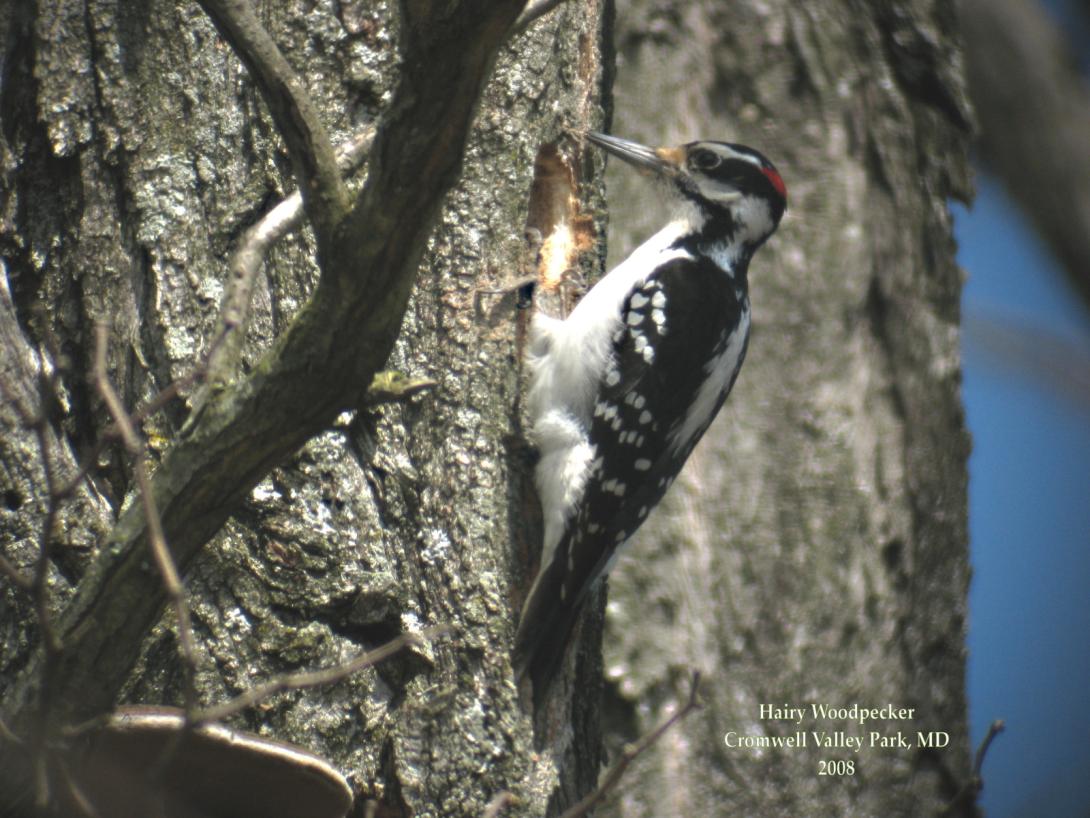
Taken by Steve Bennett at Cromwell Valley Park, Maryland on
.
Hairy Woodpecker
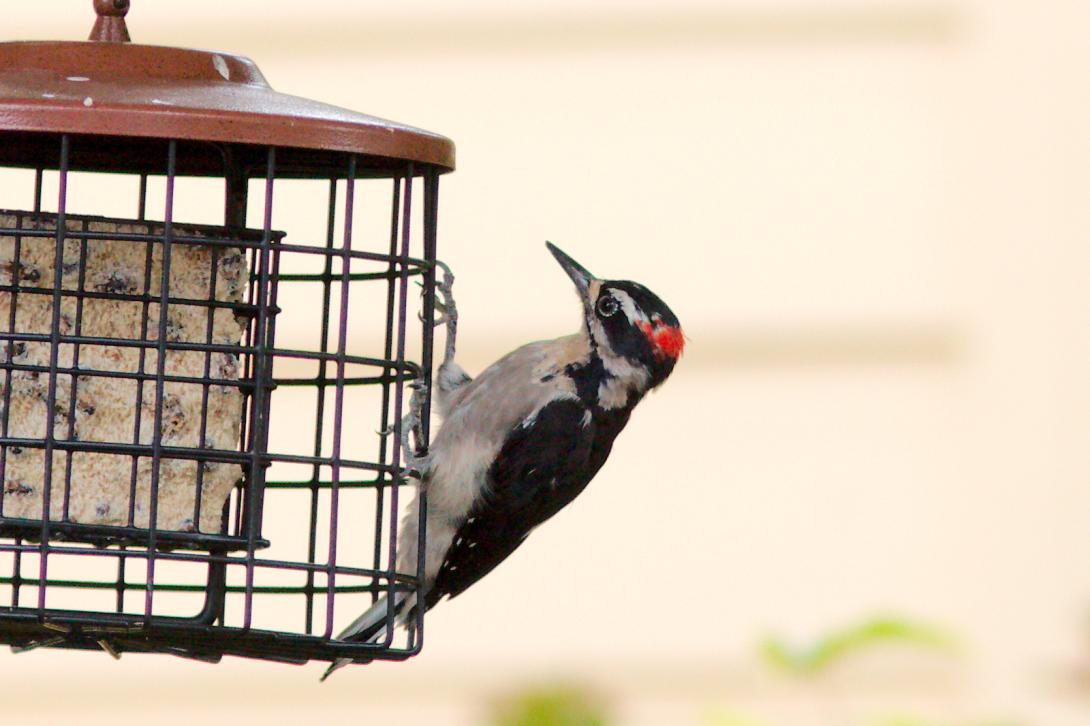
Taken by Steve Bennett at Willamette View on
.
Hairy Woodpecker