
Hermit Thrush
Catharus guttatus
The Hermit Thrush is a well-known forest bird in Oregon, recognized for its distinctive reddish tail and its exceptionally beautiful, flutelike song. Unlike some other bird species, male and female Hermit Thrushes are virtually identical in appearance, making visual sexing in the field extremely challenging for the average observer.
General Characteristics (Both Sexes):
Size and Shape: Hermit Thrushes are medium-sized songbirds, slightly smaller and more compact than an American Robin. They have a somewhat upright posture and a relatively short, straight bill.
Plumage:
Upperparts: The body (head, back, wings) is generally a rich brown or olive-brown.
Tail: A key diagnostic feature is their distinctly reddish or rufous tail, which contrasts with the browner back. This is often the first thing birders notice when identifying a Hermit Thrush, especially when it's seen flicking its tail.
Underparts: They have whitish underparts, with a creamy or buffy wash on the flanks. The breast is marked with dark, distinct spots, which become more smudged towards the belly.
Eye-ring: They possess a pale, relatively thin eye-ring that is often less bold or complete than the buffy eye-ring of the Swainson's Thrush.
Legs: Their legs are pinkish.
Behavior: Hermit Thrushes are often observed foraging on the forest floor, hopping through leaf litter and probing for insects. When perched, they frequently perform a characteristic "tail-cocking" behavior, where they slowly raise and then lower their reddish tail while sometimes flicking their wings.
Vocalization: Their song is one of the most celebrated in North America: a clear, ethereal, and melodic series of phrases, each typically starting with a single, clear note followed by a more complex, spiraling, or warbling phrase at a different pitch. It has a spiritual or contemplative quality. They also have a distinctive "chup" or "chuck" call note.
Habitat: In Oregon, they are found in coniferous and mixed forests, particularly at higher elevations during the breeding season. During migration and in winter, they can be found in a wider variety of wooded habitats, including more open woodlands and suburban areas with dense shrubs. They are more cold-tolerant than other spot-breasted thrushes and are the only one likely to be seen in the U.S. during winter.
Distinguishing Male and Female Hermit Thrushes in Oregon:
Visually, male and female Hermit Thrushes are so similar that it is almost impossible to tell them apart in the field based on plumage, size, or shape.
Appearance: Both sexes share the same coloration, reddish tail, and spotted breast pattern. While males might be marginally larger on average, this difference is too slight to be reliably used for identification by observation.
Behavioral Cues (most reliable):
Song: The **male Hermit Thrush is the primary singer**, especially during the breeding season (spring and summer). If you hear the iconic, flutelike song, it's almost certainly a male. Males sing to establish and defend territories and to attract mates. They often sing from a prominent perch.
Territoriality: Males arrive on breeding grounds earlier than females to establish and defend nesting territories.
Nest Building: The female alone builds the nest, which is a bulky, cup-shaped structure made of grasses, leaves, moss, and twigs, often placed on the ground in a natural depression or in a small conifer tree (more common in western populations, including Oregon) a few feet off the ground.
Incubation: Only the female incubates the eggs.
Parental Care: Both parents participate in feeding the nestlings after they hatch. The male often gathers most of the food for the young, while the female feeds it to them.
General Characteristics (Both Sexes):
Size and Shape: Hermit Thrushes are medium-sized songbirds, slightly smaller and more compact than an American Robin. They have a somewhat upright posture and a relatively short, straight bill.
Plumage:
Upperparts: The body (head, back, wings) is generally a rich brown or olive-brown.
Tail: A key diagnostic feature is their distinctly reddish or rufous tail, which contrasts with the browner back. This is often the first thing birders notice when identifying a Hermit Thrush, especially when it's seen flicking its tail.
Underparts: They have whitish underparts, with a creamy or buffy wash on the flanks. The breast is marked with dark, distinct spots, which become more smudged towards the belly.
Eye-ring: They possess a pale, relatively thin eye-ring that is often less bold or complete than the buffy eye-ring of the Swainson's Thrush.
Legs: Their legs are pinkish.
Behavior: Hermit Thrushes are often observed foraging on the forest floor, hopping through leaf litter and probing for insects. When perched, they frequently perform a characteristic "tail-cocking" behavior, where they slowly raise and then lower their reddish tail while sometimes flicking their wings.
Vocalization: Their song is one of the most celebrated in North America: a clear, ethereal, and melodic series of phrases, each typically starting with a single, clear note followed by a more complex, spiraling, or warbling phrase at a different pitch. It has a spiritual or contemplative quality. They also have a distinctive "chup" or "chuck" call note.
Habitat: In Oregon, they are found in coniferous and mixed forests, particularly at higher elevations during the breeding season. During migration and in winter, they can be found in a wider variety of wooded habitats, including more open woodlands and suburban areas with dense shrubs. They are more cold-tolerant than other spot-breasted thrushes and are the only one likely to be seen in the U.S. during winter.
Distinguishing Male and Female Hermit Thrushes in Oregon:
Visually, male and female Hermit Thrushes are so similar that it is almost impossible to tell them apart in the field based on plumage, size, or shape.
Appearance: Both sexes share the same coloration, reddish tail, and spotted breast pattern. While males might be marginally larger on average, this difference is too slight to be reliably used for identification by observation.
Behavioral Cues (most reliable):
Song: The **male Hermit Thrush is the primary singer**, especially during the breeding season (spring and summer). If you hear the iconic, flutelike song, it's almost certainly a male. Males sing to establish and defend territories and to attract mates. They often sing from a prominent perch.
Territoriality: Males arrive on breeding grounds earlier than females to establish and defend nesting territories.
Nest Building: The female alone builds the nest, which is a bulky, cup-shaped structure made of grasses, leaves, moss, and twigs, often placed on the ground in a natural depression or in a small conifer tree (more common in western populations, including Oregon) a few feet off the ground.
Incubation: Only the female incubates the eggs.
Parental Care: Both parents participate in feeding the nestlings after they hatch. The male often gathers most of the food for the young, while the female feeds it to them.
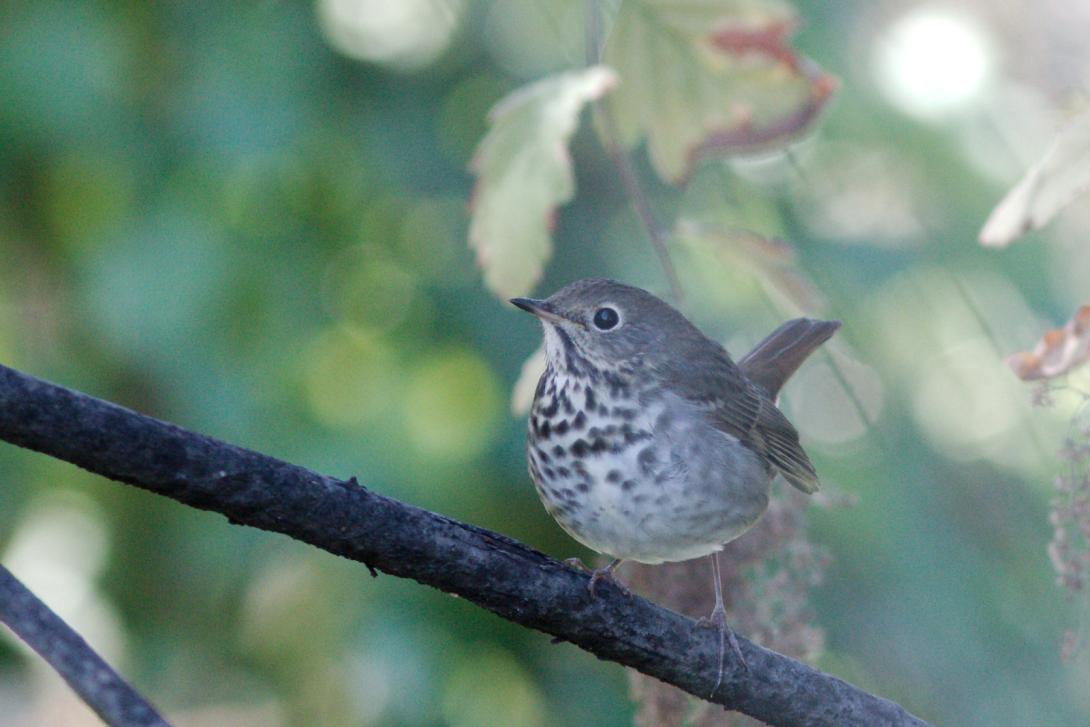
Taken by Steve Bennett at Willamette View on
.
Hermit Thrush
Taken by Steve Bennett at Willamette View on
.
Hermit Thrush