
Least Sandpiper
Calidris minutilla
The Least Sandpiper is the smallest shorebird in the world, often referred to as a "peep." In Oregon, they are a common migrant and can even be found locally common along the coast in winter.
Overall Characteristics of Least Sandpipers:
Size: Very small, about the size of a sparrow (5-6 inches long, 0.7-1.1 oz).
Legs: Key identifying feature – dull yellowish-green legs. Be aware that mud can sometimes obscure this color, making them appear darker.
Bill: Short, thin, and slightly decurved (drooping) at the tip, black in color.
Posture: Often seen with a hunched, "mouse-like" posture, walking slowly and picking food from the surface of the mud or vegetation.
Habitat in Oregon: They prefer muddier habitats, often at the edges of mudflats, salt marshes, tidal creeks, and even small, shallow inland ponds. They tend to feed on slightly drier, higher ground than some other small sandpipers.
Flight: In flight, they show a white stripe down their wing and white on either side of their tail, bisected by a dark central line on the rump.
Plumage - Similar for Male and Female, but varies by age/season:
1. Breeding Plumage (seen in Oregon during spring migration, late summer adults):
Upperparts: Brownish with dark brown streaks and a "scaly" appearance due to neat buffy or rufous edges on the feathers.
Underparts: White, with a distinct brown, streaky "bib" or band across the upper breast that sharply contrasts with the clean white belly.
Head: Dark crown, with a light line (supercilium) above the eye.
2. Non-breeding (Winter) Plumage (seen in Oregon during fall migration and winter):
Overall: Duller and grayer-brown above, with less prominent streaking and a more smudgy brown breast. The "scaly" pattern is less pronounced.
Underparts: White, with a paler, less defined breast band compared to breeding plumage.
3. Juvenile Plumage (most commonly seen in Oregon during fall migration, August-September):
Upperparts: Brighter and more rufous (rusty-colored) than adults, with crisp, buffy or whitish edges to their blackish-brown back and wing feathers. This creates a striking "scaly" or "spangled" look.
Breast: A distinct buffy breast band with blurry streaking, similar to adults but often with a warmer tone.
Overall Impression: Very fresh and neat appearance. Juveniles often show two parallel "V" marks on their back created by the pale margins of their scapular feathers.
Distinguishing Male from Female:
Like many small shorebirds, Least Sandpipers are **monomorphic**, meaning males and females have very similar plumages. There are no obvious visual differences in their feather patterns or coloration that allow for reliable sex identification in the field.
However, there can be a slight difference in size:
Females are generally slightly larger than males, and may have a slightly longer bill. These differences are subtle and usually not discernible in the field unless you have a pair standing directly next to each other for comparison, and even then, individual variation can make it tricky.
For field identification in Oregon, focus on the overall size, yellowish legs, slightly decurved bill, and the characteristic plumage patterns for the age (juvenile vs. adult) and season (breeding vs. non-breeding).
Overall Characteristics of Least Sandpipers:
Size: Very small, about the size of a sparrow (5-6 inches long, 0.7-1.1 oz).
Legs: Key identifying feature – dull yellowish-green legs. Be aware that mud can sometimes obscure this color, making them appear darker.
Bill: Short, thin, and slightly decurved (drooping) at the tip, black in color.
Posture: Often seen with a hunched, "mouse-like" posture, walking slowly and picking food from the surface of the mud or vegetation.
Habitat in Oregon: They prefer muddier habitats, often at the edges of mudflats, salt marshes, tidal creeks, and even small, shallow inland ponds. They tend to feed on slightly drier, higher ground than some other small sandpipers.
Flight: In flight, they show a white stripe down their wing and white on either side of their tail, bisected by a dark central line on the rump.
Plumage - Similar for Male and Female, but varies by age/season:
1. Breeding Plumage (seen in Oregon during spring migration, late summer adults):
Upperparts: Brownish with dark brown streaks and a "scaly" appearance due to neat buffy or rufous edges on the feathers.
Underparts: White, with a distinct brown, streaky "bib" or band across the upper breast that sharply contrasts with the clean white belly.
Head: Dark crown, with a light line (supercilium) above the eye.
2. Non-breeding (Winter) Plumage (seen in Oregon during fall migration and winter):
Overall: Duller and grayer-brown above, with less prominent streaking and a more smudgy brown breast. The "scaly" pattern is less pronounced.
Underparts: White, with a paler, less defined breast band compared to breeding plumage.
3. Juvenile Plumage (most commonly seen in Oregon during fall migration, August-September):
Upperparts: Brighter and more rufous (rusty-colored) than adults, with crisp, buffy or whitish edges to their blackish-brown back and wing feathers. This creates a striking "scaly" or "spangled" look.
Breast: A distinct buffy breast band with blurry streaking, similar to adults but often with a warmer tone.
Overall Impression: Very fresh and neat appearance. Juveniles often show two parallel "V" marks on their back created by the pale margins of their scapular feathers.
Distinguishing Male from Female:
Like many small shorebirds, Least Sandpipers are **monomorphic**, meaning males and females have very similar plumages. There are no obvious visual differences in their feather patterns or coloration that allow for reliable sex identification in the field.
However, there can be a slight difference in size:
Females are generally slightly larger than males, and may have a slightly longer bill. These differences are subtle and usually not discernible in the field unless you have a pair standing directly next to each other for comparison, and even then, individual variation can make it tricky.
For field identification in Oregon, focus on the overall size, yellowish legs, slightly decurved bill, and the characteristic plumage patterns for the age (juvenile vs. adult) and season (breeding vs. non-breeding).
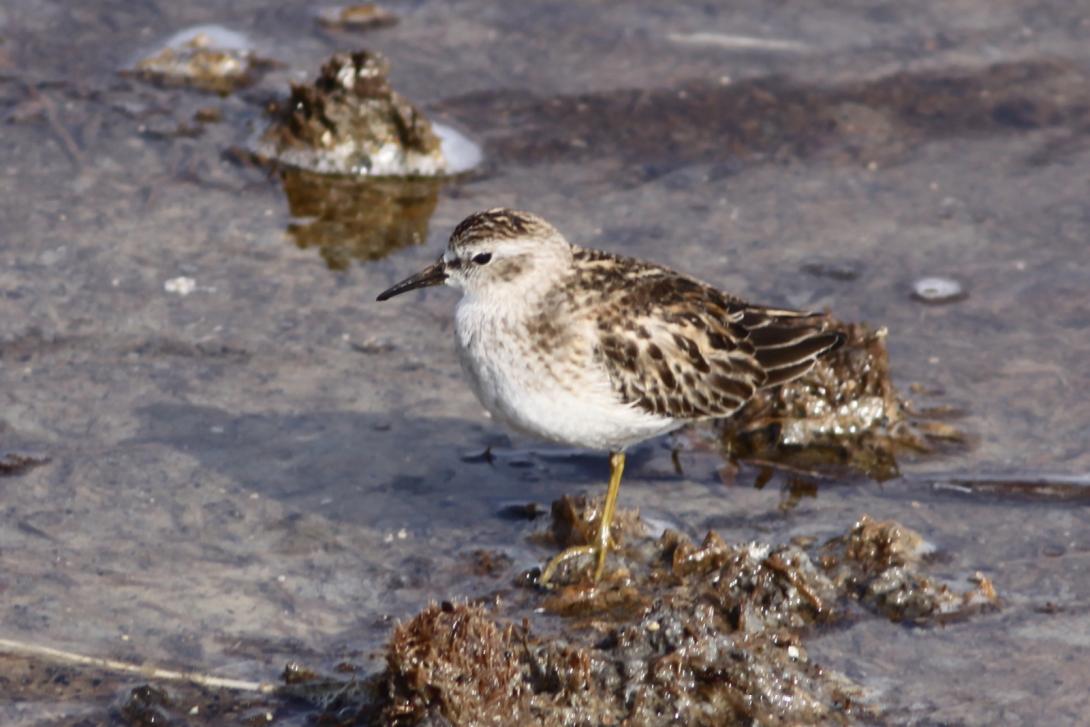
Taken by Steve Bennett at Pawley's Island, South Carolina on
.
Least Sandpiper