
MacGillivray’s Warbler
Geothlypis tolmiei
MacGillivray's Warblers are common summer residents in Oregon, frequently found in dense, shrubby habitats, particularly in riparian areas, clear-cuts, and regenerating forests. They are often described as "skulking" birds, difficult to observe clearly as they forage low in thick vegetation, but their distinctive song can often give them away. They are closely related to the Mourning Warbler of the eastern US.
Male MacGillivray's Warblers in Oregon:
Head: The most striking feature is their dark, sooty gray hood, which extends from the head down to the upper breast. This gray is typically darkest on the face and throat, sometimes appearing almost blackish around the eye and on the upper chest.
Eye-ring: They have prominent, broken white crescents (arcs) above and below each eye. These white crescents are a key distinguishing feature and give the bird a distinctive "spectacled" look.
Lores: The area between the eye and the bill (lores) is often darker, sometimes blackish, blending into the gray hood.
Underparts: The rest of the underparts, from the breast down to the undertail coverts, are a bright, rich yellow.
Upperparts: The back, wings, and tail are a relatively plain olive-green. They lack wing bars.
Bill: A thin, pointed, and relatively stout bill, dark on top and paler on the bottom.
Tail: They often exhibit a habit of flicking their tail from side to side as they forage, similar to Nashville Warblers.
Song: Males have a loud, hurried song, often described as a series of "wichety" phrases that rise and fall.
Female MacGillivray's Warblers in Oregon:
Overall Color: Females are duller than males, particularly in their head and throat coloration.
Head: The "hood" is a lighter, paler gray compared to the male's dark gray. It may also be less extensive, often appearing more as a grayish wash on the head and throat rather than a distinct hood.
Eye-ring: The white crescents above and below the eye are still present and are a good identification feature, though they may be slightly less crisp than on the male.
Underparts: The underparts are still yellow, but often a duller or paler yellow compared to the male's vibrant hue.
Upperparts: Similar olive-green back and wings as the male, but again, often a duller shade.
Bill: Similar in shape to the male's.
Tail Flicking: Females also exhibit the tail-flicking behavior.
Key Identification Points for both sexes in Oregon:
Gray Hood + Yellow Underparts + White Eye Crescents: This combination is diagnostic for MacGillivray's Warblers.
No Wing Bars: This helps differentiate them from many other warbler species.
Habitat and Behavior: They are typically found low in dense, wet thickets, often difficult to get a clear view of as they forage in the understory. Listen for their distinctive song.
Distinguishing from Mourning Warbler: While very similar, MacGillivray's Warblers consistently have the prominent white eye crescents, which the Mourning Warbler typically lacks.
MacGillivray's Warblers are primarily insectivorous, gleaning insects from foliage and the ground. They build well-concealed, cup-shaped nests in dense shrubs, often low to the ground. They are a beloved species for birders in Oregon, despite their secretive nature.
Male MacGillivray's Warblers in Oregon:
Head: The most striking feature is their dark, sooty gray hood, which extends from the head down to the upper breast. This gray is typically darkest on the face and throat, sometimes appearing almost blackish around the eye and on the upper chest.
Eye-ring: They have prominent, broken white crescents (arcs) above and below each eye. These white crescents are a key distinguishing feature and give the bird a distinctive "spectacled" look.
Lores: The area between the eye and the bill (lores) is often darker, sometimes blackish, blending into the gray hood.
Underparts: The rest of the underparts, from the breast down to the undertail coverts, are a bright, rich yellow.
Upperparts: The back, wings, and tail are a relatively plain olive-green. They lack wing bars.
Bill: A thin, pointed, and relatively stout bill, dark on top and paler on the bottom.
Tail: They often exhibit a habit of flicking their tail from side to side as they forage, similar to Nashville Warblers.
Song: Males have a loud, hurried song, often described as a series of "wichety" phrases that rise and fall.
Female MacGillivray's Warblers in Oregon:
Overall Color: Females are duller than males, particularly in their head and throat coloration.
Head: The "hood" is a lighter, paler gray compared to the male's dark gray. It may also be less extensive, often appearing more as a grayish wash on the head and throat rather than a distinct hood.
Eye-ring: The white crescents above and below the eye are still present and are a good identification feature, though they may be slightly less crisp than on the male.
Underparts: The underparts are still yellow, but often a duller or paler yellow compared to the male's vibrant hue.
Upperparts: Similar olive-green back and wings as the male, but again, often a duller shade.
Bill: Similar in shape to the male's.
Tail Flicking: Females also exhibit the tail-flicking behavior.
Key Identification Points for both sexes in Oregon:
Gray Hood + Yellow Underparts + White Eye Crescents: This combination is diagnostic for MacGillivray's Warblers.
No Wing Bars: This helps differentiate them from many other warbler species.
Habitat and Behavior: They are typically found low in dense, wet thickets, often difficult to get a clear view of as they forage in the understory. Listen for their distinctive song.
Distinguishing from Mourning Warbler: While very similar, MacGillivray's Warblers consistently have the prominent white eye crescents, which the Mourning Warbler typically lacks.
MacGillivray's Warblers are primarily insectivorous, gleaning insects from foliage and the ground. They build well-concealed, cup-shaped nests in dense shrubs, often low to the ground. They are a beloved species for birders in Oregon, despite their secretive nature.
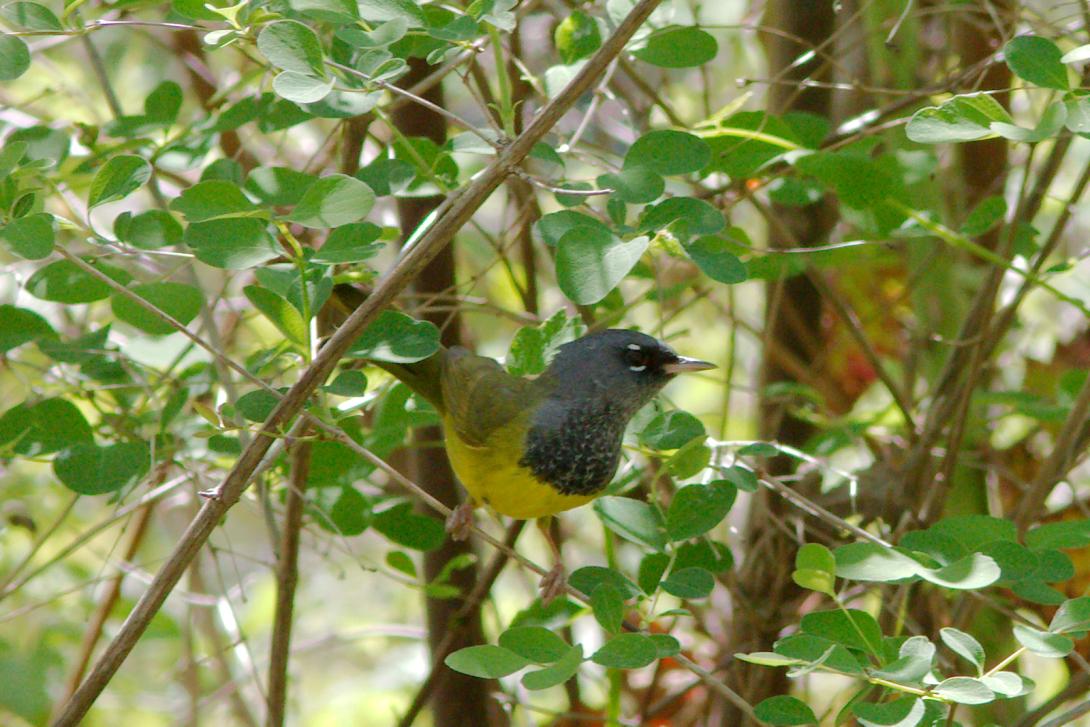
Taken by Steve Bennett at Mount Talbert, Oregon on
.
MacGillivray’s Warbler