
Osprey
Pandion haliaetus
Ospreys are magnificent fish-eating raptors that are a common sight in Oregon, particularly from spring through early fall. They are highly specialized predators with a distinctive appearance. While visually similar, there are some subtle differences that can help distinguish between males and females, especially when observing a pair.
General Appearance (Adults, Both Sexes):
Size and Shape: Ospreys are large birds of prey, with a body length of about 21-23 inches (54-58 cm) and an impressive wingspan of 59-71 inches (150-180 cm). They have a slender body, long, narrow wings, and long legs. In flight, their wings have a distinctive "M-shape" or a marked kink, with bowed wings and drooping "hands" (primaries).
Plumage: They are primarily dark brown above and white below.
Head: Their head is white with a prominent **broad brown or black stripe** that extends through the eye.
Underparts: The underparts are mostly white, with a variable brown band across the breast.
Underwings: The underwings are mostly white with a distinct dark patch at the "wrists" (carpal joint).
Eyes: Adult Ospreys have intense golden-yellow eyes, which stand out against their dark eye stripe.
Bill: Their bill is dark, hooked, and powerful, adapted for grasping slippery fish.
Feet: Their feet are large, with barbed pads on the soles and reversible outer toes, providing an excellent grip on fish. Their talons are long, curved, and very sharp.
Sexual Dimorphism (Subtle Differences):
Size and Build: This is one of the more reliable indicators, especially when a pair is together:
Females are typically larger and have a fuller, bulkier build than males. They may also appear to have slightly broader wings in flight.
Males are generally slimmer and might appear more streamlined.
Chest Band ("Necklace"): This is often considered the best visual cue:
Females tend to have a more pronounced, darker, and often speckled brown band (or "necklace") across their chest. This band can be quite distinct.
Males usually have a much lighter chest band, which can be very faint, broken, or even entirely absent, resulting in a cleaner, whiter chest.
Crown Streaking: While variable, some individuals may have slight brown streaking on the top of the head (the crown). Males often have cleaner crowns, while females might show more faint mottling.
Behavior (During Breeding Season):
During incubation and the early chick-rearing period (typically late April through July in Oregon), the female spends more time at the nest.
The male is more often seen flying and delivering fish to the female and chicks. The male will also perform "sky-dance" courtship displays, flying high over the nest with a fish or nesting material and giving loud calls.
Males will also have "resting perches" near the nest where they will eat part of a fish before bringing the rest back to the female and chicks.
Juvenile Ospreys:
Juvenile Ospreys have distinct features:
Their eyes are orange or reddish, rather than the bright yellow of adults.
Their upperpart feathers (back and wings) have pale, buffy tips, giving them a scalloped or speckled appearance.
The buffy wash may also extend to their underparts.
The barring on their underwings and flight feathers can also be a good indicator.
Habitat and Behavior in Oregon:
Ospreys are migratory birds, arriving in Oregon in late March or early April for their breeding season and typically departing south for wintering grounds (e.g., Mexico) by September. They are found throughout Oregon wherever there are suitable bodies of water for fishing, including: lakes, rivers, and reservoirs (especially those with abundant fish), estuaries and coastal areas, ponds and large wetlands.
They build large, bulky stick nests, often on tall structures like dead trees, utility poles, communication towers, or dedicated nesting platforms. Their hunting method is distinctive: they fly over water, often hovering briefly, then plunge feet-first into the water to snatch fish with their powerful talons. They typically carry the fish head-first back to a perch or the nest.
General Appearance (Adults, Both Sexes):
Size and Shape: Ospreys are large birds of prey, with a body length of about 21-23 inches (54-58 cm) and an impressive wingspan of 59-71 inches (150-180 cm). They have a slender body, long, narrow wings, and long legs. In flight, their wings have a distinctive "M-shape" or a marked kink, with bowed wings and drooping "hands" (primaries).
Plumage: They are primarily dark brown above and white below.
Head: Their head is white with a prominent **broad brown or black stripe** that extends through the eye.
Underparts: The underparts are mostly white, with a variable brown band across the breast.
Underwings: The underwings are mostly white with a distinct dark patch at the "wrists" (carpal joint).
Eyes: Adult Ospreys have intense golden-yellow eyes, which stand out against their dark eye stripe.
Bill: Their bill is dark, hooked, and powerful, adapted for grasping slippery fish.
Feet: Their feet are large, with barbed pads on the soles and reversible outer toes, providing an excellent grip on fish. Their talons are long, curved, and very sharp.
Sexual Dimorphism (Subtle Differences):
Size and Build: This is one of the more reliable indicators, especially when a pair is together:
Females are typically larger and have a fuller, bulkier build than males. They may also appear to have slightly broader wings in flight.
Males are generally slimmer and might appear more streamlined.
Chest Band ("Necklace"): This is often considered the best visual cue:
Females tend to have a more pronounced, darker, and often speckled brown band (or "necklace") across their chest. This band can be quite distinct.
Males usually have a much lighter chest band, which can be very faint, broken, or even entirely absent, resulting in a cleaner, whiter chest.
Crown Streaking: While variable, some individuals may have slight brown streaking on the top of the head (the crown). Males often have cleaner crowns, while females might show more faint mottling.
Behavior (During Breeding Season):
During incubation and the early chick-rearing period (typically late April through July in Oregon), the female spends more time at the nest.
The male is more often seen flying and delivering fish to the female and chicks. The male will also perform "sky-dance" courtship displays, flying high over the nest with a fish or nesting material and giving loud calls.
Males will also have "resting perches" near the nest where they will eat part of a fish before bringing the rest back to the female and chicks.
Juvenile Ospreys:
Juvenile Ospreys have distinct features:
Their eyes are orange or reddish, rather than the bright yellow of adults.
Their upperpart feathers (back and wings) have pale, buffy tips, giving them a scalloped or speckled appearance.
The buffy wash may also extend to their underparts.
The barring on their underwings and flight feathers can also be a good indicator.
Habitat and Behavior in Oregon:
Ospreys are migratory birds, arriving in Oregon in late March or early April for their breeding season and typically departing south for wintering grounds (e.g., Mexico) by September. They are found throughout Oregon wherever there are suitable bodies of water for fishing, including: lakes, rivers, and reservoirs (especially those with abundant fish), estuaries and coastal areas, ponds and large wetlands.
They build large, bulky stick nests, often on tall structures like dead trees, utility poles, communication towers, or dedicated nesting platforms. Their hunting method is distinctive: they fly over water, often hovering briefly, then plunge feet-first into the water to snatch fish with their powerful talons. They typically carry the fish head-first back to a perch or the nest.
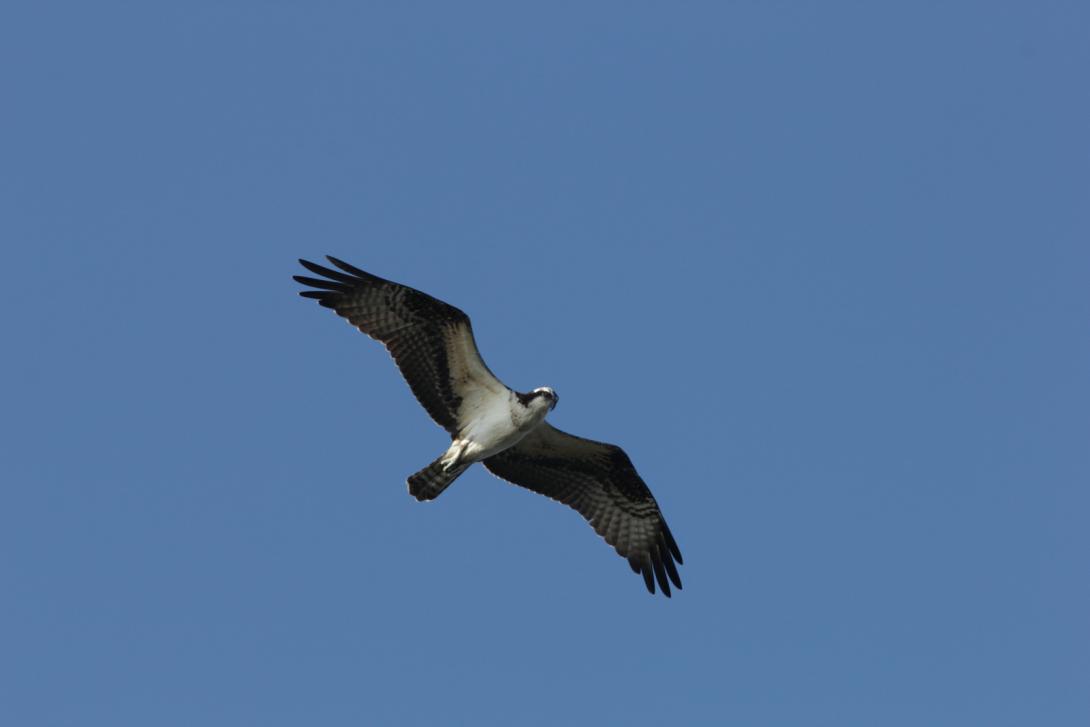
Taken by Steve Bennett at Pawley's Island, South Carolina on
.
Osprey