
Red-tailed Hawk
Buteo jamaicensis
Red-tailed Hawks are common and easily recognizable raptors found throughout Oregon. While males and females generally look very similar in plumage, there are some key differences, primarily in size and certain behaviors, that can help distinguish them.
General Appearance (Male and Female):
Size: Red-tailed Hawks are large, stocky hawks with broad, rounded wings and a relatively short, wide tail. They are among the largest *Buteo* hawks in North America.
Plumage: Both sexes typically have a rich brown back and pale underparts with a "belly band" of dark streaks. They often have dark markings on the leading edge of their underwings, visible in flight.
Tail: The most distinctive feature of adult Red-tailed Hawks is their brick-red tail, which is uniformly red on top and light buff-orange below. However, juvenile birds (both male and female) do not have this red tail, instead having a brown, barred tail. The red tail develops after their first molt.
Color Morphs: Red-tailed Hawks exhibit a wide variety of plumage variations, including light, "normal," reddish, and dark morphs. Both sexes can appear in these different morphs, making identification based solely on color challenging.
Distinguishing Male and Female Red-tailed Hawks in Oregon:
The most reliable way to differentiate between male and female Red-tailed Hawks is by size, though this is most apparent when a pair is seen together.
Size:
Females are generally larger and heavier than males, often by about 10-25%.
Male Red-tailed Hawks in Oregon might typically measure 18-24 inches (45-60 cm) in length, weigh 1.7-2.4 pounds (690-1300 g), and have a wingspan of around 45-52 inches (114-133 cm).
Female Red-tailed Hawks are larger, with lengths typically ranging from 19-26 inches (48-65 cm), weights from 2.0-3.1 pounds (900-1460 g), and wingspans similar to males, around 45-52 inches (114-133 cm).
While there's overlap, if you see a pair, the female will almost always be noticeably bulkier.
Behavioral Differences (especially during breeding season):
During courtship, males are known for their acrobatic aerial displays, including steep dives and barrel rolls, as a way to advertise territory.
During nesting, females are primarily responsible for incubating eggs and caring for offspring, while males typically provide food for the female and young.
Observing these roles can help differentiate the sexes, particularly when a pair is actively breeding.
General Appearance (Male and Female):
Size: Red-tailed Hawks are large, stocky hawks with broad, rounded wings and a relatively short, wide tail. They are among the largest *Buteo* hawks in North America.
Plumage: Both sexes typically have a rich brown back and pale underparts with a "belly band" of dark streaks. They often have dark markings on the leading edge of their underwings, visible in flight.
Tail: The most distinctive feature of adult Red-tailed Hawks is their brick-red tail, which is uniformly red on top and light buff-orange below. However, juvenile birds (both male and female) do not have this red tail, instead having a brown, barred tail. The red tail develops after their first molt.
Color Morphs: Red-tailed Hawks exhibit a wide variety of plumage variations, including light, "normal," reddish, and dark morphs. Both sexes can appear in these different morphs, making identification based solely on color challenging.
Distinguishing Male and Female Red-tailed Hawks in Oregon:
The most reliable way to differentiate between male and female Red-tailed Hawks is by size, though this is most apparent when a pair is seen together.
Size:
Females are generally larger and heavier than males, often by about 10-25%.
Male Red-tailed Hawks in Oregon might typically measure 18-24 inches (45-60 cm) in length, weigh 1.7-2.4 pounds (690-1300 g), and have a wingspan of around 45-52 inches (114-133 cm).
Female Red-tailed Hawks are larger, with lengths typically ranging from 19-26 inches (48-65 cm), weights from 2.0-3.1 pounds (900-1460 g), and wingspans similar to males, around 45-52 inches (114-133 cm).
While there's overlap, if you see a pair, the female will almost always be noticeably bulkier.
Behavioral Differences (especially during breeding season):
During courtship, males are known for their acrobatic aerial displays, including steep dives and barrel rolls, as a way to advertise territory.
During nesting, females are primarily responsible for incubating eggs and caring for offspring, while males typically provide food for the female and young.
Observing these roles can help differentiate the sexes, particularly when a pair is actively breeding.
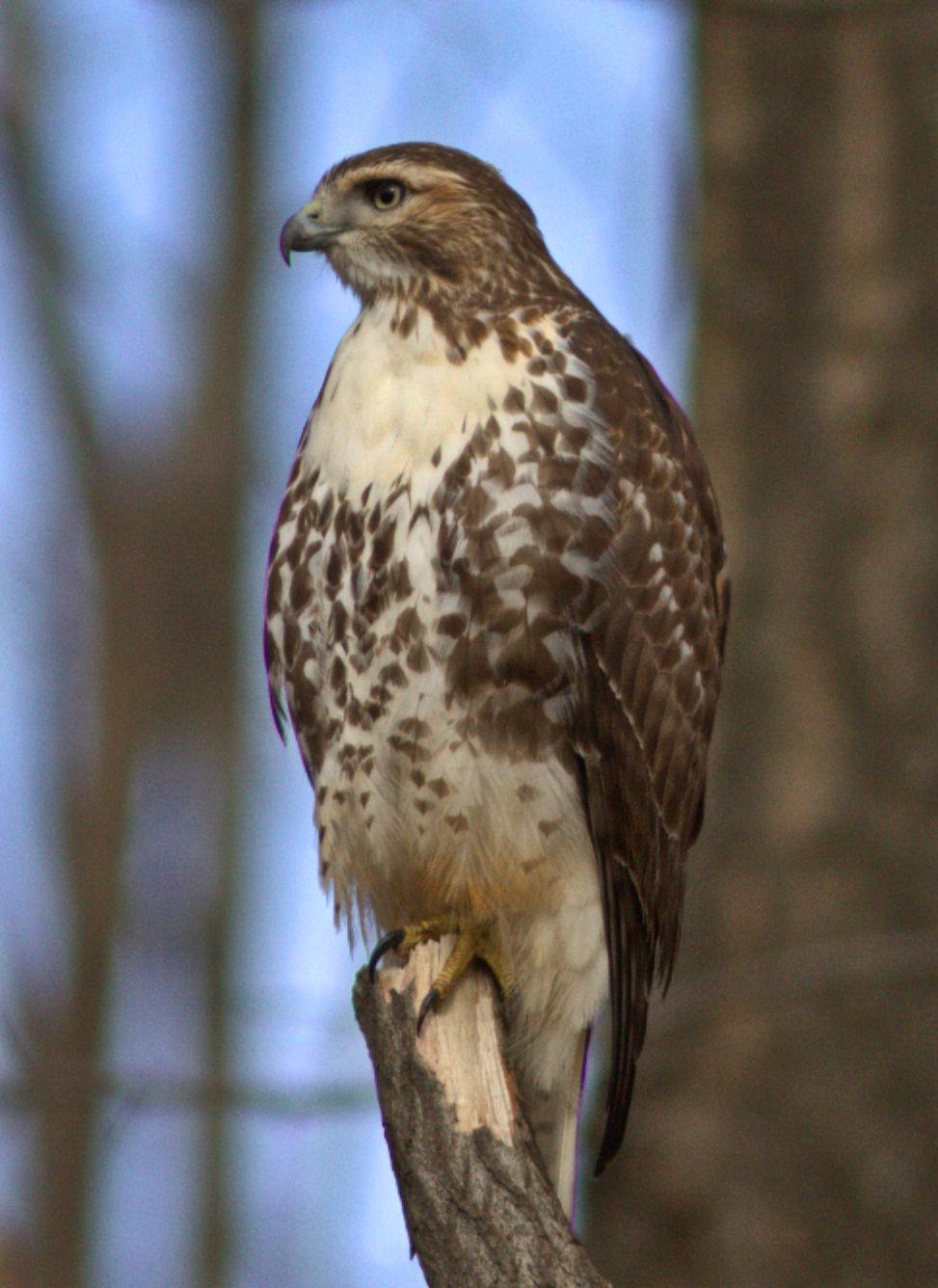
Taken by Steve Bennett at Soldier's Delight, Maryland on
.
Juvenal Red-tailed Hawk
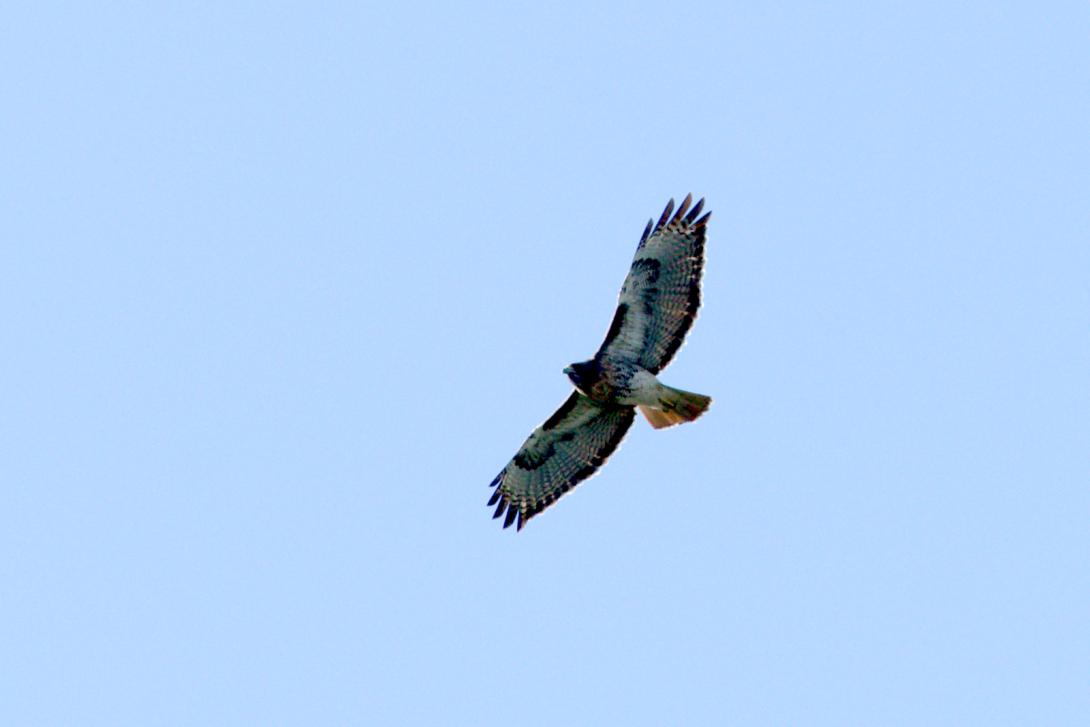
Taken by Steve Bennett at Willamette View on
.
Adult Red-tailed Hawk