
Ring-billed Gull
Larus delawarensis
The Ring-billed Gull is one of the most common and widespread gulls in Oregon, found in a wide variety of habitats from coastal areas to inland lakes, rivers, agricultural fields, and even urban environments like parking lots and landfills. They are a medium-sized gull, larger than Bonaparte's or Short-billed Gulls, but smaller than Herring or Western Gulls.
Overall Characteristics of Ring-billed Gulls:
Size & Build: A medium-sized gull with a fairly stout body. They have a round head and a medium-length bill. Their wings are long and pointed, extending beyond the tail when at rest.
Bill Their most distinctive feature in adults is the **yellow bill with a prominent, sharply defined black ring** encircling it near the tip. Immature birds will have a different bill pattern.
Legs: Yellow in adults, turning pinkish in immatures.
Eyes: Pale yellow in adults.
Flight: Strong, agile flyers, often seen soaring or foraging in large flocks. In flight, their upperwing is pale gray, with black wingtips that have distinct white "mirrors" (spots) on the outer primaries. The trailing edge of the wing is white.
Voice: A series of loud, high-pitched "kyow" or "ha-ha-ha" calls, a bit more strident than the "mew" of a Short-billed Gull.
Plumage - Very Similar for Male and Female, but varies significantly by age and season:
1. Breeding (Alternate) Plumage (Adult, seen in Oregon from early spring through late summer):
Head: Pure white head and neck.
Body: Pale gray back and upperwings (mantle), clean white underparts.
Bill: Bright yellow with a clear, neat black ring.
Legs: Bright yellow.
Eyes: Pale yellow iris with a thin reddish orbital (eye) ring, though this ring can be subtle.
2. Non-breeding (Basic) Plumage (Adult, most common in Oregon from late summer through winter):
Head: White head and neck, but with **variable amounts of dusky brown streaking or mottling** on the crown, nape, and sometimes around the eye. This streaking can range from very light to quite dense.
Body: Pale gray back and upperwings, white underparts, similar to breeding plumage.
Bill: Duller yellow, and the black ring may appear less sharp or slightly smudgy.
Legs: Duller yellow.
Eyes: Pale yellow iris with a dusky or grayish orbital ring.
3. First-Winter Plumage (Immature, very common in Oregon during fall and winter):
Ring-billed Gulls take two to three years to reach full adult plumage. First-winter birds are quite different from adults.
Overall: A mottled appearance with a mix of brown, gray, and white feathers.
Upperparts: Back and wing coverts are brownish with pale edges, giving a somewhat scaly or dusky appearance.
Wings: Show a prominent **dark brown or blackish "carpal bar"** (a diagonal band across the wing at the wrist joint) on the upperwing. The wingtips are extensively blackish.
Tail: Has a broad, distinct **black terminal band** on a white base.
Underparts: White, often with variable brown streaking or mottling on the breast and flanks.
Bill: Pinkish with a solid black tip, gradually developing a full ring as they mature.
Legs: Pinkish.
Distinguishing Male from Female:
As with most gull species, **male and female Ring-billed Gulls have virtually identical plumage and coloration**. There are no specific feather patterns or colors that reliably allow for sex determination in the field.
However, there is a **slight difference in size and structure** that can sometimes be observed, especially when comparing multiple birds:
Males are generally **slightly larger and heavier** than females. They may also have a marginally larger head and a slightly thicker bill.
This size difference is often subtle and **not consistently noticeable** unless you have a known pair side-by-side or are observing them in a context where relative size is evident (e.g., during courtship or nesting, which occurs on their breeding grounds further north or inland from most of Oregon's coastal areas).
Therefore, for practical field identification of Ring-billed Gulls in Oregon, you will focus on the age and seasonal plumage, the diagnostic bill ring, yellow legs, and overall size and shape, rather than trying to differentiate between males and females.
Overall Characteristics of Ring-billed Gulls:
Size & Build: A medium-sized gull with a fairly stout body. They have a round head and a medium-length bill. Their wings are long and pointed, extending beyond the tail when at rest.
Bill Their most distinctive feature in adults is the **yellow bill with a prominent, sharply defined black ring** encircling it near the tip. Immature birds will have a different bill pattern.
Legs: Yellow in adults, turning pinkish in immatures.
Eyes: Pale yellow in adults.
Flight: Strong, agile flyers, often seen soaring or foraging in large flocks. In flight, their upperwing is pale gray, with black wingtips that have distinct white "mirrors" (spots) on the outer primaries. The trailing edge of the wing is white.
Voice: A series of loud, high-pitched "kyow" or "ha-ha-ha" calls, a bit more strident than the "mew" of a Short-billed Gull.
Plumage - Very Similar for Male and Female, but varies significantly by age and season:
1. Breeding (Alternate) Plumage (Adult, seen in Oregon from early spring through late summer):
Head: Pure white head and neck.
Body: Pale gray back and upperwings (mantle), clean white underparts.
Bill: Bright yellow with a clear, neat black ring.
Legs: Bright yellow.
Eyes: Pale yellow iris with a thin reddish orbital (eye) ring, though this ring can be subtle.
2. Non-breeding (Basic) Plumage (Adult, most common in Oregon from late summer through winter):
Head: White head and neck, but with **variable amounts of dusky brown streaking or mottling** on the crown, nape, and sometimes around the eye. This streaking can range from very light to quite dense.
Body: Pale gray back and upperwings, white underparts, similar to breeding plumage.
Bill: Duller yellow, and the black ring may appear less sharp or slightly smudgy.
Legs: Duller yellow.
Eyes: Pale yellow iris with a dusky or grayish orbital ring.
3. First-Winter Plumage (Immature, very common in Oregon during fall and winter):
Ring-billed Gulls take two to three years to reach full adult plumage. First-winter birds are quite different from adults.
Overall: A mottled appearance with a mix of brown, gray, and white feathers.
Upperparts: Back and wing coverts are brownish with pale edges, giving a somewhat scaly or dusky appearance.
Wings: Show a prominent **dark brown or blackish "carpal bar"** (a diagonal band across the wing at the wrist joint) on the upperwing. The wingtips are extensively blackish.
Tail: Has a broad, distinct **black terminal band** on a white base.
Underparts: White, often with variable brown streaking or mottling on the breast and flanks.
Bill: Pinkish with a solid black tip, gradually developing a full ring as they mature.
Legs: Pinkish.
Distinguishing Male from Female:
As with most gull species, **male and female Ring-billed Gulls have virtually identical plumage and coloration**. There are no specific feather patterns or colors that reliably allow for sex determination in the field.
However, there is a **slight difference in size and structure** that can sometimes be observed, especially when comparing multiple birds:
Males are generally **slightly larger and heavier** than females. They may also have a marginally larger head and a slightly thicker bill.
This size difference is often subtle and **not consistently noticeable** unless you have a known pair side-by-side or are observing them in a context where relative size is evident (e.g., during courtship or nesting, which occurs on their breeding grounds further north or inland from most of Oregon's coastal areas).
Therefore, for practical field identification of Ring-billed Gulls in Oregon, you will focus on the age and seasonal plumage, the diagnostic bill ring, yellow legs, and overall size and shape, rather than trying to differentiate between males and females.
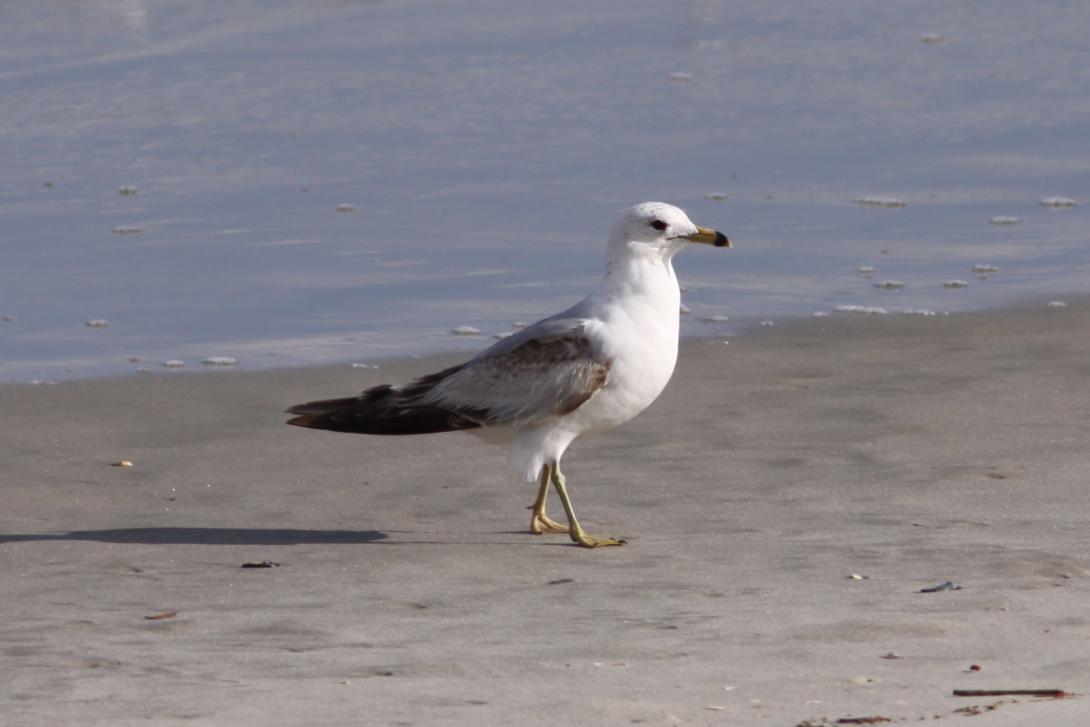
Taken by Steve Bennett at Pawley's Island, South Carolina on
.
Ring-billed Gull