
Spotted Towhee
Pipilo maculatus
Spotted Towhees are striking and common birds found throughout Oregon, especially in brushy habitats. They exhibit sexual dimorphism, meaning males and females have distinct plumage differences, making them relatively easy to tell apart.
Male Spotted Towhee:
Head, Throat, and Upperparts: Jet black and glossy. This includes their head, throat, back, and upper breast.
Wings and Back: The black upperparts are distinctly spotted and streaked with bright white. These white spots are particularly noticeable on the wings and scapulars (shoulder area).
Sides (Flanks): A prominent warm rufous (reddish-brown) patch on their sides.
Belly: Clean white.
Eyes: Usually a striking red iris.
Tail: Long and black with conspicuous white corners that are very noticeable in flight.
Bill: A stout, conical bill, usually dark.
Female Spotted Towhee:
Head, Throat, and Upperparts: Instead of the male's jet black, the female has dark grayish-brown coloration in these areas. While still dark, it lacks the glossy black intensity of the male.
Wings and Back: Like the male, females also have white spots and streaks on their wings and back, though these might appear slightly less contrasting against the browner background compared to the male's black.
Sides (Flanks): They also possess the warm rufous patches on their sides, similar to the male, though perhaps a touch duller.
Belly: White, just like the male.
Eyes: Red iris, similar to the male.
Tail: Long and dark, with white corners visible in flight, just like the male.
Bill: Stout, conical bill, usually dark.
Key Differences to Remember:
The primary difference lies in the color of the head, throat, and upperparts.
Males = Black
Females = Grayish-brown
Habitat in Oregon:
Spotted Towhees are widely distributed in Oregon and are adaptable to various brushy and semi-open habitats. You'll commonly find them in:
Brushy areas and thickets: Their preferred habitat, where they can scratch around in leaf litter for food.
Forest edges: Along the transition zones between forests and open areas.
Overgrown fields: Areas with dense weeds and shrubs.
Riparian zones: Along streams and rivers with dense vegetation.
Backyards and suburban parks: Especially those with dense shrubbery and ground cover, where they often visit bird feeders for scattered seed.
They are primarily ground-foragers, known for their distinctive "double-scratch" method, where they kick both feet backward simultaneously to uncover insects and seeds in leaf litter. You'll often hear their characteristic "chewink" call or buzzy "drink-your-tea" song before you spot them.
Male Spotted Towhee:
Head, Throat, and Upperparts: Jet black and glossy. This includes their head, throat, back, and upper breast.
Wings and Back: The black upperparts are distinctly spotted and streaked with bright white. These white spots are particularly noticeable on the wings and scapulars (shoulder area).
Sides (Flanks): A prominent warm rufous (reddish-brown) patch on their sides.
Belly: Clean white.
Eyes: Usually a striking red iris.
Tail: Long and black with conspicuous white corners that are very noticeable in flight.
Bill: A stout, conical bill, usually dark.
Female Spotted Towhee:
Head, Throat, and Upperparts: Instead of the male's jet black, the female has dark grayish-brown coloration in these areas. While still dark, it lacks the glossy black intensity of the male.
Wings and Back: Like the male, females also have white spots and streaks on their wings and back, though these might appear slightly less contrasting against the browner background compared to the male's black.
Sides (Flanks): They also possess the warm rufous patches on their sides, similar to the male, though perhaps a touch duller.
Belly: White, just like the male.
Eyes: Red iris, similar to the male.
Tail: Long and dark, with white corners visible in flight, just like the male.
Bill: Stout, conical bill, usually dark.
Key Differences to Remember:
The primary difference lies in the color of the head, throat, and upperparts.
Males = Black
Females = Grayish-brown
Habitat in Oregon:
Spotted Towhees are widely distributed in Oregon and are adaptable to various brushy and semi-open habitats. You'll commonly find them in:
Brushy areas and thickets: Their preferred habitat, where they can scratch around in leaf litter for food.
Forest edges: Along the transition zones between forests and open areas.
Overgrown fields: Areas with dense weeds and shrubs.
Riparian zones: Along streams and rivers with dense vegetation.
Backyards and suburban parks: Especially those with dense shrubbery and ground cover, where they often visit bird feeders for scattered seed.
They are primarily ground-foragers, known for their distinctive "double-scratch" method, where they kick both feet backward simultaneously to uncover insects and seeds in leaf litter. You'll often hear their characteristic "chewink" call or buzzy "drink-your-tea" song before you spot them.
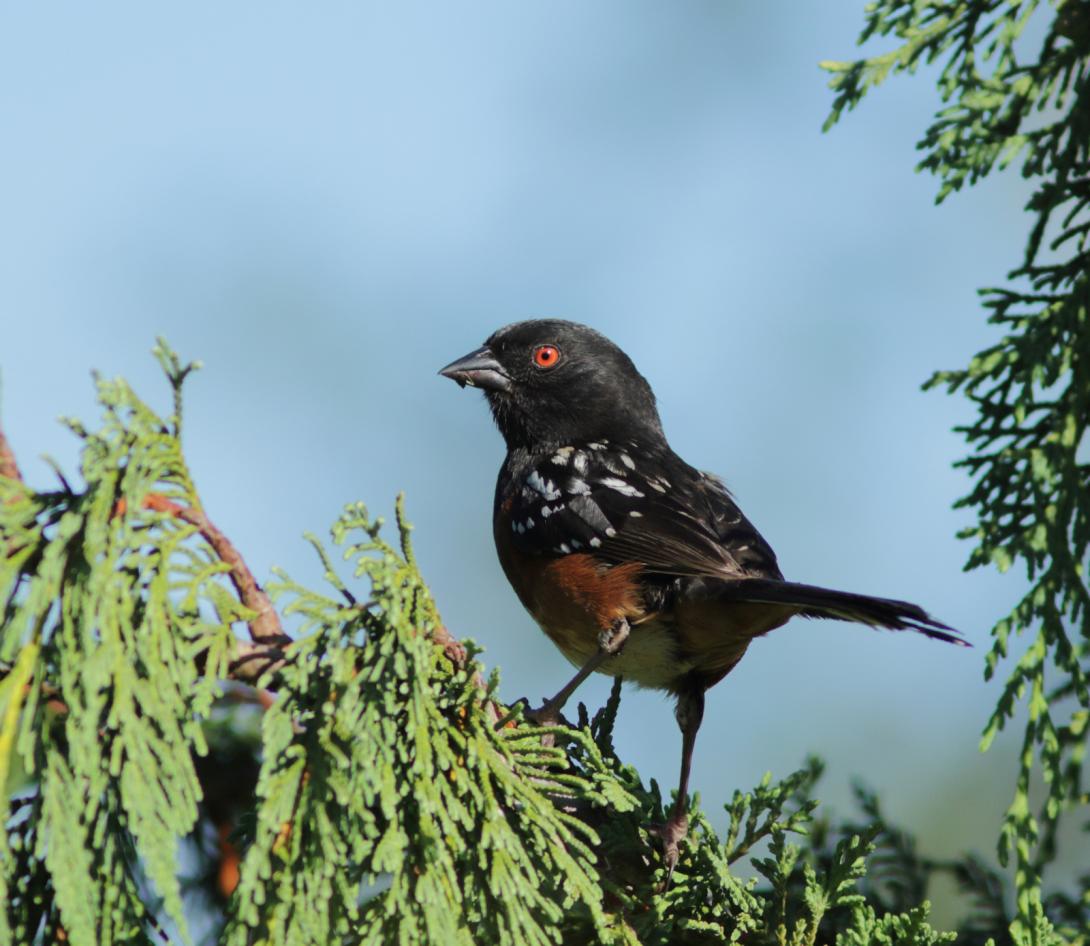
Taken by Steve Bennett at Willamette View on
.
Male Spotted Towhee