
Yellow Warbler
Setophaga petechia
Yellow Warblers are truly a "rich yellow flame among the opening leaves". They are one of the most widespread and easily recognizable warblers in Oregon, particularly in riparian (streamside) thickets and other shrubby, wet habitats. They are bright and active, bringing a cheerful song to the breeding season.
Male Yellow Warblers in Oregon:
Overall Color: Males are exceptionally bright, vibrant yellow all over, often described as an "egg-yolk" or "butter" yellow. This bright yellow extends from their head, face, and throat down to their belly and undertail coverts.
Back and Wings: While primarily yellow, their back and wings are typically a yellowish-green, providing a subtle contrast.
Streaking: A key distinguishing feature of breeding males is the presence of rich chestnut-red or reddish-brown streaks on their breast and flanks. The extent and intensity of these streaks can vary, but they are usually quite noticeable.
Tail: They have yellow tail feathers with darker tips, which are often visible when the bird fans its tail.
Face: The face is largely unmarked, making their large, beady black eye stand out. They lack the strong facial patterns of many other warblers.
Bill: They have a relatively stout, conical, and pointed bill, usually dark above and paler below.
Song: Their song is a cheerful, sweet, and often accelerating whistle, commonly transcribed as "sweet, sweet, sweet, I'm so sweet!" or "witchety-witchety-witch."
Female Yellow Warblers in Oregon:
Overall Color: Females are also predominantly yellow, but their coloration is generally duller and less intense than the males. They are more of a muted or pale yellow, often with a stronger olive or greenish wash, especially on the upperparts.
Streaking: Females typically lack the chestnut-red streaks on the breast and flanks that characterize the males. If any streaking is present, it will be very faint and dusky, not reddish.
Back and Wings: Their back and wings are more distinctly olive-green compared to the male's yellowish-green.
Tail: Similar to males, they have yellow tail feathers with darker tips, but the yellow may be less vibrant.
Face: Their face is unmarked, with a dark eye.
Bill: Similar to the male's.
Behavior: Females are generally more subtle in their movements and less conspicuous than the singing males, especially when nesting.
Key Identification Points for both sexes in Oregon:
Overall Yellow Color: Their overall yellow plumage is the primary field mark.
Lack of Strong Facial Patterns: Unlike some other yellow warblers (e.g., Common Yellowthroat, Wilson's Warbler), they lack a black mask or cap.
Lack of Wing Bars: They do not have prominent white wing bars.
Habitat: Look for them in dense, wet, shrubby habitats, particularly willows and alders along rivers, streams, and wetlands. They are also found in other thickets and sometimes in suburban gardens with good cover.
Male's Red Streaks: The reddish streaks on the male's breast are diagnostic.
Female's Unstreaked Yellow: The duller, unstreaked yellow of the female, combined with her habitat, is a good clue.
Yellow Warblers are known for their resilience against Brown-headed Cowbird parasitism; they will often build new nest layers on top of cowbird eggs, sometimes creating multi-tiered nests to bury the parasitic eggs. They are highly insectivorous, gleaning insects from foliage.
Male Yellow Warblers in Oregon:
Overall Color: Males are exceptionally bright, vibrant yellow all over, often described as an "egg-yolk" or "butter" yellow. This bright yellow extends from their head, face, and throat down to their belly and undertail coverts.
Back and Wings: While primarily yellow, their back and wings are typically a yellowish-green, providing a subtle contrast.
Streaking: A key distinguishing feature of breeding males is the presence of rich chestnut-red or reddish-brown streaks on their breast and flanks. The extent and intensity of these streaks can vary, but they are usually quite noticeable.
Tail: They have yellow tail feathers with darker tips, which are often visible when the bird fans its tail.
Face: The face is largely unmarked, making their large, beady black eye stand out. They lack the strong facial patterns of many other warblers.
Bill: They have a relatively stout, conical, and pointed bill, usually dark above and paler below.
Song: Their song is a cheerful, sweet, and often accelerating whistle, commonly transcribed as "sweet, sweet, sweet, I'm so sweet!" or "witchety-witchety-witch."
Female Yellow Warblers in Oregon:
Overall Color: Females are also predominantly yellow, but their coloration is generally duller and less intense than the males. They are more of a muted or pale yellow, often with a stronger olive or greenish wash, especially on the upperparts.
Streaking: Females typically lack the chestnut-red streaks on the breast and flanks that characterize the males. If any streaking is present, it will be very faint and dusky, not reddish.
Back and Wings: Their back and wings are more distinctly olive-green compared to the male's yellowish-green.
Tail: Similar to males, they have yellow tail feathers with darker tips, but the yellow may be less vibrant.
Face: Their face is unmarked, with a dark eye.
Bill: Similar to the male's.
Behavior: Females are generally more subtle in their movements and less conspicuous than the singing males, especially when nesting.
Key Identification Points for both sexes in Oregon:
Overall Yellow Color: Their overall yellow plumage is the primary field mark.
Lack of Strong Facial Patterns: Unlike some other yellow warblers (e.g., Common Yellowthroat, Wilson's Warbler), they lack a black mask or cap.
Lack of Wing Bars: They do not have prominent white wing bars.
Habitat: Look for them in dense, wet, shrubby habitats, particularly willows and alders along rivers, streams, and wetlands. They are also found in other thickets and sometimes in suburban gardens with good cover.
Male's Red Streaks: The reddish streaks on the male's breast are diagnostic.
Female's Unstreaked Yellow: The duller, unstreaked yellow of the female, combined with her habitat, is a good clue.
Yellow Warblers are known for their resilience against Brown-headed Cowbird parasitism; they will often build new nest layers on top of cowbird eggs, sometimes creating multi-tiered nests to bury the parasitic eggs. They are highly insectivorous, gleaning insects from foliage.
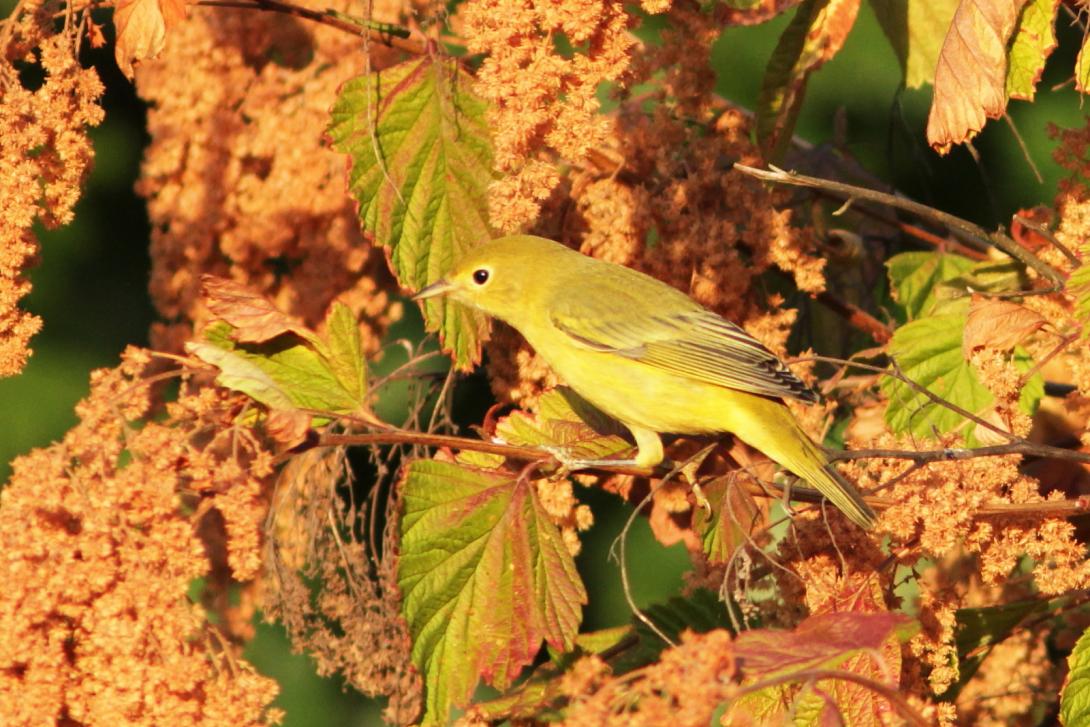
Taken by Steve Bennett at Willamette View on
.
Female Yellow Warbler