
Residents and visitors alike marvel at the beauty of the Willamette View campus. The wide variety of beautiful trees on our 27-acre campus has led some to call Willamette View a miniature arboretum. Amazingly, when the Manor first opened in 1955, there were very few sizable trees here. That means that many of the large trees have been planted since then. Oh, if only we had a record of what was planted when!
In 2023, the Blue Heron Foundation funded a project to identify and label some of the specimen trees on our campus. One very useful source was a Manor Tree Walk designed by resident Fred Rauch more than ten years prior. His walk described 20 different trees around the Manor building. By 2023 six of those 20 trees had either died or been removed. Those that remained, however, serve as the foundation for a number of Tree Walks now being designed. Each Walk can be completed in less than one hour. Maps will be available, and QR codes on the tree labels will help everyone learn more about each tree.
The original Manor Tree Walk can be split into two Tree Walks - Manor West and Manor East. The trees on Manor Walk East are mostly accessible from paved walkways - and therefore wheelchair accessible.
The Duck Pond area adjacent to the Terrace building lends itself to another wheelchair accessible Tree Walk.
See the tree descriptions below that correspond to the three Tree Walks mentioned above.
Manor Tree Walk - West
|
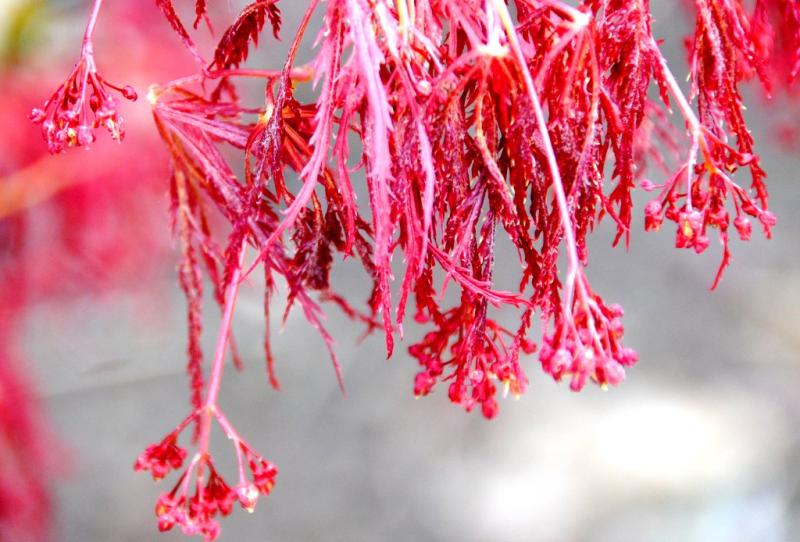
Japanese Maple (Acer palmatum, var. dissectum)The Japanese maple is native to Japan, Korea and China. Lace-leaf Japanese Maple, Acer palmatum var. dissectum ‘Seiryu’ is a small, deciduous tree, 10 to 15 feet high with green, deeply dissected leaves. Small red flowers are produced in the spring, followed by winged samaras in the fall and good fall color. |
|
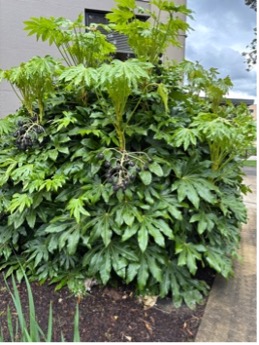
Big-leaf Paper Plant (Fatsia japonica)
Location: NW corner of Manor B Wing |
|
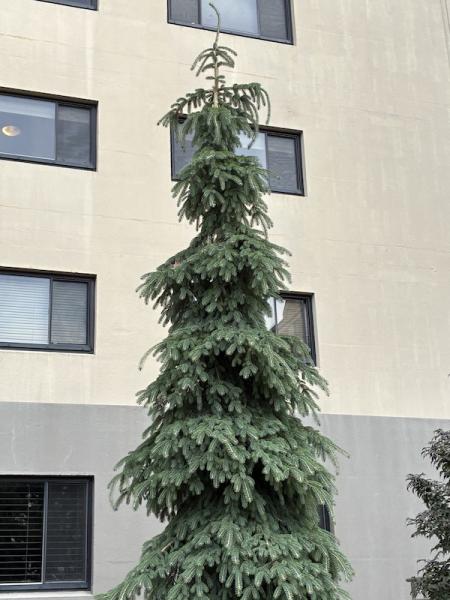
Weeping White Spruce (Picea glauca ‘Pendula’)
Location: Exiting Manor library, west side; this tree is just to the right. |
|
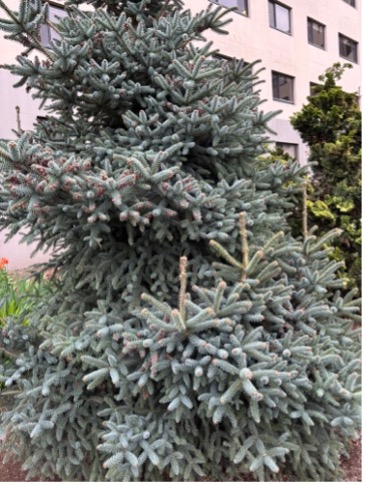
Spanish Fir (Abies pinsapo 'Horstmann')
Location: along southwest-facing wall of Manor D Wing. |
|
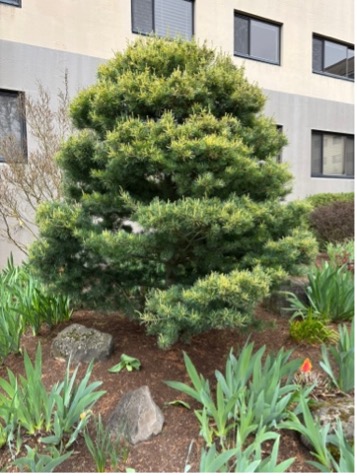
Japanese White Pine (Pinus parviflora ‘Ogon Janome’)
Location: along southwest-facing wall of Manor D Wing. |
|
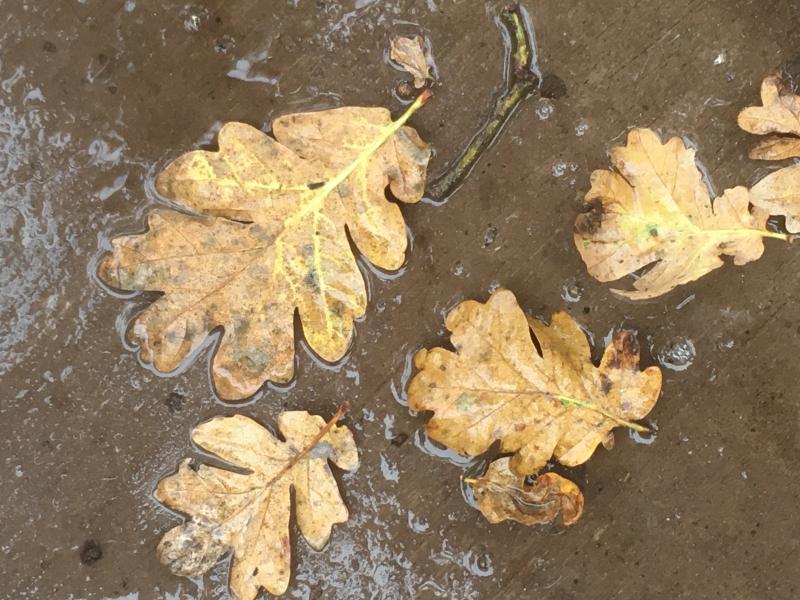
Oregon White Oak (Quercus garryana)Our native White Oak is a slow growing, medium sized (40-60 feet) deciduous tree with good drought tolerance. It is found west of the Cascade Range from British Columbia to California. Oak Grove gets its name from the abundance of these trees in the Willamette Valley. |
|
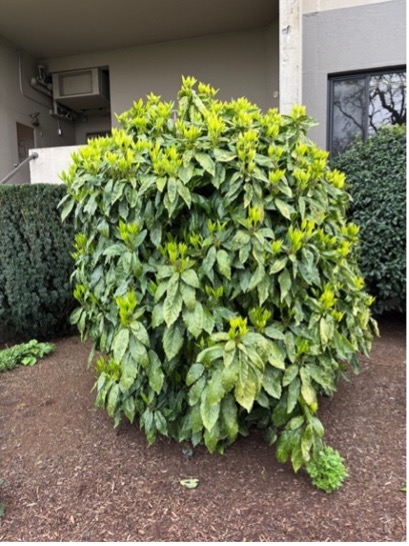
Japanese Aucuba (Aucuba japonica)
Location: at end of Manor D Wing at entry from Rose Garden |
|
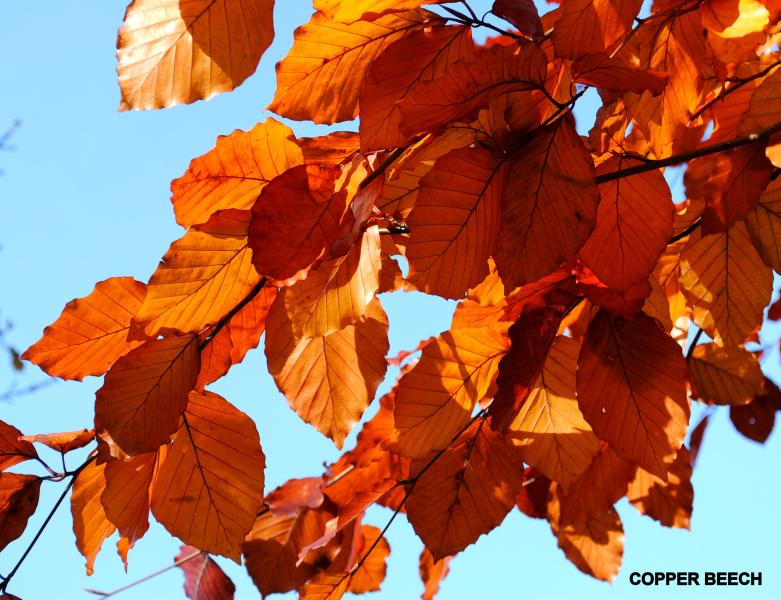
Copper Beech (Fagus sylvatica)This form of the Common European Beech was selected for its attractive leaves which emerge deep purple and fade somewhat to purple-green during the summer. It is a moderately slow growing deciduous tree from Europe, attaining a height of 50 to 75 feet at maturity. It is noted for its outstanding fall color. It is a memorial tree donated to WV by Avery Steimnetz, former owner of Portland Nursery and WV board member. |
|
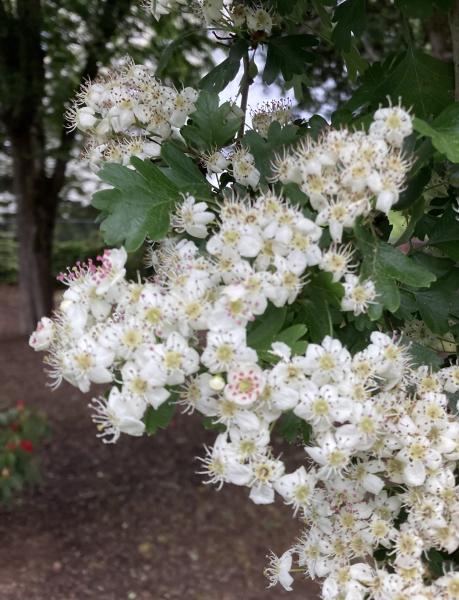
Hawthorn (Crataegus)The Hawthorn, or Common Hawthorn, is a dense shrub to medium sized tree (40-45 feet) from Europe, Northwest Africa and Western Asia. The white flowers are followed by attractive, edible red fruit. Numerous hybrids exist, some with pink or red flowers. |
|
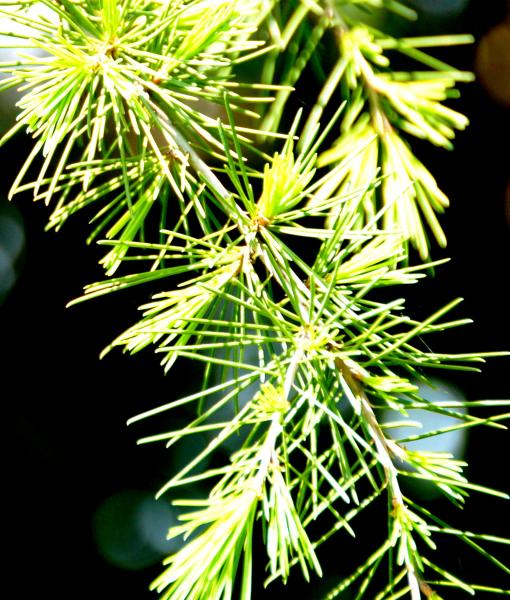
Deodar Cedar (Cedrus deodara)This large (over 100 feet high in its native habitat) evergreen coniferous tree is native to the western Himalayas. The needle-like leaves are borne single or in dense clusters of 20 to 30 on short shoots; varying from bright green to glaucous blue depending on the many varieties. It is worshiped by the Hindus as a divine tree and is the national tree of Pakistan. |
|
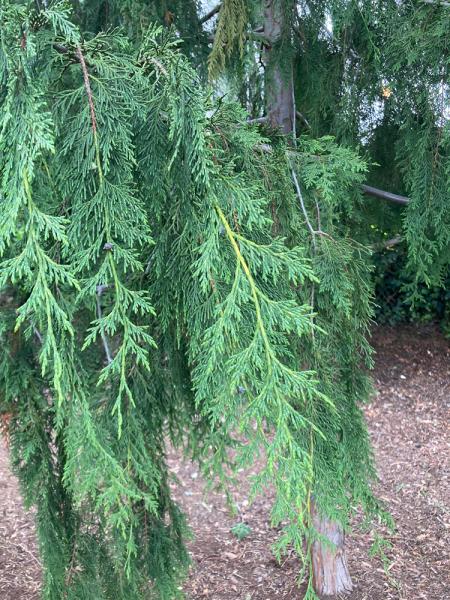
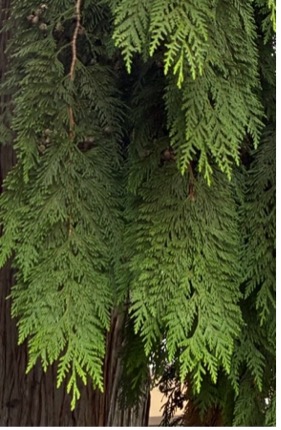
Western Red Cedar (Thuja plicata)The Western Red Cedar is native to the PNW and is a large evergreen coniferous tree 150 to 330 feet tall. It is not a true cedar (Cedrus) and is shade tolerant and prefers a moist growing area. The foliage forms flat spays with scale-like leaves in opposite pairs. The cones are slender, less than 1 inch long and brown at maturity. |
|
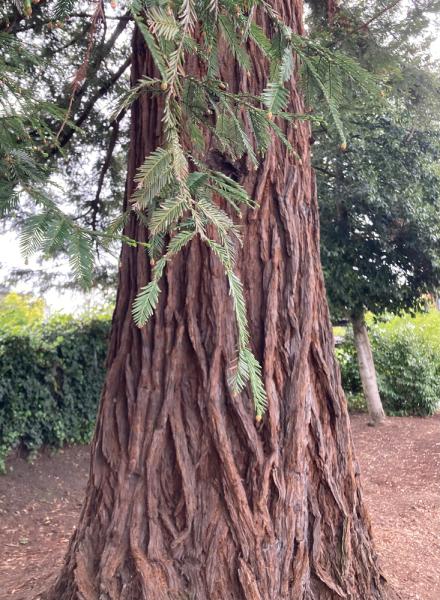
Coast Redwood (Sequoia sempervirens)The Coast Redwood or California Redwood is among the oldest living things on earth (1,200 to 1,800 years) and is among the tallest trees now living on earth, reaching up to 379 feet. It is native to coastal California and the southwestern corner of Oregon. The typical medium green needles are flattened, produced in one plane on each side of the stem giving a feather-like look. |
|
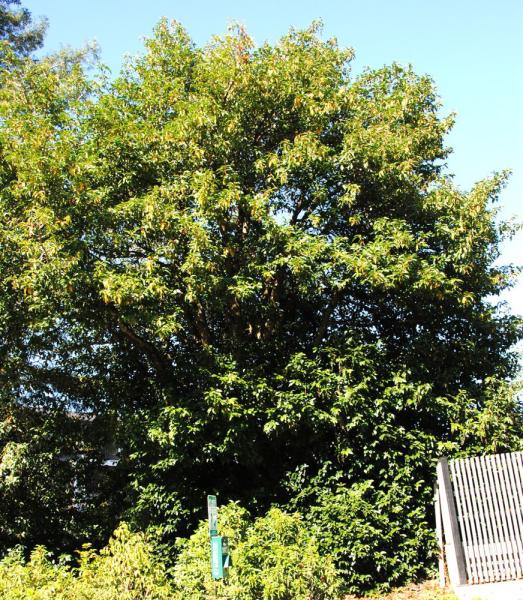
Portuguese Laurel (Prunus lusitanica)The Portugal Laurel, also known as Portuguese Cherry Laurel, is an evergreen shrub or small tree. It is native to Portugal and Spain. As a shrub it is dense and round and used as a hedge or screen plant in the landscape. It is also useful trained to a small tree 10 to 20 feet high. Fragrant clusters of white flowers, 6 to 10 inches long, are produced in the spring followed by purple berries. |
|
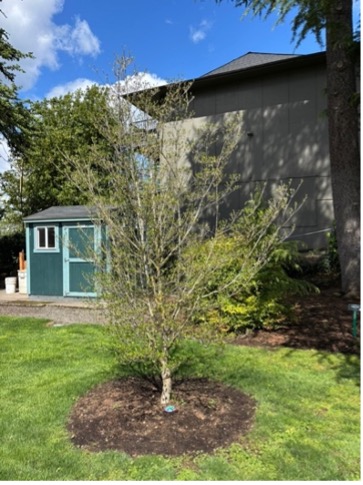
Kousa Dogwood (Cornus kousa)
Location: Behind Manor, north of Rose Gardens, near blue garden shed. |
|
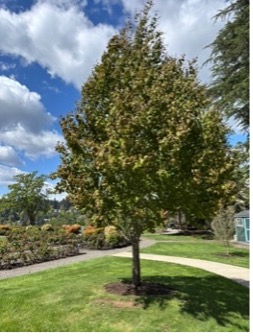
Katsura Tree (Cercidiphyllum japonicum)
Location: At North Pointe, either end of covered parking pavilion |
|
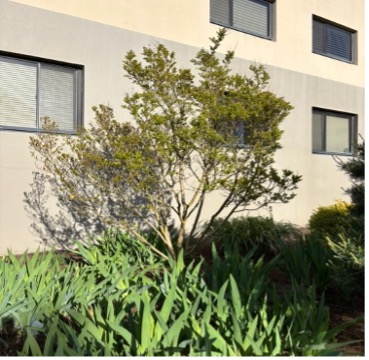
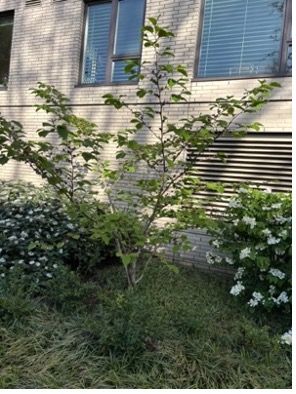
Cornelian Cherry Dogwood (Cornus mas)
Location: along west end of North Pointe, facing the Rose Garden and river. |
|
Common Witch Hazel (Hamamelis virginiana)
Location: along west end of North Pointe, facing the Rose Garden and river. |
Manor Tree Walk - East
|
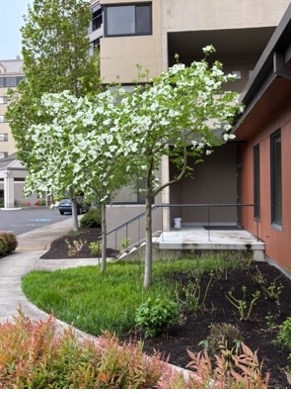
Pacific Dogwood (Cornus nuttallii)
Location: In a triangle west of the connector between Manor and Northpoint |
|
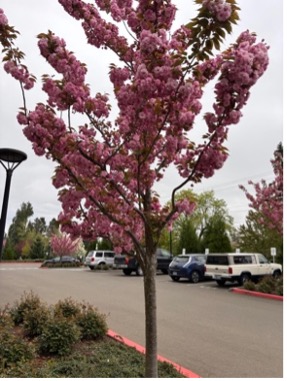
Japanese Flowering Cherry (Prunus serrulata)
Location: right side of main entrance to North Pointe; several specimens extending into parking area. |
|
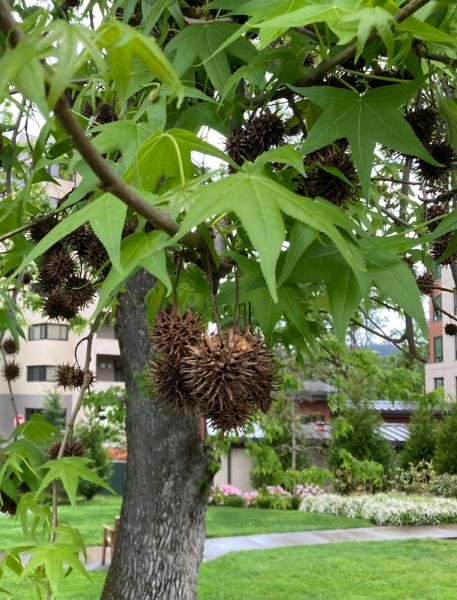
American Sweetgum (Liquidambar styraciflua)
Native to temperate areas of eastern North America south to Central America, this evergreen to semi-deciduous tree is characterized by its five-pointed star-shaped leaves and its hard, spiked fruit. Sweetgum is a medium to large-sized tree (35 to 50 feet in cultivation). A number of selected cultivars are available with outstanding fall color in brilliant orange, red and purple. |
|
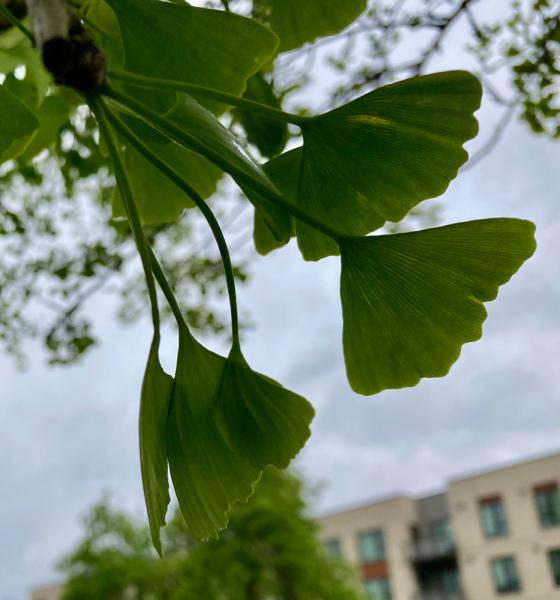
Ginkgo (Ginkgo biloba)
The Ginkgo or Maidenhair Tree is a living fossil dating back 270 million years from China. The Ginkgo is dioecious, with male and female plants. It is advisable to plant male flowering trees as the fruit from female trees has a smell like rancid butter. It has a rather distinctive fan shaped leaf which turns a deep saffron yellow in the fall. |
|
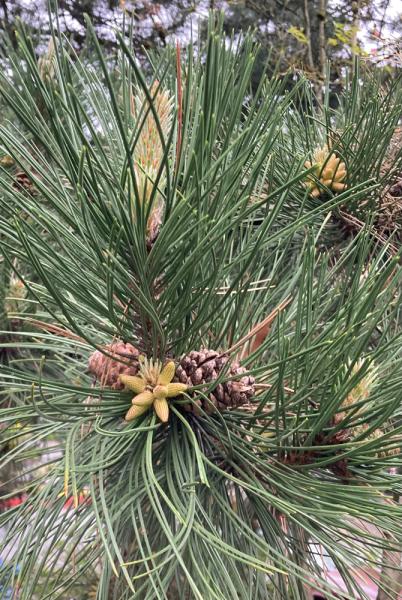
Austrian Pine (Pinus nigra)
The Austrian or Black Pine is a medium to large evergreen conifer, growing 40 to 60 feet high. It is native to southern Europe with dark brown to black furrowed bark and needles in bundles of two. The Austrian pine may be used in the landscape as a specimen, screen, or windbreak. |
|
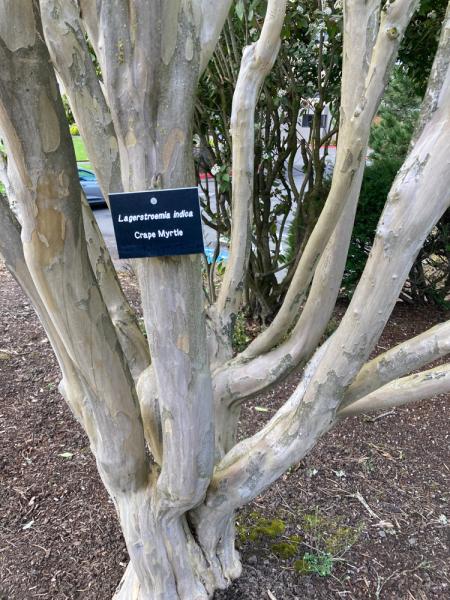
Crape Myrtle (Lagerstroemia indica)
Crape Myrtle is a deciduous, multi-stemmed large shrub or small tree to 40 feet high native to Asia. The bark is a prominent feature, being smooth, pinkish-gray and mottled, shedding each year. Many cultivars have been developed providing flower colors in white, pink, mauve, purple or carmine, lasting through the summer months. |
|
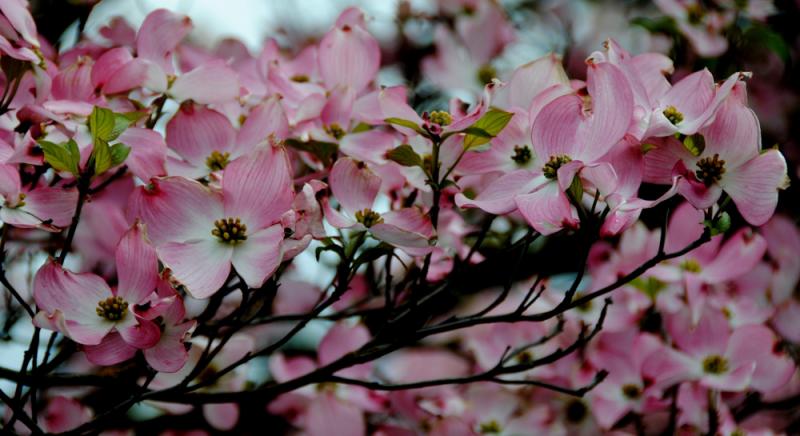
Pink Dogwood (Cornus florida)
Cornus florida is native to the eastern United States and forms a small tree to 25 feet high. It is the state tree of Missouri and Virginia. A popular form is the Pink Flowering Dogwood with pink to reddish pink petal-like bracts in early spring followed by attractive red fruit. It is noted for its excellent fall color. |
|
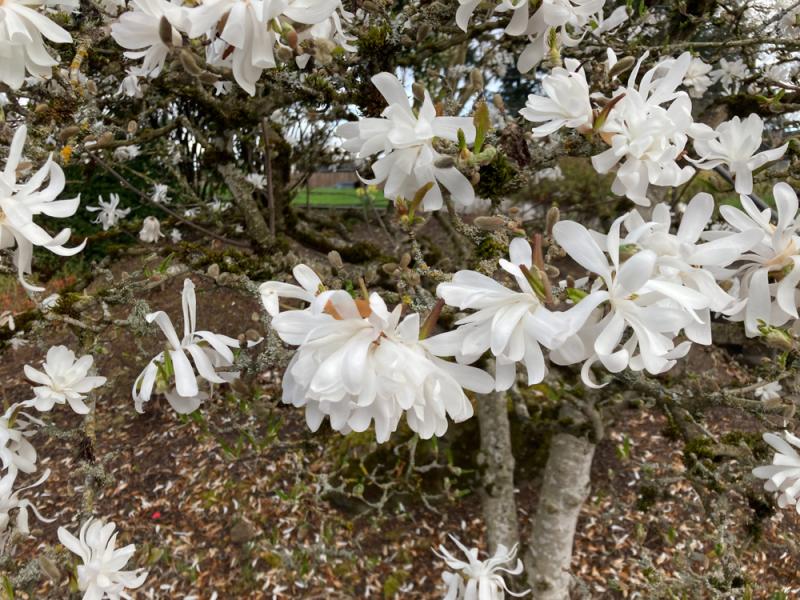
Star Magnolia (Magnolia stellata)
Star Magnolia is a slow-growing, deciduous shrub or small tree (to 10 feet) from Japan. Its showy white or pink, star-shaped flowers are produced in the spring before its leaves open. The new leaves have a bronze-green tint and turn yellow in fall before dropping. |
|
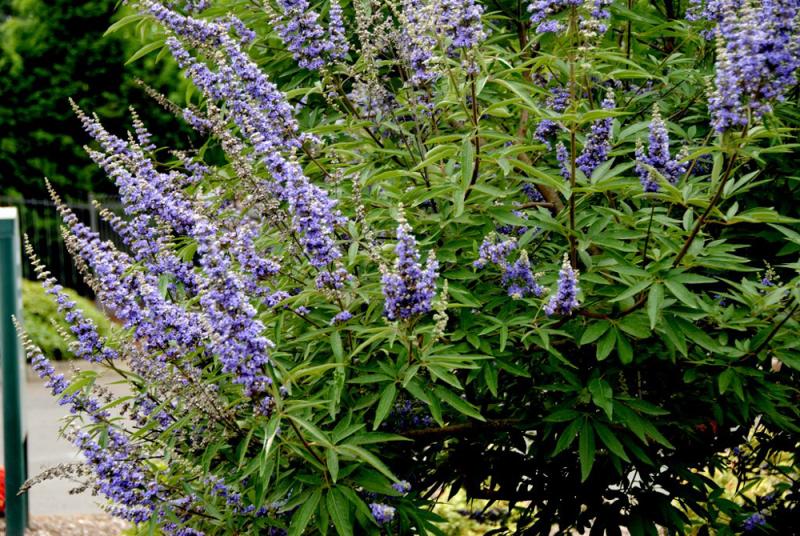
Chaste Tree (Vitex agnus-castus)
The Chaste Tree is native to the Mediterranean region. It develops into a large shrub or can be trained to form a small tree to 15 feet. It is extensively cultivated for delicate-textured aromatic foliage and butterfly attracting spikes of lavender flowers in late summer. It is known to have medicinal properties. |
|
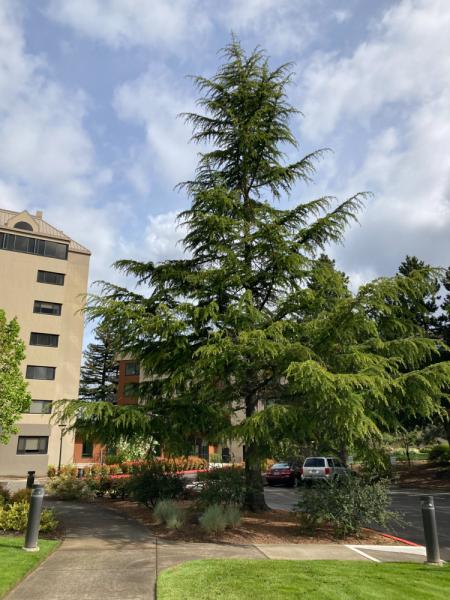
Deodar Cedar (Cedrus deodara)
This evergreen is native to the Himalayan mountains. It has bristly short needles bunched at the end of short spur branches, with large upright cones. Its long horizontal branches appear somewhat pendulous, or weeping. |
|
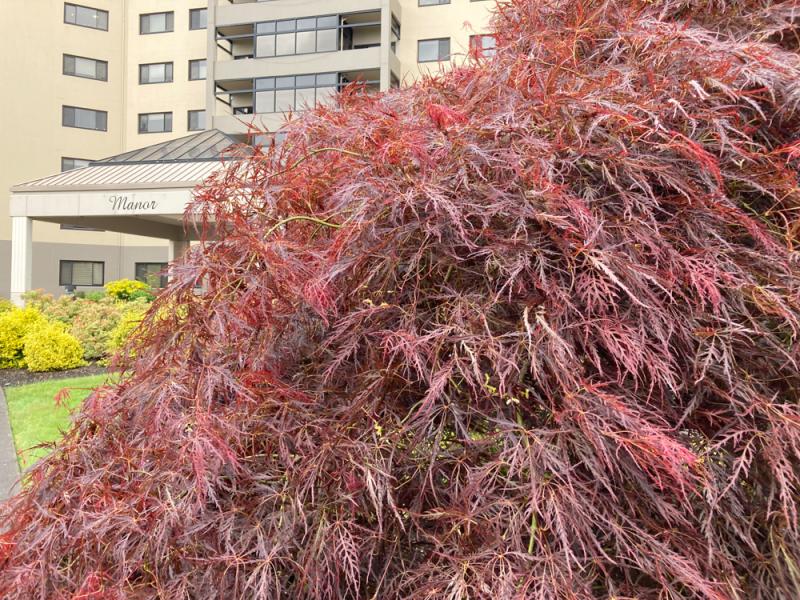
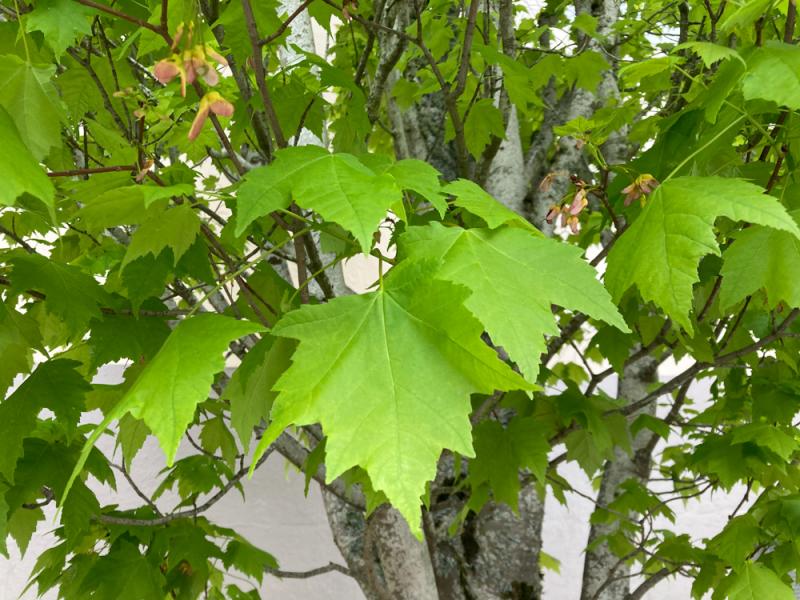
Japanese Maple (Acer palmatum)
Acer palmatum is a deciduous shrub or small tree (20 to 35 feet) native from Asia to southern Russia. This species has palmately lobed leaves, small red or purple flowers and winged fruit (samara). Hundreds of named cultivars are available and are grown worldwide for their attractive leaf shapes and colors. |
|
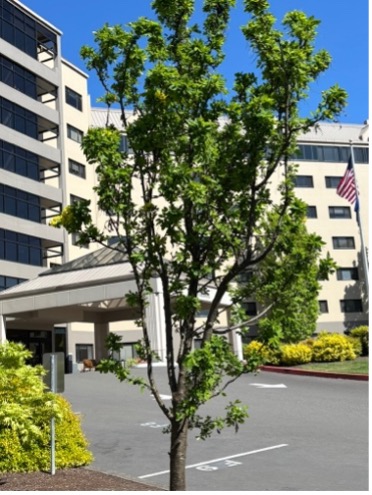
Columnar Maple (Acer rubrum)
The Red Maple is the most prominent tree in eastern North America. This highly variable tree in its native habitat may attain a height of 50 feet. It has gained popularity in the landscape due to its vigorous habit, its attractive and early red flowers and its flaming red fall color. Numerous cultivars have been selected including several with a more columnar growth habit. |
|
Golden Chain Tree (Laburnum x watereri)
Location: North side of Manor A Wing |
Duck Pond Walk
|
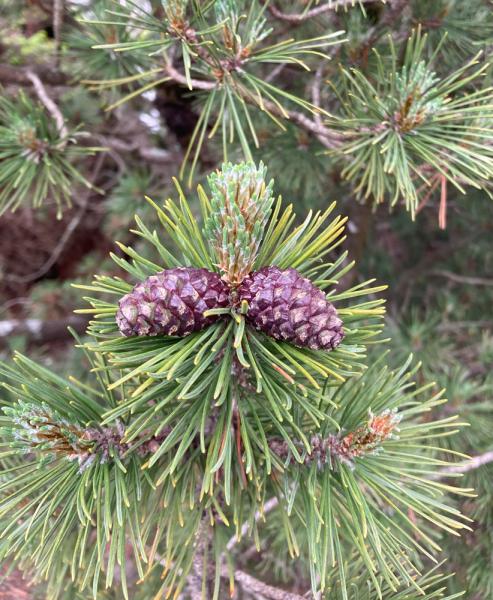
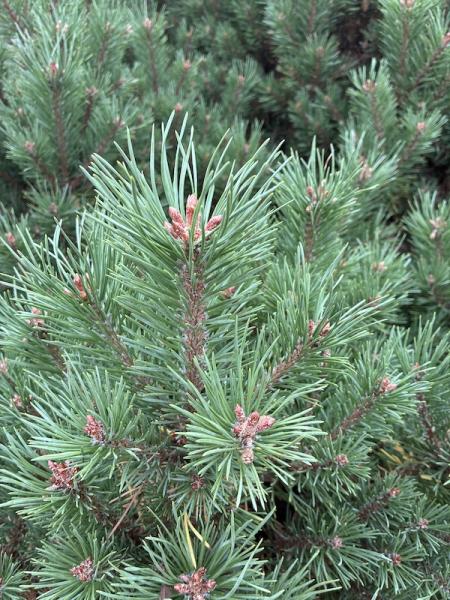
Mugo Pine (Pinus mugo)
Mugo Pines, sometimes called Stone Pines, are found in the high elevations of southern European mountains. They are very variable in nature and due to nurserymen who sell seedling varieties, there is no accepted defined shape. Some grow into small trees, often multi-stemmed, while others, through pruning, stay shrubby. The modern nursery industry has developed clones of dwarf and miniature seedlings which has mostly solved this problem. Useful in small spaces and a favorite for use as Bonsai trees. |
|
Scotch Pine (Pinus sylvestris)
Location: Duck Pond area, at Patio homes |
|
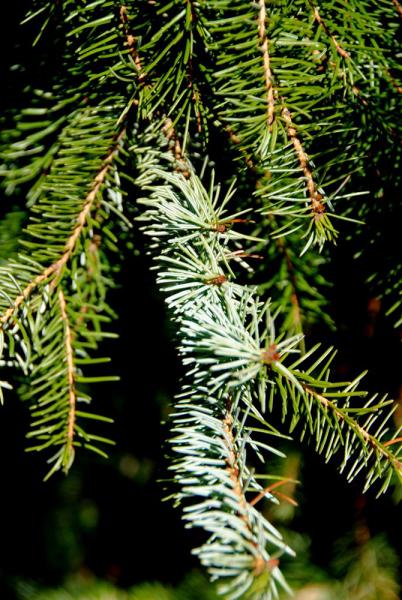
Weeping Serbian Spruce (Picea omorika)
Serbian spruce have only been in cultivation since 1875. They were discovered high in the west Serbian and eastern Bosnian mountains as a small remnant population. It soon became popular in Europe. Picea omorika has many dwarf and miniature varieties. Here we have a weeping tree, the Bruns Weeping Serbian Spruce, Picea omorika ‘Pendula’, with sharply descending branches to easily slough off alpine snow. Highly suitable for the confined area around the pond. |
|
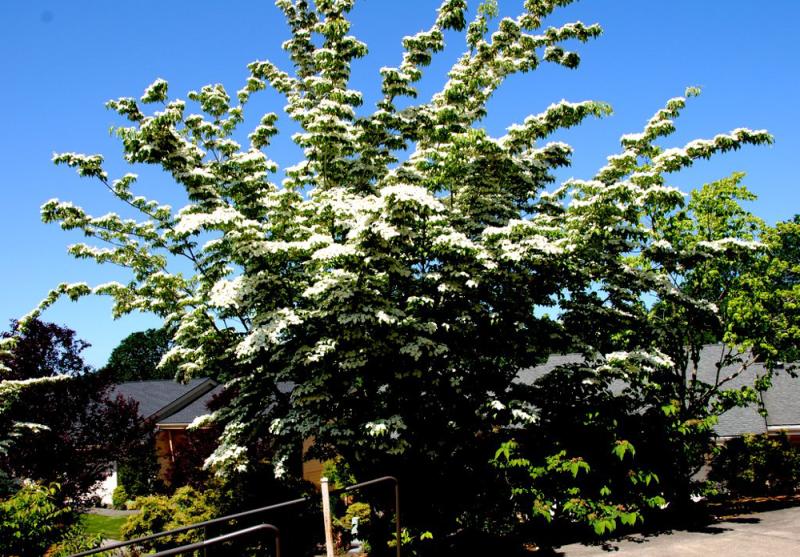
Kousa Dogwood (Cornus kousa)
This dogwood tree is native to East Asia and has been called Chinese dogwood, Korean dogwood, and Japanese dogwood. A mature tree reaches 30 feet in height. Kousa is the Japanese word for dogwood. The red berries are edible, similar in taste to a persimmon, but not recommended to eat. Birds love them. The attractive star-shaped white blooms are actually showy bracts (foliage) surrounding tiny yellow true flowers. The Kousa blooms several weeks after the native pink dogwood trees (Cornus florida) seen elsewhere on our campus. Go back, turn right to cross bridge |
|
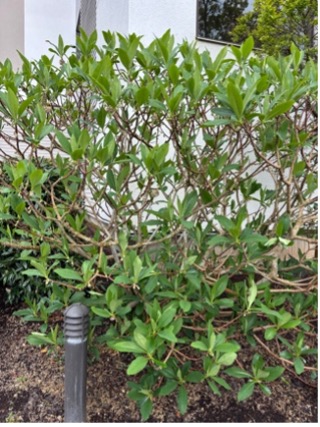
Chinese Paperbush (Edgeworthia papyrifera)
Location: NW corner of Terrace Building |
|
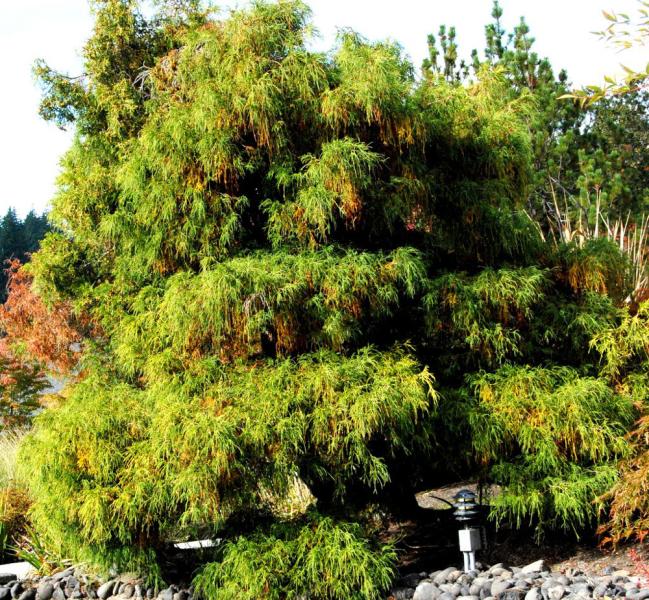
Sawara Cypress (Chamaecyparis pisifera)
This member of the Cupressaceae family, native to Japan, is closely related to the Hinoki Cypress, Chamaecypraris obtusa. Both are used in Japan to build temples and shrines. Its wood is light colored, straight grained and rot resistant. It is also known as the thread leaf tree, sometimes the golden thread leaf, for its string like foliage which bear some resemblance to miniature dreadlocks. The Latin name pisifera (pea-bearing) refers to its small round green cones. Pisifera varieties are very variable and divided into three main groups. The thread leaf group (filifera); the soft ferny foliage group (plumosa); and the group that retains juvenile foliage (squarosa). Our specimen is a pale golden thread leaf filifera plant. |
|
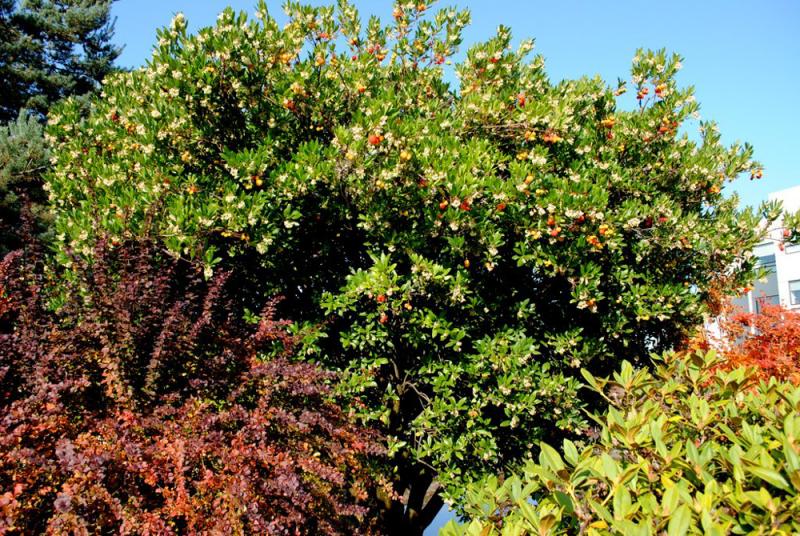
Strawberry Tree (Arbutus unedo)
The Strawberry Tree is an evergreen shrub or small tree, 13 to 23 feet tall, native to the Mediterranean basin and Westerm Europe. It is the national tree of Italy because of the green leaves, its white flowers and its red berries that recall the Italian flag. The red, edible, strawberry-like fruit matures in autumn about the time that next year’s urn-shaped, white flowers are produced. |
|
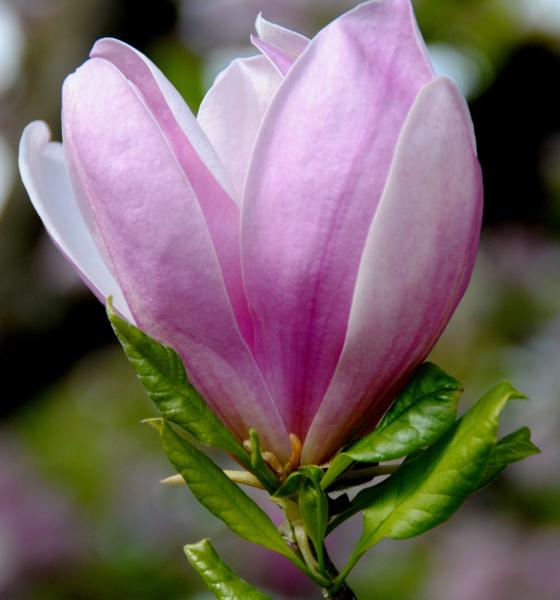
Saucer Magnolia (Magnolia soulangeana)
The Saucer Magnolia is a multi stemmed deciduous large shrub or small tree. It’s a hybrid developed in France and the most widely planted magnolia, especially on the east and west coasts of the United States. It is noted for its large, various colored flowers of shades of white, pink and maroon which emerge in early spring before the leaves. |
|
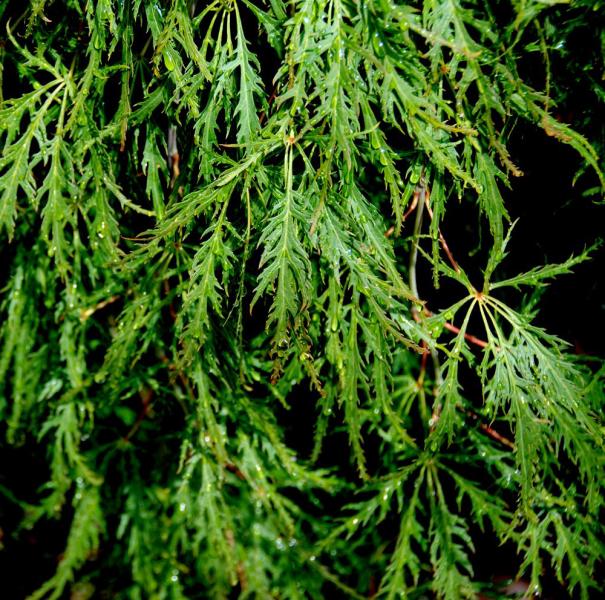
Japanese Maple (Acer palmatum var. Viridus)
This plant, Acer palmatum ‘Viridis’ is a green example of the more commonly cultivated red dissected plant seen all around our campus. Acer palmatum is genetically overwhelmingly variable. Originating in the mixed forests of Japan and China, this weeping green laceleaf example illustrates that natural diversity. Here at Willamette View we have many examples of red, green and variegated, many with differing leaf configurations. In stature they come as small trees to prostrate mounds. Look left, then turn right |
|
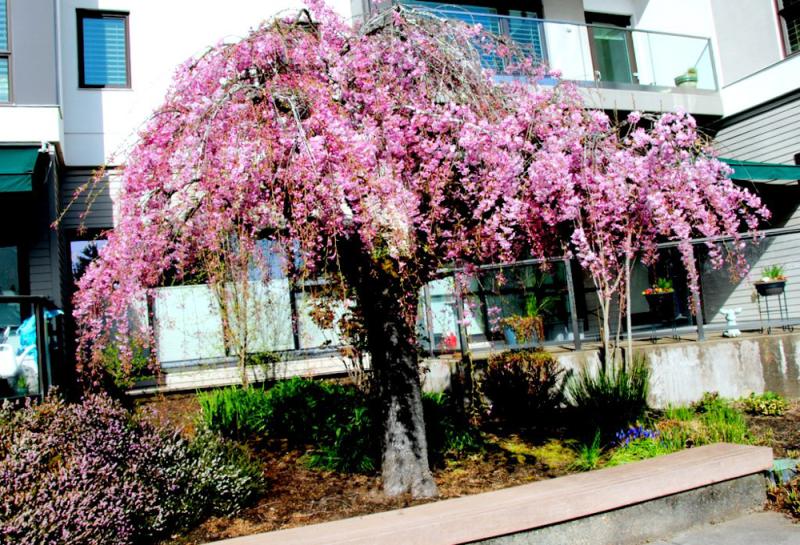
Weeping Flowering Cherry (Prunus subhirtella)
The Weeping Higan Cherry, Prunus subhirtella ‘Pendula’, is valued both for its flowers and its shape. It flowers at least a month before the famed displays associated with Japan, Washington DC, downtown Portland and elsewhere on the campus. This naturally spreading form is grafted at head height to accentuate its weeping nature. There are four more of these trees in front of the Manor. Its ebony berries are not edible. |
|
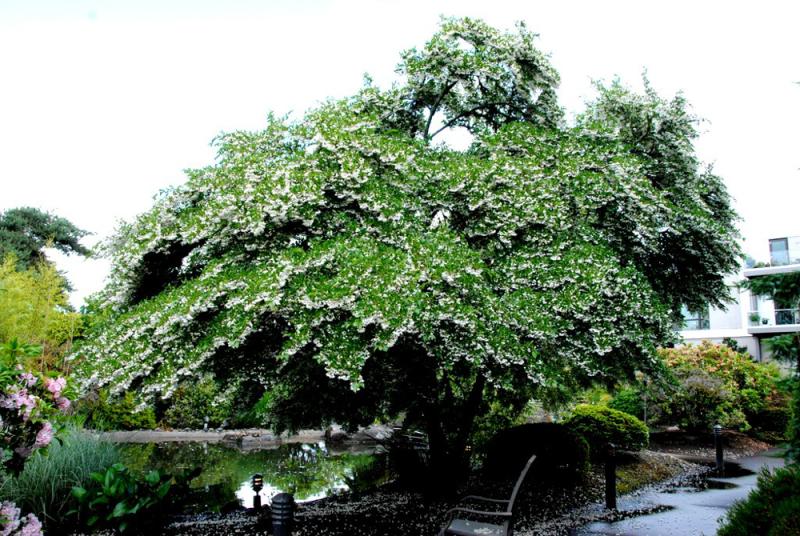
Japanese Snowbell (Styrax japonicus)
Also referred to as Japanese Snowdrop, this tree, native to East Asia, has hanging bell shaped flowers best seen from below. The horizontal branches feature many white flowers in early spring. There is another Snowbell just south of the east entrance to the Court, and a large one in the middle of the Court lawn. |
|
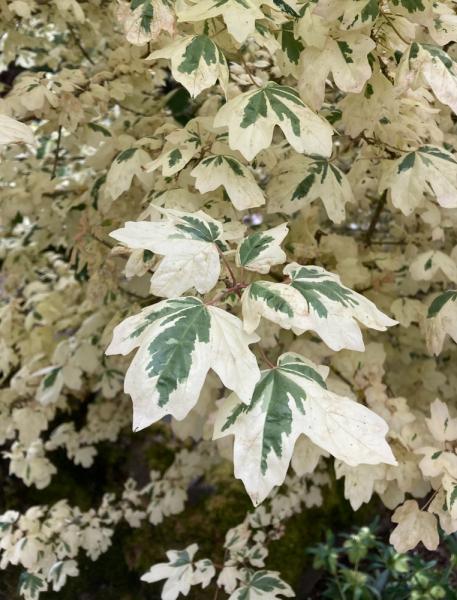
Variegated Field Maple (Acer campestre)
The green and white variegated leaves of this field maple make it stand out among other maple trees. This extraordinary cultivar ‘Carnival’ was found among a batch of seedlings by a nurseryman in the Netherlands in 1989. Field maples are the only maples native to the UK, but they can be found throughout Europe and North Africa. These relatively small trees may live up to 400 years and thrive in the understory of European forests fulfilling much the same function as vine maples do in North America. As with many variegated plants, care must be taken to remove shoots that revert to the common green foliage. |
|
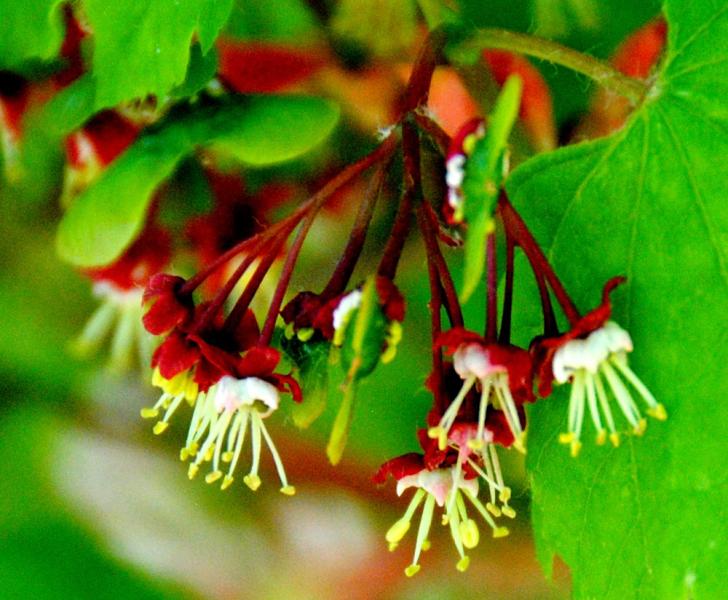
Vine Maple (Acer circinatum)
This species of maple is native to the northwestern part of the US. As an understory plant in forest shade, it sprawls and spreads like a twisting vine, taking on unusual shapes. It is a broadleaf deciduous tree. The circular leaves with many lobes change from red in spring to green in summer to red and gold in the fall. It is easily misidentified as a Japanese maple. |
|
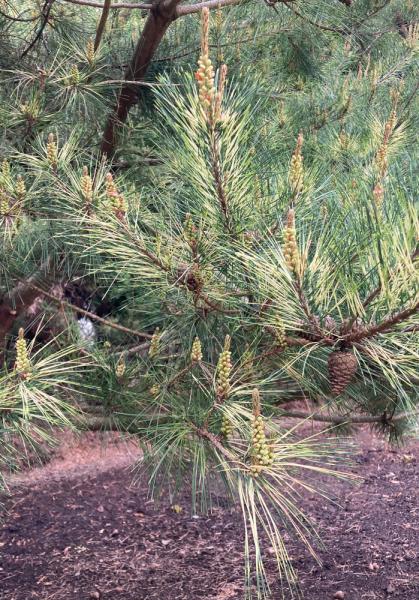
Japanese Red Pine (Pinus densiflora)
Identified by Fred Rauch as a Burk’s Red Variegated cultivar, this red pine has a unique contorted shape with glossy green and yellow needles. Densiflora refers to the large number of pine cones it produces. Hugh Ferrar believes this variegated specimen of a common timber tree in NE China and Japan is probably Pinus densiflora ‘Oculis Draconis’. It is not very common in American domestic gardens because of its size, but miniature or dwarf varieties are now becoming available. In Japan and China, Pinus densiflora is used extensively in ornamental gardens where its informal shape has been manipulated and pruned extensively. The ephemeral male pollen-cones are densely clustered at the bottom of each year’s new growth, thus giving it its name. |
|
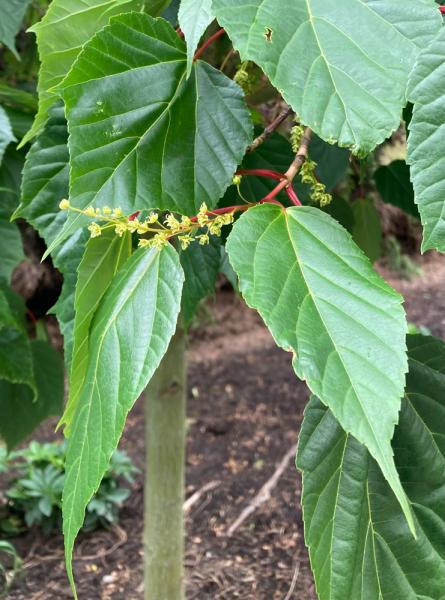
Striped Maple (Acer pensylvanicum)
Also known as moosewood, snakebark maple, whistlewood, or goosefoot maple (because of its broad three-pronged leaves), this tree has twisting vertical white stripes on its bark and boasts bright yellow leaves in fall. it prefers partial shade. This tree is principally dioecious which means each tree bears only male or female characteristics preventing self pollination. Other examples of dioecious trees are Ginkgos and Holly trees. Our specimen of unknown origin has variegated leaves on young foliage. Time will tell if this is a permanent characteristic. |
|
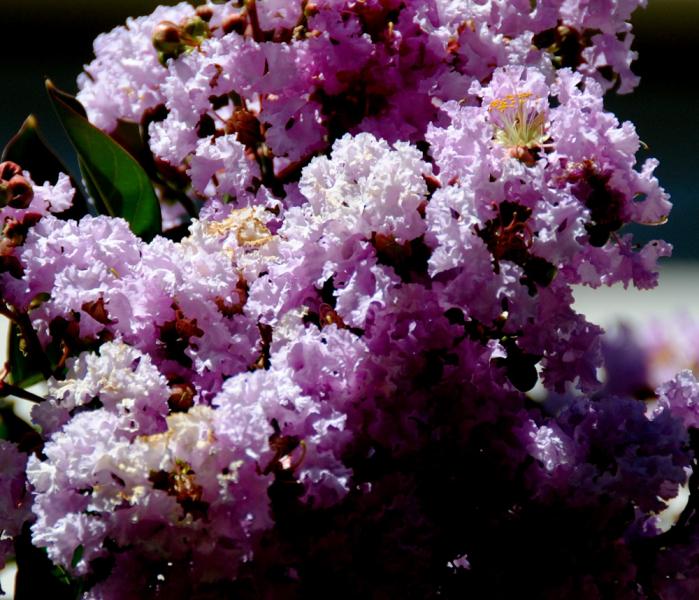
Crape Myrtle (Lagerstroemia indica)
Crape Myrtle is a deciduous, multi-stemmed large shrub or small tree to 40 feet high native to Asia. The bark is a prominent feature, being smooth, pinkish-gray and mottled, shedding each year. Many cultivars have been developed providing flower colors in white, pink, mauve, purple or carmine, lasting through the summer months. |
|
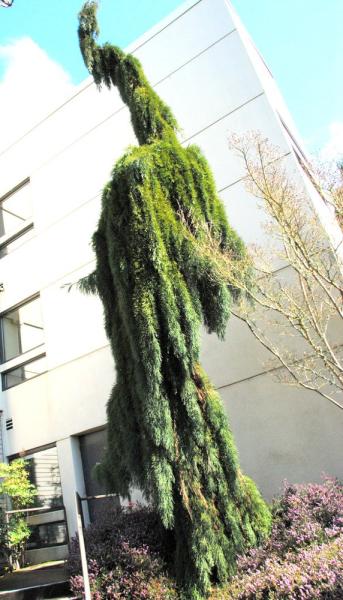
Weeping Giant Sequoia (Sequoiadendrum giganteum)
Giant Sequoias are one of the largest organisms in the world. They can live 3,500 years or more, but today only remnant native populations exist on the western slopes of the Sierra Nevada mountains. However it has been successfully grown in urban landscapes for two hundred years. Our weeping variety, Sequoiadendron giganteum ‘Pendulum’, originated as a seedling in France in 1863 and is still a puppy. It has never existed in the wild. Its strictly weeping characteristics along with the wayward behavior of its leader and branches give it a Dr Seuss appearance which endears it to the modern gardener. Unfortunately this erratic growth habit leads to weaknesses and is often damaged in extreme weather. There are many examples around the campus. Head towards Gym entrance |
|
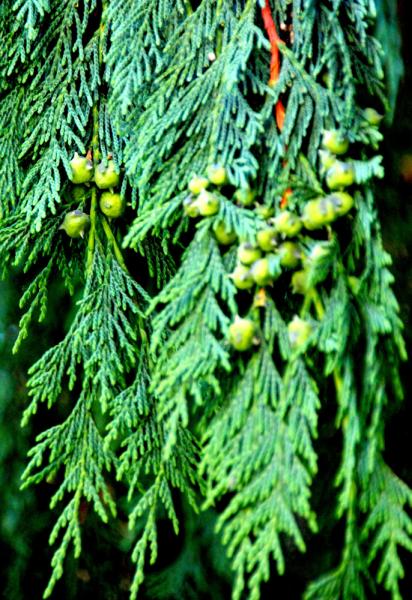
Nootka Cedar (Callitropsis nootkatensis)
Also called Nootka Cypress, this evergreen tree is native to the coastal regions of the Pacific Northwest. The name Nootka refers to where it was discovered, on the lands of the Nootka First Nation people who lived on Vancouver Island in British Columbia. It can grow taller than 100 feet and older than 1000 years. Its genus over the years has been changed from Cupressus to Chamaecyparis to Xanthocyparis, and finally in 2021 to Callitropsis. Taxonomists are alive and kicking. |
|
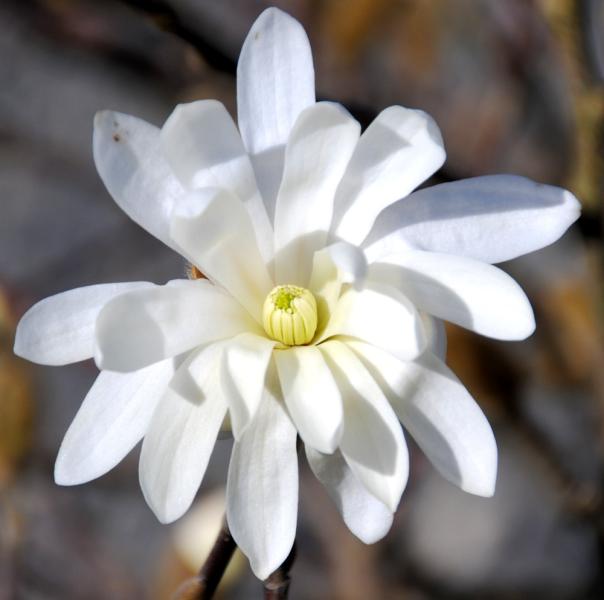
Star Magnolia (Magnolia stellate)
Star Magnolia is a slow-growing, deciduous shrub or small tree (to 10 feet) from Japan. Its showy white or pink, star-shaped flowers are produced in the spring before its leaves open. The new leaves have a bronze-green tint and turn yellow in fall before dropping. |
|
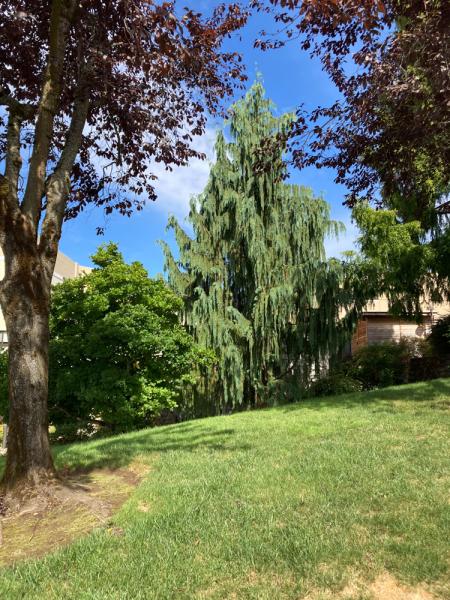
Weeping Nootka (Callitropsis nootkatensis)
To distinguish this evergreen from the nearby Nootka Cedar, it's best to add 'Pendula' to its name, because it is more weeping in shape. Other names include Alaska Cedar and Alaska Yellow Cedar. The bark is scaly and breaks off into flakes. Its cones are rounder than those of other cedars. |
|
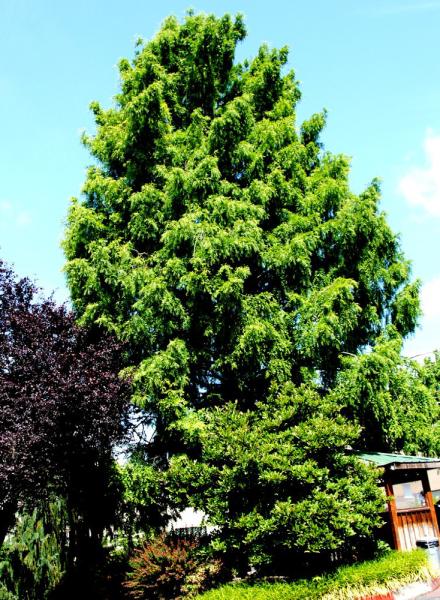
Dawn Redwood (Metasequoia glyptostroboides)
Look up at the top of the slope to see the magnificent Dawn redwood. It is a small cousin of the coastal redwood and giant sequoia trees found in CA. Just like larch trees, it is deciduous and loses its needles every winter. It is considered a living fossil. Dawn redwoods thrived for millions of years all over the northern hemisphere, including central Oregon. Evidence in the John Day Fossil Beds show they vanished about five million years ago. Scientists thought it was extinct until a grove of Dawn Redwoods was found in China in 1943. They were reintroduced into cultivation very successfully and today thrive with many different variations of color and size. Our plant is a seedling forest tree planted around the time the Terrace was built, probably in the late 1970s or early 1980s. |
River Walk
|
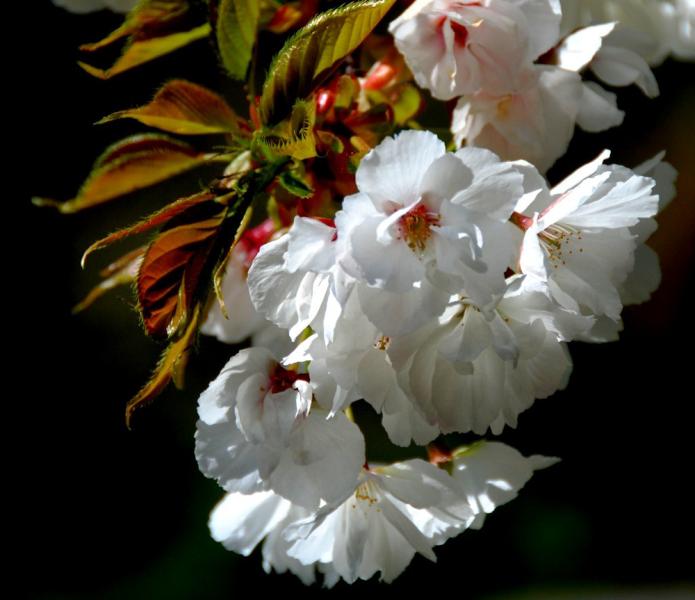
Flowering Cherry (Prunus serrulate)
These Japanese cherry trees are favorites because of their spectacular blossoms which herald the onset of spring, both here and in Japan. The Latin word Prunus means plum or cherry, but this species does not produce edible fruit. Mature trees grow to 35 feet high. In contrast to these trees, we have several weeping Japanese cherry trees near the Duck Pond. |
|
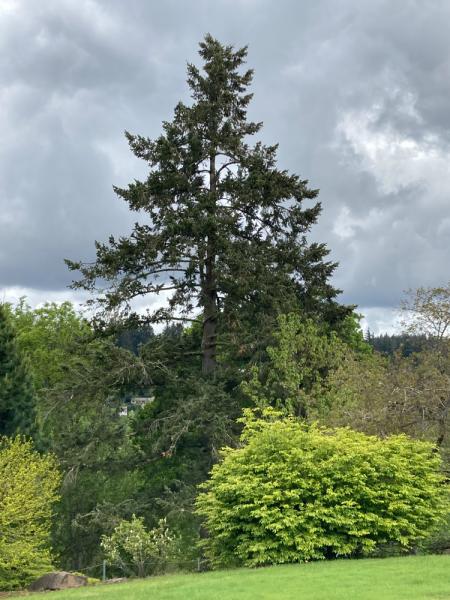
Douglas Fir (Pseudotsuga menziesii)
The Douglas Fir is native to the PNW and has been designated as the state tree of Oregon. It is one of the taller trees on earth (70- 330 feet) and is prized for its economic value (construction material) and as a specimen landscape plant. It is not a true fir (Abies) or pine (Pinus) as often referred to, but a “false hemlock”. The 1-2 inch needles are all the way around the stem and the female cone has a three pointed bract protruding from under the scales. |
|
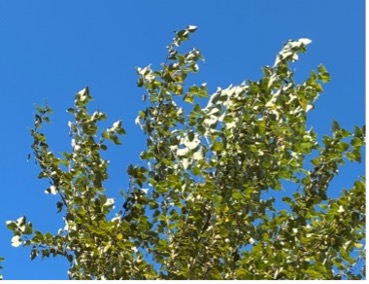
Black Cottonwood (Populus trichocarpa)
Location: Second downhill curve from north end of River Walks |
|
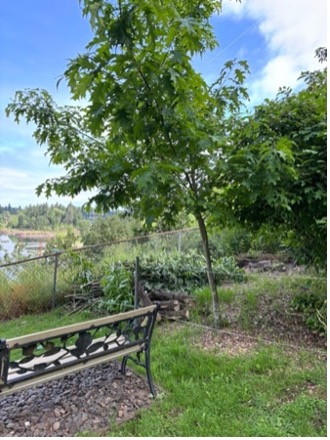
Northern Red Oak (Quercus rubra)
Location: On River Walk, on the second curve winding down from the north end, near the bench. |
|
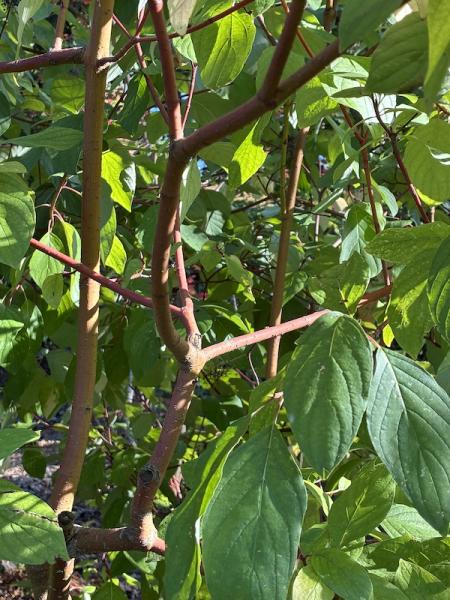
Red Osier Dogwood (Cornus sericea)
Location: north end of River Walk trail |
|
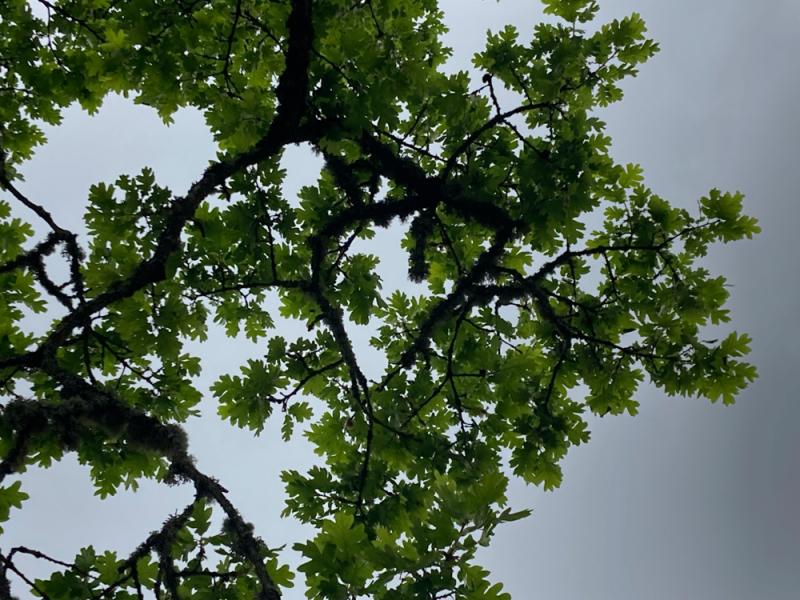
Oregon White Oak (Quercus garryana)
Our native White Oak is a slow growing, medium sized (40-60 feet) deciduous tree with good drought tolerance. It is found west of the Cascade Range from British Columbia to California. Oak Grove gets its name from the abundance of these trees in the Willamette Valley. |
|
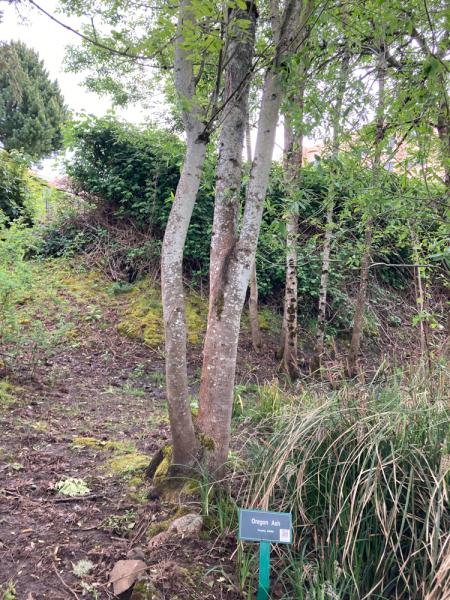
Oregon Ash (Fraxinus latifolia)
This is the only ash tree native to the Pacific Northwest. It likes moist ground. Latifolia (wide leaves) means its leaves are wider than most ash trees. It can grow up to 100 feet high and live more than 100 years. Its hard wood is used in furniture and flooring, particularly for axe handles and baseball bats. |
|
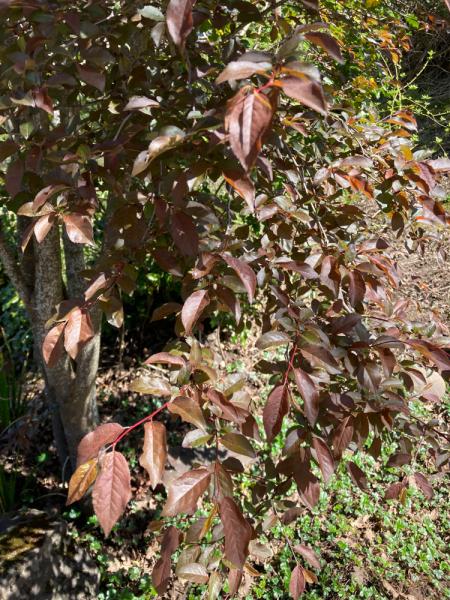
Cherry Plum (Prunus cerasifera)
This early blooming tree is native to SE Europe (Romania) and Western Asia (Georgia). Some cultivars, like this one, have purple foliage. Cerasifera means its fruit looks like cherries, hence the name Cherry Plum. Compare with the nearby Indian Plum. Neither tree bears fruit suitable for human consumption. |
|
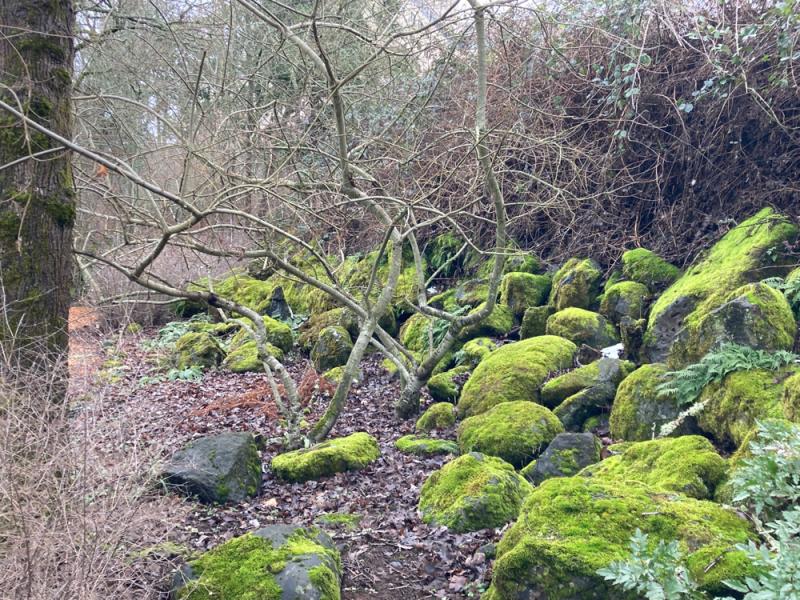
Scouler’s Willow (Salix scouleriana)
This mountain willow is widespread in the Pacific Northwest. It was named after the Scottish naturalist John Scouler. It is a small tree with multiple stems that peak out at 20 feet. It invades quickly after wildfires or logging, but is short-lived. Its narrow winter buds can produce the familiar "pussy willows" in spring. |
|
Indian Plum (Oemleria cerasiformis)
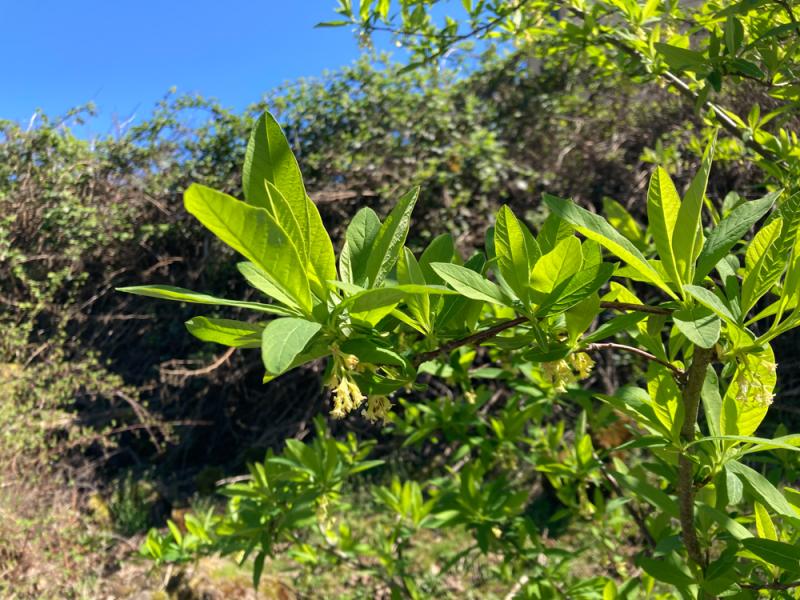
This is a Pacific Northwest native that only grows to about 20 feet in height. Cerasiformis means cherry-shaped. It is the only species in the genus Oemleria, named after a German naturalist. As with other plants, Indian Plum has many alternate names: Oregon Plum, Osoberry, Indian Peach, Bird Cherry and Skunkbush. Its bright greenish-white flower clusters indicate spring has arrived. |
|
Cascara (Rhamnus purshiana)
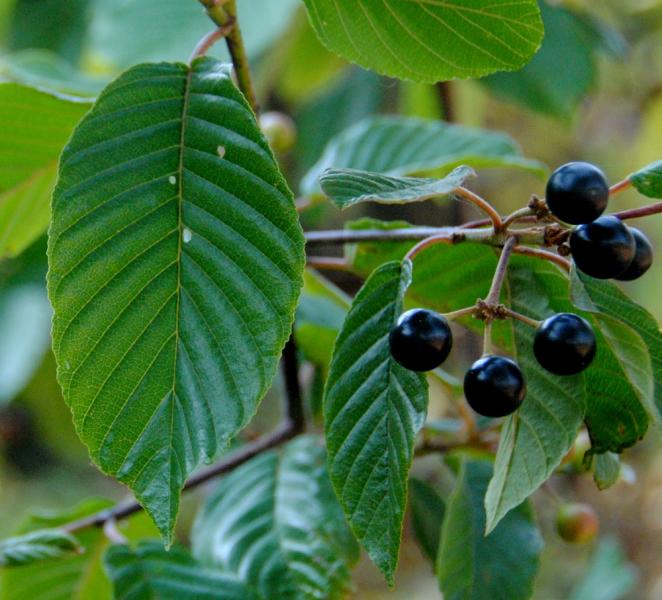
Another Northwest native, Cascara is the Spanish word for bark. Its smooth gray bark was made into a laxative tea by Native Americans. Its leaves turn a brilliant yellow in fall. |
|
Mountain Ash (Sorbus aucuparia)
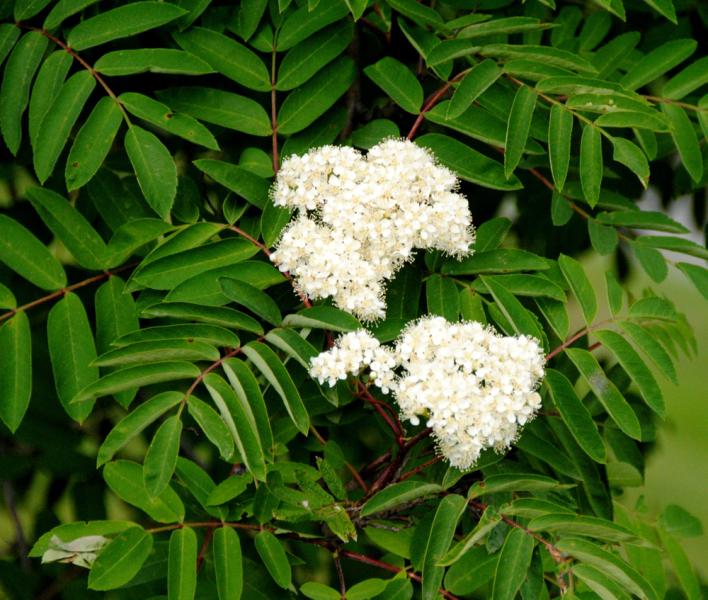
Also called Rowan, this tree can grow to 50 feet in height. It has a slender trunk with smooth bark. The small yellowish white flowers develop into clusters of red berries, which are very prominent from late summer to early autumn. It is quite different from the nearby Oregon Ash. |
|
Blue Blossom (Ceanothus thyrsiflorus)
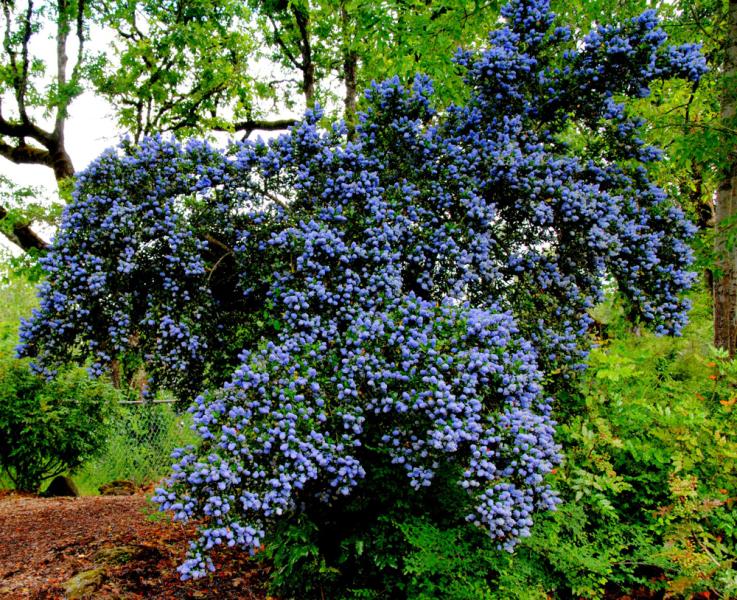
True to its name, this large shrub sports large clusters of blue blossoms. Another name is California lilac, although it is also native to Oregon. It requires very little care and is drought resistant. The glossy leaves look attractive throughout all seasons. |
|
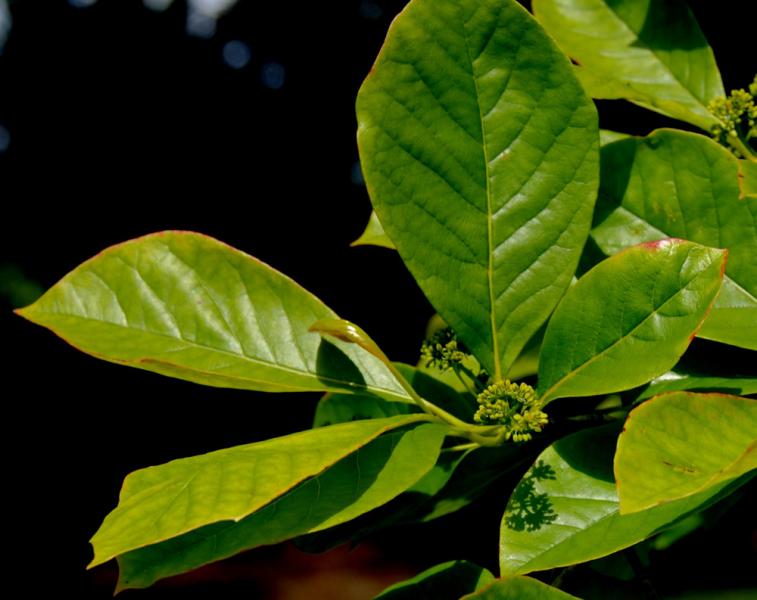
Black Tupelo (Nyssa sylvatica)
This is a medium-sized deciduous tree growing up to 50 feet high. It is native to eastern North America. Tupelo is the Creek Indian word for swamp, so perhaps this tree is well situated. Because its wood is highly cross-grained, it is very difficult to split, making it ideal for handles of heavy tools. |
|
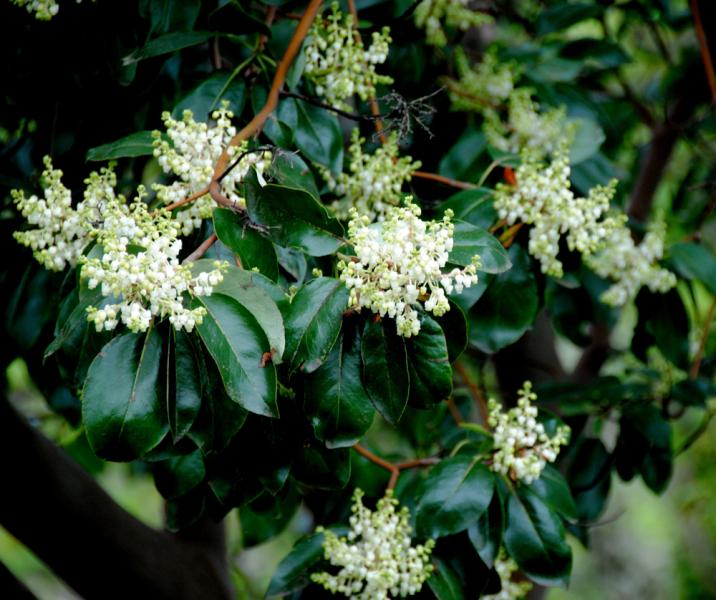
Pacific Madrone (Arbutus menziesii)
Pacific madrones are recognized by their smooth, bright orange-red branches. Its upper red-brown bark peels each summer in thin strips to reveal smooth, greenish-yellow bark that turns into a deep, dark red color. This cluster of trees appears to have suffered over the years, but is making a comeback. Madrones seek out light from among other large trees and can lean as much as 15 degrees. They are related to blueberries, mountain laurels, rhododendrons, and manzanita. Another member of the Arbutus family is the Strawberry Tree near the Duck Pond. |
|
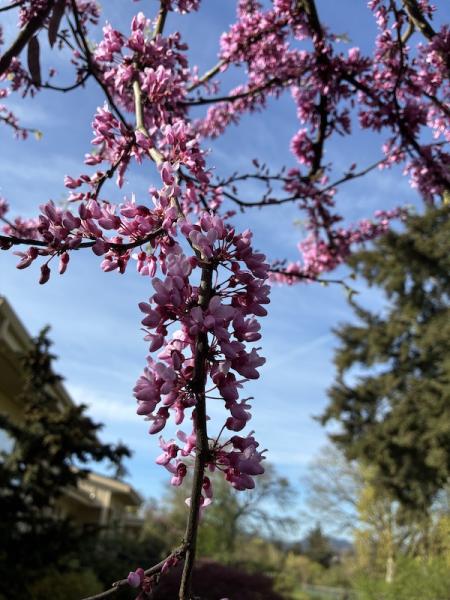
Redbud (Cercis canadensis)
Location: Southern end of River Walk, beyond boardwalk; look to the left to view redbud at corner of River Ridge home. |
|
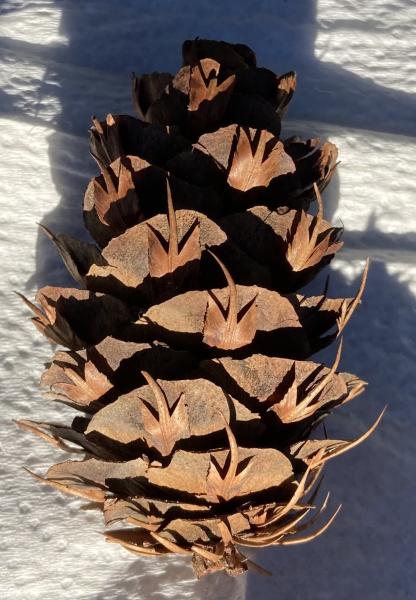
Douglas Fir (Pseudotsuga menziesii)The Douglas Fir is native to the PNW and has been designated as the state tree of Oregon. It is one of the taller trees on earth (70- 330 feet) and is prized for its economic value (construction material) and as a specimen landscape plant. It is not a true fir (Abies) or pine (Pinus) as often referred to, but a “false hemlock”. The 1-2 inch needles are all the way around the stem and the female cone has a three pointed bract protruding from under the scales. |
|
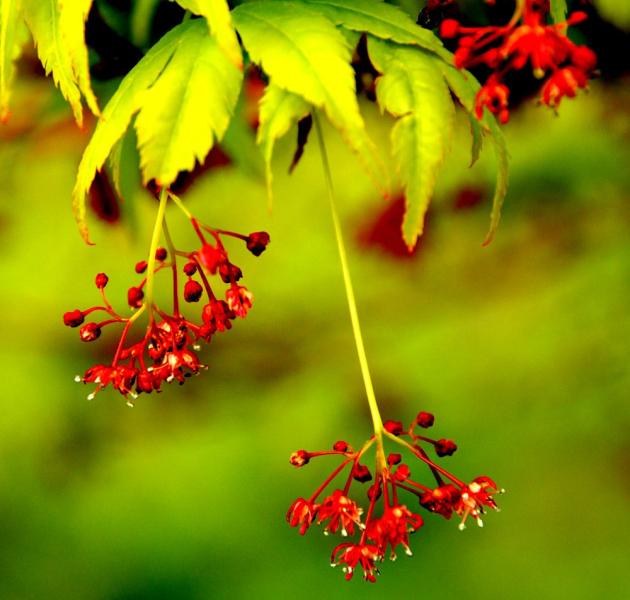
Coral Bark Maple (Acer palmatum ‘Sango Kaku’)
This is a relatively large Japanese maple, growing up to 25 feet tall. In the winter the bark develops a bright coral red color, which contrasts nicely with its foliage, which changes from light green in spring to darker green to golden yellow or orange or red in the fall. To see this tree's reddish bark, look up at the younger branches. In Japanese, Sango means sea coral, and Kaku means upward growing. The name suggests coral rising upward from a reef. |
|
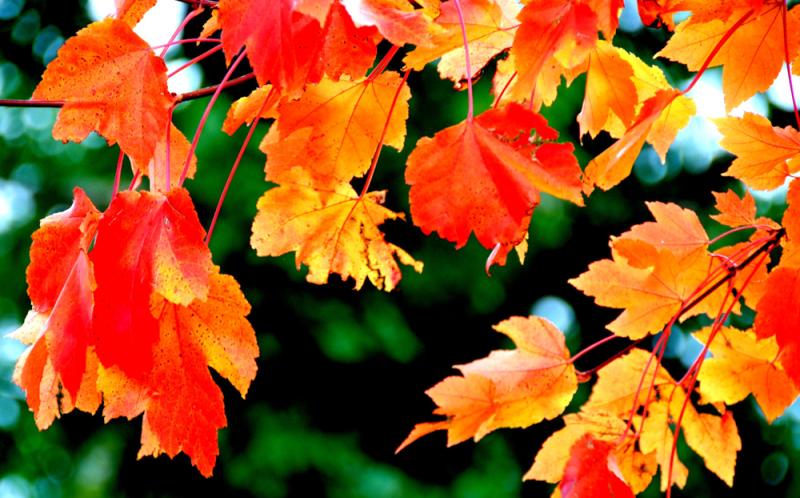
Red Maple (Acer rubrum)
This is the most abundant native tree in eastern North America. It can attain a height of 100 feet. Although its flowers, twigs and seeds are all red, its deep scarlet fall foliage is most impressive. |
|
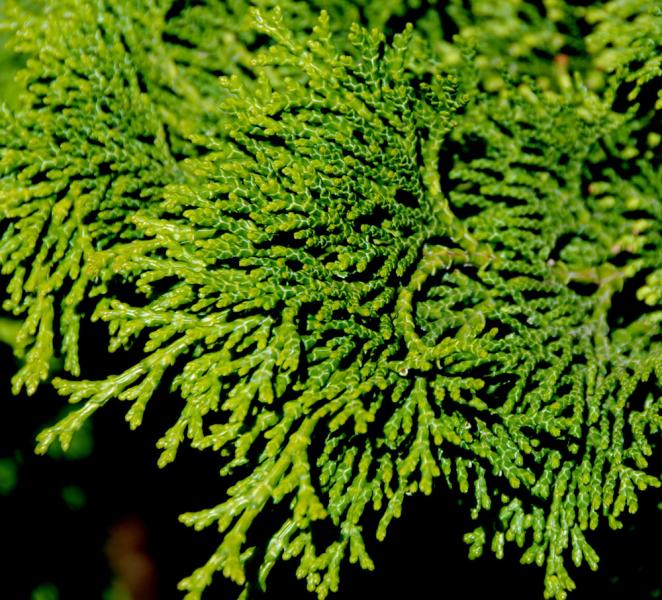
Hinoki Cypress (Chamaecyparis obtusa)
This Japanese native is slow-growing, reaching heights over 100 feet with trunks up to 3 feet in diameter. The leaves are long and blunt-tipped (obtuse), different from the pointed tips of the Sawara Cypress in the Duck Pond area. Hinoki means cypress in Japanese. In Japan its high quality lumber is used to build beautiful shrines, temples and palaces. |
|
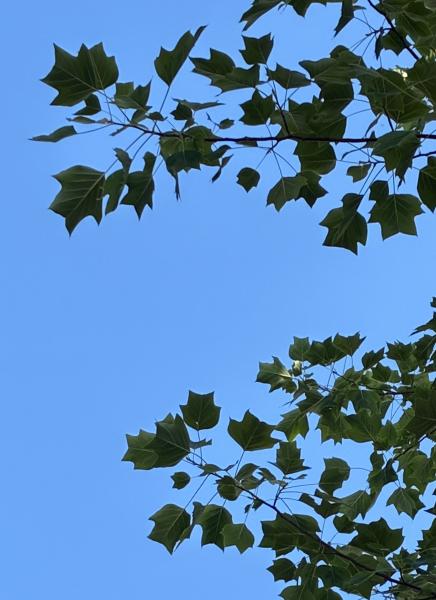
Tulip Poplar (Liriodendron tulipifera)
Location: Southern end of River Walk just before trail turns uphill |
|
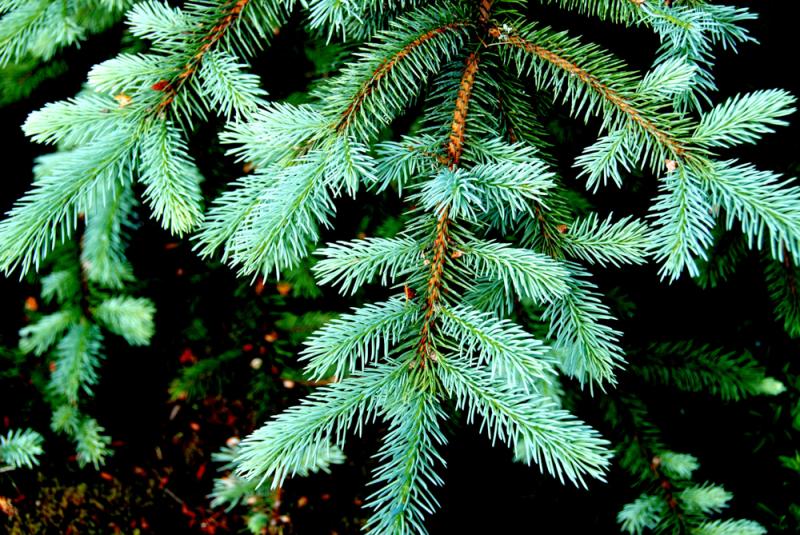
Blue Spruce (Picea pungens)
The Colorado blue spruce, prominent in the Christmas tree industry, can reach 75 feet in height if left to grow. This evergreen is slow growing, taking 10 years to reach 6 feet. It can live up to 800 years. Pungens means sharply pointed, referring to its leaves. |
|
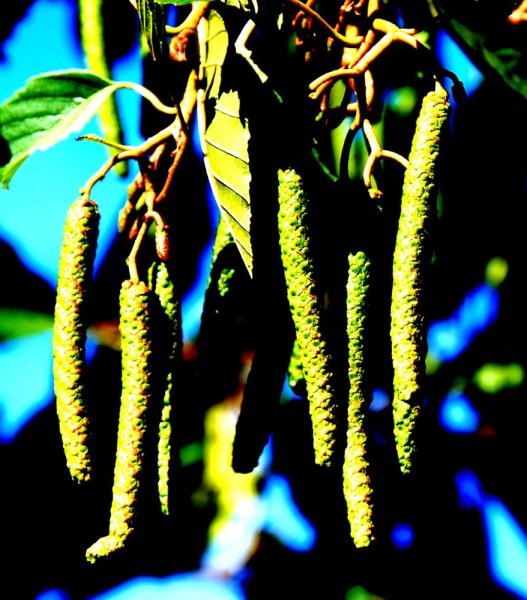
Common Alder (Alnus glutinosa)
Also called black alder, this species is native to Europe, western Asia and northern Africa. Alder trees like moist surroundings and can grow fast. They are easily recognized because of their peculiar, long woody cones which hang like lanterns. Its leaves shed while still green. |
Main Street
|
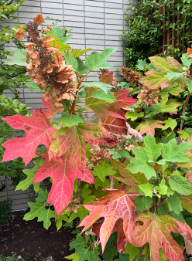
Oakleaf Hydrangea (Hydrangea quercifolia)
Location: Riverview entrance east side, along “ Main Street” |
|
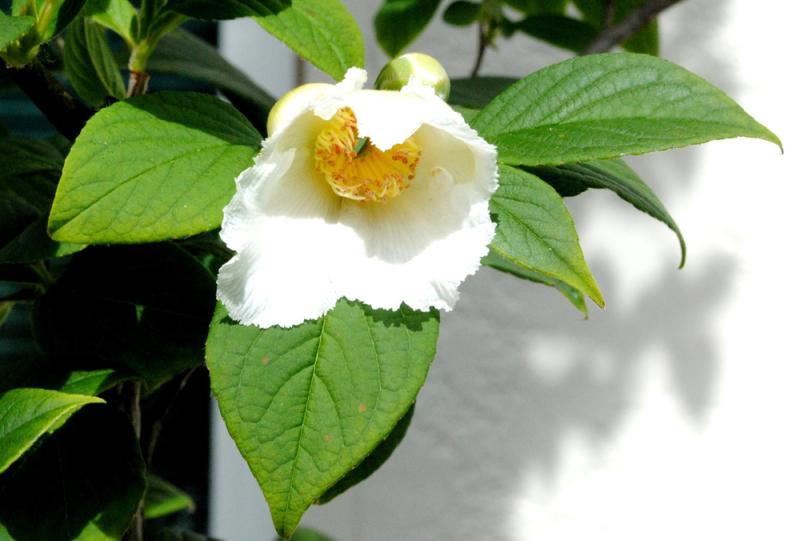
Stewartia (Stewartia pseudocamellia)
This deciduous tree is native to Japan and Korea. Its camellia-like flowers appear in summer, white with orange antlers. It does best in light shade and can grow to 40 feet high. The bark is smooth but appears mottled and sports a variety of colors. |
|
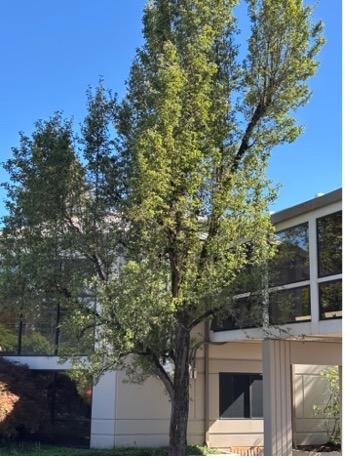
Flowering Pear (Pyrus calleryana ‘Bradford’)
Location: along the west wall of the central garage building. |
|
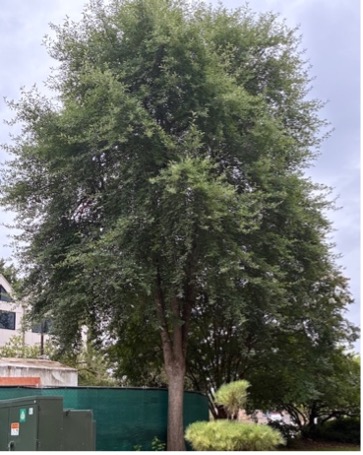
Black Tupelo (Nyssa sylvatica)
Location: Along the east wall of Court building |
|
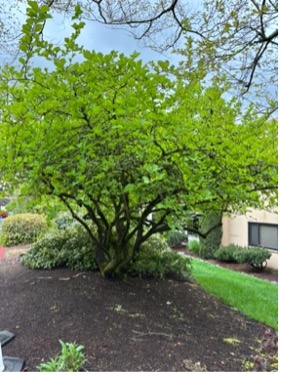
Ozark Witch Hazel (Hamamelis vernalis)
Location: on east side of Court building |
|
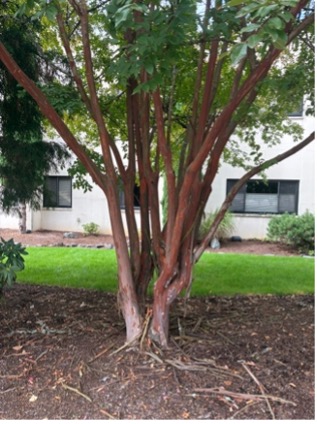
Crepe Myrtle Natchez (Lagerstroemia ‘Natchez’)
Location: Along east wall of The Court building |
|
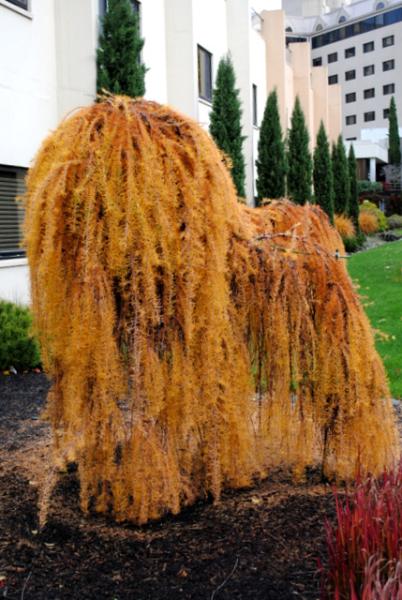
Weeping Larch (Larix decidua)
Larch trees are deciduous and native to Europe, Japan and North America. Forest trees have a tall conical open shape with soft light green spring foliage turning to a medium blue/green in summer and a clear bright yellow in the Fall. They are very conspicuous to motorists driving around Mount Hood to Hood River on the Columbia river. There is some argument as to whether this weeping variety is from Japan or Europe but the local plantsmen sell it as Larix decidua ‘Pendula’. Young plants need to be staked and trained to a desired shape so that its weeping nature can be shown to the best effect. This weeping specimen could be as much as sixty years old. |
|
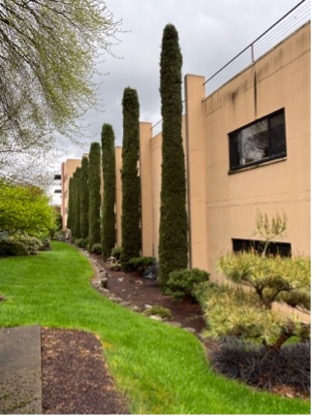
Mediterranean Cypress (Cupressus sempervirens)
Location: along wall at Court building |
|
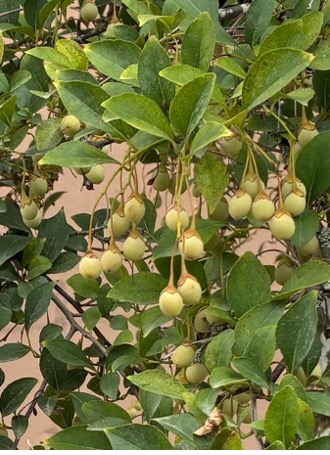
Japanese Snowbell (Styrax japonicus)
Location: east side entry to Court building |
|
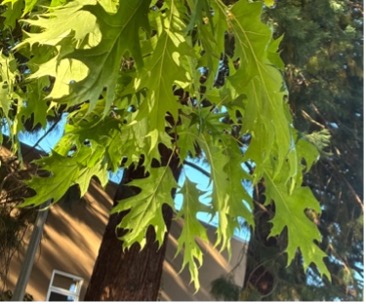
Northern Red Oak (Quercus rubra)
Location: On the northern side of The Neighborhoods building |
|
Western Red Cedar (Thuja plicata)
Location: At NE corner of the Neighborhoods building, near the parking lot. |
|
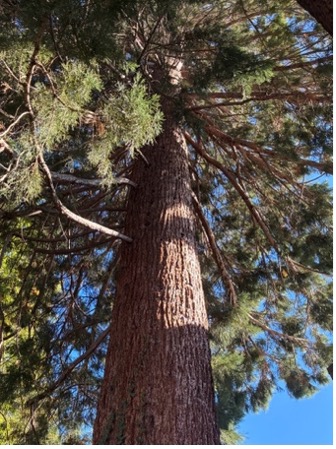
Giant Sequoia (Sequoiadendron giganticum)
Location: On the northern side of The Neighborhoods building along the sloping driveway. |
|
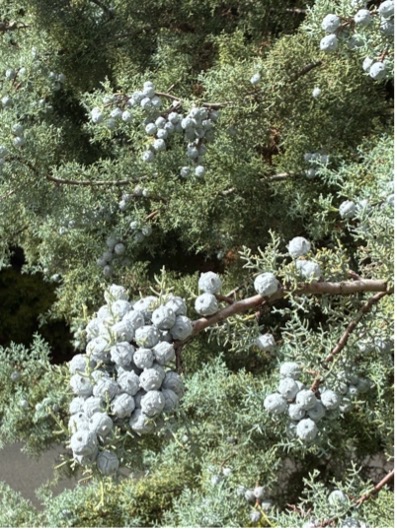
Arizona Cypress (Hesperocyparis arizonica)
Location: Opposite main entrance of The Terrace on sloped. Bank. |